Fashion fades, only style remains the same. - Coco Chanel
Within the 2026 Federal Budget Papers[1] we identified three key insights relevant to Value investors.
1. Australia’s top policy makers at odds over nation’s direction
Australia’s Gross Domestic Product (“GDP”), adjusted for inflation, is one of the broadest measures of national economic activity, yet Treasury[2] and the Reserve Bank of Australia[3] differ substantially in their outlook as shown in the table below.
Real GDP Forecast Comparisons
- Treasury Department 2027 FY: +2.25%; 2028 FY: +2.5%
- Reserve Bank of Australia 2027 FY: +1.3%; 2028 FY: +1.4%
- Difference 2027 FY: 0.95% (Treasury +73%); 2028 FY: 1.1% (Treasury +78%)
Treasury, whilst they do have a reasonable track record of forecasting Real GDP outcomes over time, have managed to seriously miss the mark in periods of elevated uncertainty including the Global Financial Crisis and COVID years as shown in the table below:[4]
GDP Forecasts vs Outcomes
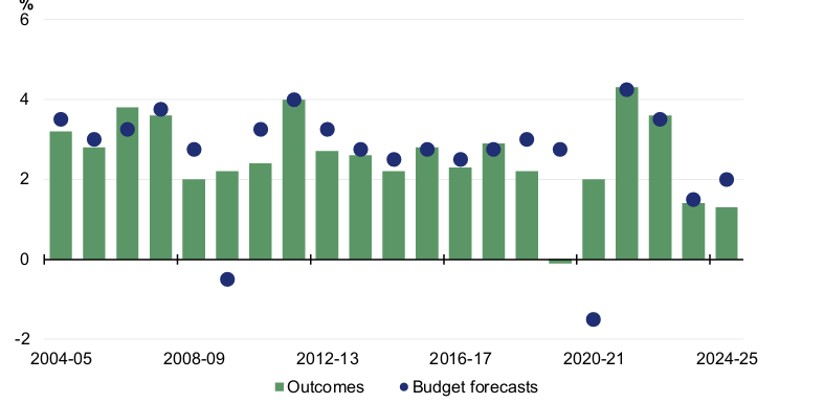
The current environment, dominated by supply chain and energy market disruptions, is arguably equally uncertain.
Consequently, in the short term:
- Monetary and Fiscal policy may move in different directions and at differing levels of intensity.
- The outlook for domestic growth at a headline level, is muted.
- Heightened potential for policy error or execution risk by policy makers.
From an investment perspective:
- Avoid broad index exposures. Focus on asymmetrically priced stocks with strong fundamentals that can weather volatile economic scenarios.
- Margins of safety in times of uncertainty are achieved at the point of purchase – focus on low price to earnings multiples (<10X) for revenue earning businesses and conservative price to book ratios (<1) for asset plays.
- Keep it simple. If an investment thesis has too many moving parts, or if the success of an idea is too highly leveraged to macro variables, look elsewhere.
2. Selective support for industry with moderate productivity measures
The overarching private sector bias of the Budget is towards small to mid cap sized companies, both listed and unlisted. This was expressed in tax and productivity related measures, the most relevant being:
- Reintroduction of the Loss Carry Back provisions for companies with “aggregated annual global turnover of less than $1 billion”[5] which will allow a company to “carry back a tax loss and offset it against tax paid up to two years earlier… limited by a company’s franking account balance”.[6]
- Optimised immigration intake planning that seeks to align with skill gaps in our existing workforce prioritising younger onshore applicants.[7]
These measures are unlikely to uncover greenfield investment opportunity, however, may offer incremental benefits through:
- Provision of a temporary taxation tailwind to profitable companies investing heavily into growth.
- Releasing excess franking credits, otherwise not being valued by the market, in the listed stock price, particularly for companies where dividends are reduced during periods of elevated capital expenditure.
- Potentially alleviate labour shortages and reduce professional services linked inflation, although with a significant time lag and potential urbanised geographic skew that may not support key areas of growth.
At Collins St we prefer to invest in companies with robust business models that do not rely on financial engineering for taxation benefits or sit at the upper end of their industry cost curve due to wage inflation.
3. Energy security is in focus – but will policy setting look beyond the sugar hit?
The consequences of conflict in the Middle East have been felt globally and highlighted the inelasticity of demand for traditional energy sources – a thematic Collins St have been investing in since 2021.
We note that Budget Paper No.2 states that the Federal Government will establish:
…a $3.2 billion Australian Fuel Security Reserve to increase long term fuel supply and storage in combination with an increase to the Minimum Stockholding Obligation (MSO), to increase Australia’s fuel reserves to 50 days.[8]
Whilst this announcement is, subject to securing supply, a temporary step in the right direction for domestic energy security; as portfolio managers, our key questions are:
- Are the right approval settings in place for timely development of domestic oil and gas reserves?
- How attractive is Australia, from a sovereign risk perspective, to international companies partnering with domestic companies on local projects?
- Which companies are best positioned to benefit from any easing in domestic policy framework?
Within both the Collins St Value Fund and the Collins St Global Fund we have expressed a high conviction view in favour of traditional energy companies, however investors need to be very selective within the sector as capital management, project execution, asset quality and cost curve positioning vary markedly across listed companies.
So, how is Collins St responding to the 2026 Budget announcements?
Collins St Asset Management has always taken a long-play approach to investing in listed stocks.
Much of our success over the last decade has been due to the ability of our Investment team to focus on fundamentals, strip the noise from decision making and stay true to a philosophy and process that has stood the test of time.
While these Budget announcements may be causing ripples at the moment, with a long term perspective, they fail to meaningfully impact our portfolios.
It is for this reason, irrespective of how the 2026 Federal Budget is eventually implemented, that we remain confident in the outlook for the companies within our funds and in the prospect of superior long term returns.
After all, style is timeless!
[1] Budget documents | Budget 2026–27. Accessed 13 May 2026.
[2] Budget Paper No. 2. Page 7. Accessed 13 May 2026.
[3] Outlook | Statement on Monetary Policy – May 2026 | RBA. Accessed 13 May 2026.
[4] Budget Paper No. 1. Page 272. Accessed 13 May 2026.
[5] Budget Paper No. 2. Page 20. Accessed 13 May 2026.
[6] Ibid.
[7] Budget Paper No. 2. Page 7. Accessed 13 May 2026.
[8] Budget Paper No. 2. Page 65. Accessed 13 May 2026.
Frequently asked questions
How do Treasury and the RBA differ on Australia's economic outlook?
Treasury forecasts real GDP growth of 2.25% for FY2027 and 2.5% for FY2028, while the Reserve Bank of Australia forecasts 1.3% and 1.4% for the same years. Collins St notes that Treasury has seriously missed the mark in past periods of elevated uncertainty, including the Global Financial Crisis and COVID years.
How does Collins St approach investing in uncertain economic conditions?
The team favours avoiding broad index exposures and focusing on asymmetrically priced stocks with strong fundamentals. Margins of safety are achieved at the point of purchase, through low price to earnings multiples (under 10X) for revenue earning businesses and conservative price to book ratios (under 1) for asset plays.
What does the 2026 Federal Budget offer small and mid cap companies?
The Budget reintroduces Loss Carry Back provisions for companies with aggregated annual global turnover of less than $1 billion, and optimises immigration intake to align with workforce skill gaps. Collins St prefers companies with robust business models that do not rely on financial engineering for taxation benefits.
What energy security measure did the 2026 Federal Budget announce?
The Budget announced a $3.2 billion Australian Fuel Security Reserve, combined with an increase to the Minimum Stockholding Obligation, to lift Australia's fuel reserves to 50 days. Both the Collins St Value Fund and the Collins St Global Fund hold a high conviction view in favour of traditional energy companies, a thematic Collins St has invested in since 2021.
Will the 2026 Federal Budget affect Collins St's funds?
The team's view is that, with a long term perspective, the Budget announcements fail to meaningfully impact its portfolios. Collins St remains confident in the outlook for the companies within its funds.