The September 2026 Quarterly Report discusses how to negate the trap of forming an 'inside view' when investing and quarterly performance for each of the Collins St Asset Management suite of managed funds.
The report discusses the concern of forming an 'inside view' when investing and the appropriate safeguards to remain objective when conducting research.
The September 2026 was a positive one for all Collins St's open funds. More detail is available within each individual report.
The report covers portfolio positioning and quarterly performance for the Collins St Global Fund, Value Fund and Special Situation Fund #2 (Gold Fund).
“If you find yourself in a fair fight, you didn't plan your mission properly”
- Colonel David Hackworth (U.S. Army, Retired)
Thoughtful planning, whether in warfare or investing, materially enhances the prospect of success. Asymmetric opportunities abound for those prepared to broaden their perspective of what is possible and bring to life strategies informed by insights into the ‘bigger picture’ — what it takes to actually win both the battle and the war.
At Collins St Asset Management, the planning and preparation we undertake before investing into an idea requires an equally broad lens. Genuine ‘Value’ centric opportunities are rarely understood in isolation from their global context, be they gold, media, uranium, infrastructure or even technology stocks.
The last of these examples is perhaps the most topical for Value investors, particularly those domiciled in Australia, as they are less frequently associated with Artificial Intelligence (AI) or Information Technology (IT) related portfolio holdings.
Historically this has been an outworking of valuation metrics where long dated cash flows and newly created key performance indicators such as Price to Sales saw share prices rewarded with little reference to profit or the moat that sits around it. The profound impact that AI and IT has had, and will continue to have, has always been accepted.
“AI is probably the most important thing humanity has ever worked on. I think of it as something more profound than electricity or fire.”
- Sundar Pichai (CEO, Google)
Recently, the valuation aspect of this narrative has flipped with the pace of AI and IT related disruption creating concern that Software as a Solution (SaaS) business models — that were themselves considered quite avant garde only a few years ago — are now at risk of obsolescence from newer AI generative systems.
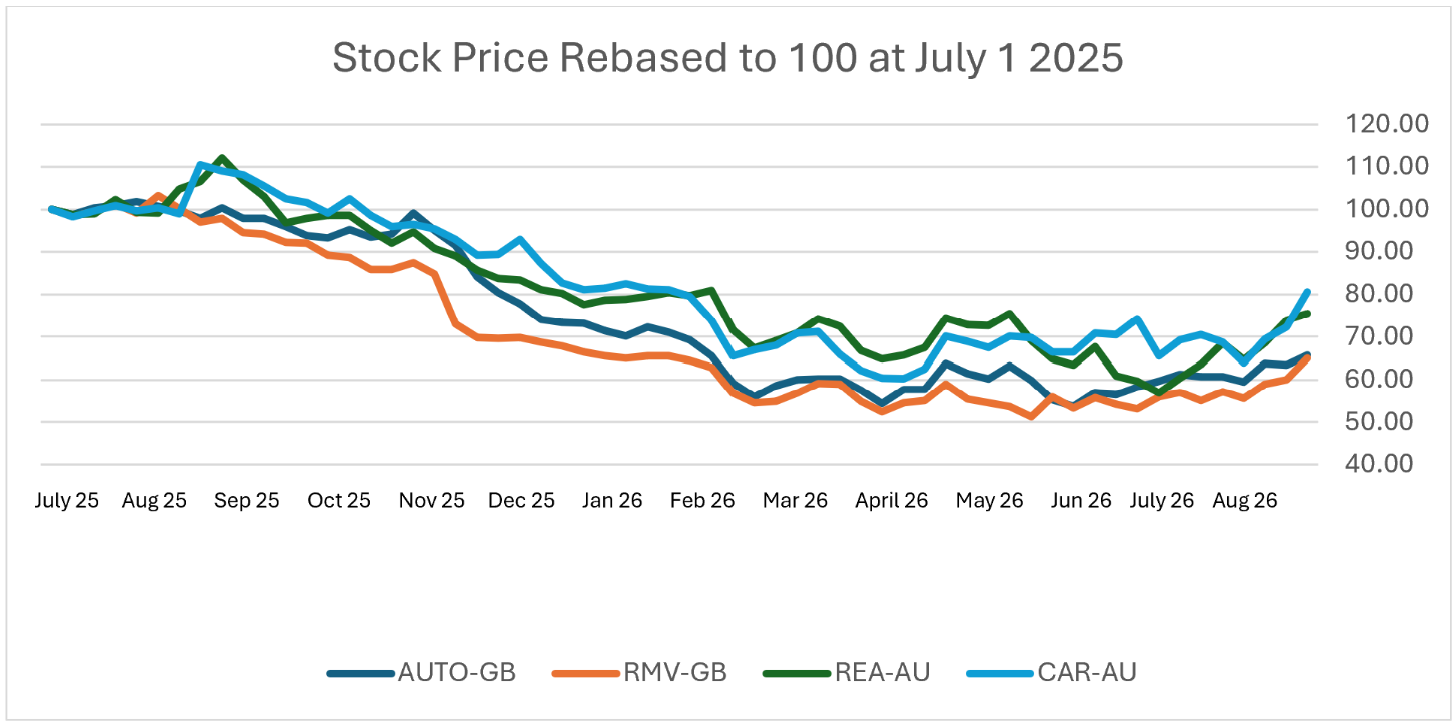
The sell-off that resulted was savage with the share price of many SaaS stocks both domestically and abroad witnessing declines of around 60% throughout a highly volatile 12 month period as the selected stocks in the graph below demonstrate.

Source: Factset
As Value investors, this raised three key questions in our minds:
Firstly, our research led us to understand that not all SaaS businesses would be negatively impacted by AI, in fact, some may actually be net beneficiaries. This is because:
Examples of this include historical listing times/patterns for residential real estate, viewer engagement of online ads and, in the case of car sales businesses, historical sales prices which are not as readily available as they are in the property sector.
Examples of this include the co-dependent nature of the relationship between real estate agents and their online advertisers and also between car yards and their online advertisers.
Secondly, the value remaining in the sector was real, although not uniform across markets due to country specific dynamics and market structures. As Collins St Asset Management have both global and domestic mandates, this presented an opportunity to focus research efforts towards those stocks that were most prospective and which, in the eyes of Colonel David Hackworth, may have given us a well-earned advantage in the market.
By way of example, consider the following stocks:
Source: Factset
Each of the stocks shown above have significant market capitalisations, established networks within their country of listing, existing revenue streams and are paying a dividend, thus reflecting residual value in the business model.
The third question therefore is whether or not there is better opportunity domestically, globally, or across both markets for this set of SaaS sold off stocks.
As can be seen from the following table, the choice is clear.
Source: Factset
The key points to note are that:
Investing, much like the warfare experienced by Colonel Hackworth, does not exist in a vacuum. Looking at the bigger picture and, through thoughtful planning and an open mind, there is potential to unlock asymmetry that makes investing far from a ‘fair fight’.
It is this exact same mindset that we bring to life across all of our publicly listed equity strategies, most recently through the open ended Collins St Global Fund which has achieved over 20% per annum net returns since inception in February 2024 and which holds current positions in both Auto Trader and Right Move.
Disclaimer:
This article is provided as general commentary. It is not and must not be construed as advice whether specific advice or general advice. Past performance is not an indicator of future performance. Any performance figures included in this article have been accompanied by a description of the timeline relevant to that return and are net of fees.
Collins St Asset Management holds AFSL468935. Collins St Asset Management funds are open to wholesale and sophisticated investors only.
Concern that newer AI generative systems could make Software as a Solution (SaaS) business models obsolete triggered a savage sell-off. Many SaaS stocks in Australia and abroad fell around 60% over a highly volatile 12 month period.
The team's view is that not all SaaS businesses will be negatively impacted by AI, and some may be net beneficiaries. Businesses with privately sourced industry data and deep customer relationships, such as online real estate and car sales classifieds, can use internal AI systems to unlock value from that data.
Based on the Factset data in the article, Right Move and Auto Trader Group trade on price to earnings multiples of 17.4X and 15.7X, almost half those of REA Group (38.8X) and Car Group (28.1X). The UK stocks also had higher free cash flow yields and EBITDA margins, while the Australian stocks had higher 2026 earnings per share growth estimates.
Yes. The open ended Collins St Global Fund holds current positions in both Auto Trader and Right Move, and has achieved over 20% per annum net returns since inception in February 2024.
Intuit provides financial software and services in the US that help consumers and small businesses manage taxes, accounting, and payments. Their main two segments are QuickBooks and TurboTax, which we delve into below. The company is analogous to Xero used here in Australia.
The market tends to value the technology, while overlooking the harder-to-replicate foundation beneath it: trust, networks, and mission-critical workflows.
When a wave of fear sweeps through software investors, the instinct is to sell anything that looks like a subscription business sitting on top of a workflow that a machine could theoretically replicate. Intuit was not immune to this shift in sentiment, becoming caught up in the broader “SaaSpocalypse” narrative in early 2026 — a period of time where all software businesses sold off indiscriminately due to AI disruption fears.
This is a company that processes close to a trillion dollars of small-business financial activity each year, holds roughly 70% of the U.S. small-business accounting market, and has spent decades embedding itself in the tax and bookkeeping habits of more than 100 million consumers and businesses. Yet this year, the market priced it as though AI would commoditise its software and erode the value proposition built on decades of trust, embedded workflows, and customer relationships.
For investors focused on long-term fundamentals, as we are, the gap between perception and reality has created an opportunity.
Few companies have built a software franchise as durable as Intuit. QuickBooks is not simply an accounting application; it has become the financial operating system through which millions of small businesses run their payroll, invoicing, bill payments, and tax obligations, embedded in regulated workflows spanning payroll tax, multi‑state compliance, and audit exposure. Its position is reinforced by deep integrations with more than 700 third-party applications (such as Shopify, PayPal) and an ecosystem of accountants and advisors who actively recommend the platform to their clients. TurboTax, similarly, is far more than a digital form-filler; it is a trusted tax platform that millions of Americans rely on each year to navigate one of their most important financial obligations, particularly when accuracy, compliance, and confidence matter most.
That combination, dominant share, high switching costs, and recurring, mission-critical usage, has historically earned Intuit a premium valuation. Reflected in the average P/E multiple of approximately 32.0x over the past decade. The market no longer assigns Intuit the same valuation it once did.
2026 has been devastating for the share price. Intuit became one of the worst-performing large-cap software names of the year, down roughly 61% year-to-date at its lows in mid-June, with the crystallising moment being the Q3 FY2026 earnings report on May 20, when the stock fell roughly 20% in a single session. As of late July 2026, the share trades at a forward P/E of just 10.8x FY28 earnings, near its all time low.
The "SaaSpocalypse" narrative that hit Intuit was simple, and on the surface, plausible: generic AI would commoditise subscription software broadly, eroding pricing power across the sector as free or near-free large language models replicated much of the functionality that software companies had historically been able to monetise. Applied to Intuit specifically, the fear was that a free AI assistant could walk a taxpayer through a W-2 as competently as TurboTax, or that an AI-native accounting startup could ingest a small business's historical data and replace QuickBooks at a fraction of the price.
Our view, even at the height of that fear, was that this framing misunderstood where Intuit's value actually lies. The technology itself was never the primary source of value. The real moat lies in the networks, deeply integrated workflows, industry relationships and trust built over decades. The same qualities have allowed dominant online classifieds platforms, such as Rightmove and Auto Trader, to remain resilient amid fears of AI-driven disruption.
This distinction matters most in the parts of Intuit’s business that involve compliance and liability.
QuickBooks is entrenched in payroll tax, multi-state compliance, and audit exposure, areas where an error carries a real financial and legal cost, not just an inconvenience. TurboTax carries an accuracy guarantee; Intuit pays penalties if it makes a mistake and backs its ‘Live’ customers with licensed tax professionals in the event of an IRS audit. A generic AI chatbot offers neither of those protections. Given the complexity of payroll, deductions, multi-entity compliance, and financial reporting, a cheaper AI alternative alone is unlikely to be sufficient to pull consumers or businesses away from a platform where years of financial history, bank connections, and regulatory filings are already embedded.
For most businesses, trusting an unproven AI platform with their financial records and compliance obligations is a far higher hurdle than simply adopting a cheaper piece of software. That is precisely why churn for both products has remained extremely low, even as investor sentiment reached its most negative.
The May 2026 sell-off was the result of three developments unfolding simultaneously.
Management cut the TurboTax revenue outlook for FY2026 to $5.277–$5.282 billion, down from a prior range of $5.305–$5.330 billion. On a $5‑plus billion base, a $23–48 million reduction is immaterial in dollar terms, but it mattered symbolically: it was the first explicit downgrade to the segment investors were already viewing through an AI‑disruption lens.
The reaction was amplified after CEO Sasan Goodarzi acknowledged some pressure among the most price-sensitive DIY filers earning under $50,000, a segment where lower-cost and free alternatives are gaining traction. Crucially, this cohort contributes very little to Intuit’s earnings and primarily serves as an entry point into the broader Intuit ecosystem. Even if some of these low-income DIY customers leave the platform today for free alternatives, many are likely to return as their tax situations become more complex or their financial circumstances improve, at which point they can adopt higher-value products and services.
Layered on top of that came a 17% workforce reduction, roughly 3,000 jobs, with $320 million of restructuring charges. Management initially framed the cuts as an efficiency and AI-driven restructuring, a natural enough explanation on its own. But when a question came directly on whether AI played a role in the decision, the CEO pushed back defensively, insisting the cuts had nothing to do with AI. That framing created unnecessary scepticism rather than resolving it. It invited the obvious question — if growth is intact, why cut so much headcount — and left the market to fill in the gap with its own, more negative interpretation of what management was reluctant to say directly: AI is disrupting our business, and we need to cut costs to remain competitive. However, the more constructive interpretation is that Intuit is proactively simplifying its cost base and reallocating resources towards AI and higher-growth priorities.
This was poor optics and mishandled messaging, not imminent AI disruption.
Importantly, the competitive advantages that underpin the investment thesis remain as strong as ever.
QuickBooks remains considerably more insulated than the headlines suggested. The Global ‘Business Solutions’ segment, which houses QuickBooks and Mailchimp, generated $11.1 billion in FY2025, growing 16% year over year, with ‘Online Ecosystem’ revenue of $8.3 billion growing 20%. AI inside the platform has so far behaved as an enhancer rather than a disruptor. Intuit's own accounting agents categorised 237 million transactions in a single month, and QuickBooks Live, its bookkeeping-as-a-service offering, grew more than 50% in Q2 FY2026. The fastest-growing part of the QuickBooks base is customers graduating from basic bookkeeping plans into QuickBooks Advanced and the Intuit Enterprise Suite, where they pay several times more per month for additional users, automation, and mid-market features. A $90 billion addressable market Intuit is only beginning to penetrate.
TurboTax is the more actively contested part of the story, and it’s better to acknowledge that than pretend otherwise. The pressure has been concentrated among low-income, highly price-sensitive DIY filers earning under $50,000, with TurboTax shedding around 1 million free-tier users during the 2026 season as some simple returns shifted toward cheaper or free alternatives. The key nuance is that this cohort is also Intuit’s least profitable segment, as mentioned above, and management has been clear it is prepared to let those customers go for now. Although we expect a meaningful proportion of these individuals to return in the years ahead as their tax situations become more complex.
The growth engine within TurboTax is a very different product. Specifically, this refers to TurboTax Live. This is Intuit’s AI-enabled assisted-tax offering, combining its self-preparation software with access to tax experts who can provide advice, review a return, or prepare and file it on the customer’s behalf. Pleasingly, this grew 47% in FY2025 and is guided to grow a further 36% in FY2026 to roughly $2.8 billion, representing more than half of total TurboTax revenue. Structurally, this is the part of the franchise best insulated from pure AI commoditisation, as it combines software with licensed expertise, an accuracy guarantee, and audit support. The kind of professional accountability a chatbot cannot provide.
Two things are turning in Intuit's favour, and both point toward the same conclusion. Firstly, the market overreacted to a segment-specific pricing problem as though it were an existential threat to the entire platform.
As the narrative that "generic AI will eat all software" has evolved, investors have become more discerning, increasingly distinguishing between businesses built on easily replicated products and those with durable competitive advantages rooted in proprietary data, deeply embedded workflows, and regulatory complexity. Intuit falls firmly into the latter category. As this distinction has become more widely appreciated, the market has increasingly viewed the company as a beneficiary of the AI transition rather than a victim of it.
The second is a simple correction in how investors are reading the TurboTax commentary itself. The initial interpretation of the May earnings call was that AI is starting to commoditise the platform, full stop. The more measured read, and the one gaining traction as the dust settles, is that Intuit lost a low-margin, price-sensitive cohort it was willing to lose, while its highest-value, most defensible product line kept compounding at a rate most software companies would envy. That distinction is exactly what a market recovering from an overreaction typically re-prices.
The deeply discounted valuation is what makes this investment most compelling.
Intuit currently trades at around $335, on a current P/E of roughly 13.2x, and a forward multiple in the 10x-12x range depending on the fiscal year used. This is against a five-year average closer to 32x. Consensus still points to earnings growth around 18% FY2026, alongside an expected 30% return on equity, gross margins above 80%, and roughly $3.5 billion of buybacks planned for 2026, a figure management has signalled it intends to increase further in 2027.
Our base case does not require aggressive assumptions. It requires QuickBooks to keep compounding at its current mid-teens growth rate, TurboTax Live to continue taking share of TurboTax's mix as guided, and Intuit's earnings multiple to normalise around 17.5x. In our view, this is extremely conservative, given that it implies only a partial reversion towards Intuit’s historical valuation range. Under those conditions, we see roughly 60%+ upside over a two-year horizon, without assuming any recovery among the lower-value, price-sensitive DIY filers.
We anticipate that, in the not-too-distant future, Intuit will be priced to reflect its high-quality, deeply entrenched business that will continue to compound earnings over time.
This is among one of the highest quality businesses that the Fund currently owns. With the company’s moat built on trust, integration, and regulatory complexity rather than the underlying technology, this firmly remains intact. The company’s current deeply discounted valuation provides investors with a meaningful margin of safety while the market’s perception catches up with its underlying fundamentals.
Intuit Inc. remains a core holding for the Collins St Global Fund.
Disclaimer:
This article is provided as general commentary. It is not and must not be construed as advice whether specific advice or general advice. Past performance is not an indicator of future performance. Any performance figures included in this article have been accompanied by a description of the timeline relevant to that return and are net of fees.
Collins St Asset Management holds AFSL468935. Collins St Asset Management funds are open to wholesale and sophisticated investors only.
Intuit provides financial software and services in the US that help consumers and small businesses manage taxes, accounting and payments. Its two main products are QuickBooks and TurboTax, and the business is comparable to Xero in Australia.
Intuit was caught up in the broader "SaaSpocalypse" sell-off driven by AI disruption fears. The stock then fell roughly 20% after its Q3 FY2026 result on 20 May 2026, which combined a small TurboTax revenue downgrade, commentary on pressure among price-sensitive DIY filers and a 17% workforce reduction.
Our view is that Intuit's moat sits in trust, deeply embedded workflows, networks and regulatory complexity rather than the software itself. QuickBooks is entrenched in payroll tax, compliance and audit work, and TurboTax Live combines software with licensed tax experts, an accuracy guarantee and audit support.
At around $335, Intuit trades on a current P/E of roughly 13.2x and a forward multiple in the 10x to 12x range, against a five-year average closer to 32x.
Yes. Intuit Inc. remains a core holding for the Collins St Global Fund.
The June 2026 Quarterly Report discusses how to value SpaceX as a potential investment and provides an overview of the portfolio positioning and quarterly performance for each of the Collins St Asset Management suite of managed funds.
The report discusses how to value SpaceX as a potential investment, and provides an overview of portfolio positioning and quarterly performance for each fund.
The June 2026 report works through how to value SpaceX as a potential investment from the team’s fundamental perspective.
The report covers portfolio positioning and quarterly performance for each of the Collins St Asset Management suite of managed funds.
Earlier this year, Collins St announced that their Global Fund was now open to public investment. In a recent interview with Money of Mine podcast, Chief Investment Officer Vasilios Piperoglou discussed a wide range of thematics and opportunities that lie within this expanded mandate.
Here are some highlights of Vas’ interview.
Collins St launched its global equities fund in early 2024, opening the door to opportunities beyond the Australian market.
Whilst we initially found value in a number of Chinese businesses listed in Hong Kong, such as online retailer JD.com. As these businesses reached their intrinsic value we reduced many of our positions.
Recent investments range from a Kazakh fintech company trading on six times earnings to UK-listed classified businesses caught in the AI sell-off and, perhaps most surprisingly, Australia's largest almond producer.
The common thread isn't geography or sector.
It is valuation.
In a market increasingly driven by momentum and narratives, some of the most compelling opportunities are emerging in places few investors are paying attention to.
Kaspi.kz is a dominant fintech, banking and payments platform that has become deeply embedded in the Kazakhstan economy.
If consumers pay utility bills online, there's a good chance they're using Kaspi. Retail payment terminals are powered by Kaspi infrastructure. The company also operates a major banking franchise and has expanded into logistics and e-commerce.
Despite generating earnings growth of roughly 15-20% annually, the company trades on around six times earnings.
Kaspi effectively holds a monopoly on handling financial transactions in the country.
But the market's concern stems largely from geopolitics.
Following Russia's invasion of Ukraine in 2022, investors began questioning whether Kazakhstan could become exposed to similar regional instability. As a result, Kaspi's valuation collapsed despite continued earnings growth.
That disconnect is precisely what attracted us.
After investment in achieving a banking license in Turkey, Kaspi has recently reinstated its dividend, with distributions equivalent to roughly 10% of its current share price, while still retaining substantial earnings to fund future growth.
For a business of its quality and market position, we believe the low valuation remains difficult to justify.
Artificial intelligence has become one of the market's most disruptive forces, prompting investors to reassess entire industries.
However, that fear might also have created opportunity.
The Global Fund recently invested in two UK-listed online classified businesses: Rightmove and Auto Trader, effectively Britain's equivalents of REA Group and Carsales.
Both companies have faced investor concerns that AI could eventually disrupt their business models.
Our belief is that those fears underestimate the complexity of what these businesses actually do.
The market has focused on the front end and forgotten about the back end. While AI may make it easier to build consumer-facing software, the underlying infrastructure supporting these platforms remains extraordinarily difficult to replicate.
Auto Trader, for example, maintains relationships with thousands of independent dealerships across the United Kingdom. The business employs hundreds of representatives who work directly with dealers, helping manage inventory, listings and advertising.
Similarly, property portals rely on extensive relationships with real estate agencies and agents built over decades.
These networks create powerful barriers to entry that cannot simply be recreated using newer technology.
The result is a market that may be overestimating disruption while underestimating competitive advantages.
The most attractive investments often emerge when supply and demand become badly misaligned. It's a framework that has driven our successful investments in uranium, oil services and gold.
Following this framework, where do we see a new thematic emerging?
Collins St has become increasingly bullish on Select Harvests, Australia's largest listed almond producer.
The underlying dynamics are surprisingly similar to many of the capital cycle opportunities we have successfully identified in the past.
Global demand for almonds continues to grow steadily, driven by rising consumption across China, India and the Gulf region.
At the same time, supply is beginning to contract.
Many almond orchards established during the previous boom are now reaching maturity and reducing productivity. Years of weak pricing have discouraged new plantings, while some growers have removed orchards altogether.
The situation is particularly acute in California, which accounts for approximately 70% of global almond production.
Water shortages, regulatory constraints and rising costs have further reduced the industry's ability to expand supply.
As a result, almond prices have begun recovering from cyclical lows.
And this might only be the beginning.
We are only one or two years into the almond bull market. Importantly, demand appears relatively resilient even if prices continue rising. Consumers may adjust behaviour at the margin, but almonds remain a staple ingredient across a wide range of food products.
Meanwhile, Select Harvests has strengthened its balance sheet and continues to trade at a substantial discount to the replacement value of its underlying assets.
For us, the attraction is easy to understand.
It's a capital-intensive industry. Supply has been constrained and demand continues growing. And the market has yet to fully appreciate the implications.
All these point to another successful thematic for our portfolio, except that there is only one listed business in this industry.
Could Almonds form a thematic of one?
Collins St launched its global equities fund in early 2024, opening the door to opportunities beyond the Australian market. In 2026, Collins St announced that the Global Fund was open to public investment.
Kaspi.kz is a dominant fintech, banking and payments platform in Kazakhstan that generates earnings growth of roughly 15 to 20% a year, yet trades on around six times earnings due largely to geopolitical concerns. The team believes this low valuation is difficult to justify for a business of its quality and market position.
Both UK listed online classified businesses were caught in the AI sell-off. The team's view is that the market has focused on the front end and underestimated the dealer and agency relationships behind these platforms, which create barriers to entry that newer technology cannot simply recreate.
Collins St has become increasingly bullish on Select Harvests, Australia's largest listed almond producer, as global almond demand grows while supply contracts, particularly in California, which accounts for approximately 70% of global production. Select Harvests has strengthened its balance sheet and trades at a substantial discount to the replacement value of its underlying assets.
The common thread is valuation rather than geography or sector.
This piece marks a return to Domino’s Pizza Group UK, the stock we first highlighted in our Global Fund introduction video. (Watch here)
With the 2026 FIFA World Cup now underway and the potential for improved performance, it feels like an apt moment to revisit a company in the portfolio that stands to benefit from the tournament. So, sit back, ideally with a Domino’s box on the table, as we walk through the thesis in more detail and bring everyone back up to speed on the story.
The market rarely leaves well-known category leaders lying around on depressed multiples for long.
When a company controls more than half of its core market, throws off dependable free cash flow, and has handed back around £500 million - equivalent to 65% of its market capitalization - to shareholders since 2021, investors usually do not hesitate to pay up for that certainty. For years, Domino's Pizza Group fitted that description neatly: a low-drama, cash-generative listed business with an easy-to-understand model and a long runway for store expansion.
That confidence has faded. The stock is trading around 9x forward earnings and near the bottom end of its multi-year range, placing the shares in a valuation range usually reserved for businesses facing structural decline. The market's message is clear: growth is slowing, store rollouts have lost momentum, and the unit economics that once looked self-evident are no longer being taken on trust.
That judgement looks too harsh.
For investors focused on long-term fundamentals, as we are, this has created an opportunity.
The issues weighing on Domino's appear temporary rather than terminal. The market seems to be treating a cyclical soft patch in UK consumer demand and franchisee economics as though it has broken the long-term earnings engine altogether. That is the gap worth examining.
Domino's Pizza Group has spent years building one of the most attractive business models in UK listed quick service restaurant (QSR) stocks.
At first glance, it looks like a pizza retailer. In practice, it is much closer to a branded platform with a captive supply chain. The group is the exclusive master franchisee for Domino's in the UK and Ireland, and it earns its economics not simply from pizzas sold to end customers, but from supplying the system itself. The company works with roughly ~130 franchise partners across its 1,400 stores, with more than 97% of outlets owned and operated by franchisees rather than run in-house.
Franchisees operating under the brand are required to buy dough, ingredients, packaging and equipment from the group, which turns the supply chain into the main profit engine of the business. In addition, the group receives a royalty stream linked to system sales, creating a layered earnings model tied directly to network activity.
This structure has important consequences. The company does not need to deploy large amounts of capital into each incremental store, because franchisees carry most of that burden. Instead, Domino's benefits as the network grows: every new outlet adds volume through the supply chain, adds royalty income, and does so without requiring a matching rise in central overhead. In FY2025, new stores delivered an average cash payback of roughly 3.5-4 years, implying an incremental return of around ~25% and highlighting just how cash-efficient the model remains even through a tougher trading patch.
That combination of predictability, scale, and capital-light growth once earned Domino's a premium rating. It no longer does.
The recent disappointment has come from cyclical macroeconomic pressure rather than a break in the model.
The most obvious evidence of this has been the slowdown in store openings. Domino's opened only 31 new stores in FY2025, down from 54 in FY2024 and below the pace needed to keep the long-term rollout story feeling effortless. This matters because the network expansion story is central to the bull case. More stores mean more system sales, more supply chain throughput, and greater central cost absorption.
Why has that cadence slowed? The answer sits mostly with franchisees. Rising labour costs, especially UK wage inflation and higher National Living Wage rates, have put pressure on store-level returns, making operators more cautious about committing capital to new openings. That does not mean the network has stopped working. It means franchisees are requiring clearer economics before pushing ahead with expansion.
Secondly, the like-for-like system sales in FY2025 rose just 0.2%, while total orders declined 0.9%. That is not what investors expect from a business that once looked like a reliable traffic compounder. A pressured UK consumer has become more selective, and some households have traded down, reduced frequency, or shifted toward collection over delivery to save money.
Taken together, these issues reflect temporary macroeconomic headwinds that will eventually abate. Nonetheless, they have been sufficient to sour the market’s perception of the stock.
The important point is that the franchise's underlying advantages remain intact.
Domino's holds a 52.6% share of the UK takeaway pizza market, making it more than three-and-a-half times the size of its nearest branded competitor. That kind of scale matters in a category where brand familiarity, delivery density, and logistical reliability all reinforce one another. It is not simply a recognisable name; it is an operating system built over decades.
The supply chain is a particularly underappreciated strength. Because the group is the mandatory supplier to the network, it captures economics that customers do not see and competitors struggle to match. Volume purchasing drives input-cost advantages, central manufacturing improves consistency, and each incremental order pushes more throughput across an already-built platform. A challenger would need to replicate the brand, the store network, the driver density, the digital ordering platform, and the supply chain all at once. That is a much higher hurdle than opening a few rival pizza shops.
Also, Domino’s Pizza Group UK competes in a structurally favourable market relative to its Australian and US cousins. With relatively few scaled independents offering meaningfully better pizza, there is less need to chase volume through aggressive vouchering. This has supported a structurally higher operating margin of 15–20%, versus the ASX‑listed Domino’s, where margins have oscillated in a lower 4–12% band. The UK‑listed stock is even competing with the US‑listed Domino’s, the global master franchisor that earns a royalty on every Domino’s pizza sold worldwide, whose own margins have sat in a 13–20% range over the last decade.
In short, the moat is still there. The market is simply choosing not to pay for it right now.
The long-term case for Domino's is still built around a simple formula: more stores, more orders, more supply chain volume, and more profit flowing through a largely fixed central infrastructure.
Encouragingly, management’s latest Q1 2026 trading update showed clear progress, with system sales up around 5.8% and like-for-like system sales rising 4.5%, while total orders increased 2.3% and like-for-like orders edged 0.9% higher. App engagement also remained strong, and early performance from Chick ‘N’ Dip was ahead of internal expectations, suggesting top line is being driven by both volume recovery and pricing mix.
Management continues to target at least 1,550 stores by 2028 and 2,000 by 2033, compared with 1,400 stores at the end of FY2025. That remains a meaningful runway. If achieved, it would imply years of network-led growth before even considering pricing, mix, or additional order occasions.
At the same time, the competitive backdrop is steadily tilting in Domino’s favour. Papa John’s and Pizza Hut continue to rationalise their UK estates, both closing ~70 underperforming sites and retreating from weaker catchments. As these legacy stores disappear, Domino’s inherits both delivery “white space” and incremental consumer demand without needing to outlay additional capital.
There are also product-led drivers that could support sales growth. As mentioned above, Chick 'N' Dip gives the group exposure to the UK chicken delivery market without requiring a separate store estate, effectively widening the menu and increasing the number of meal occasions Domino's can capture. This matters because the easiest growth in consumer businesses often comes not from finding new customers, but from giving existing customers more reasons to order.
A smaller, but still relevant, near-term tailwind may come from the 2026 FIFA World Cup. Domino's has benefited from major football tournaments before, as big televised events tend to create exactly the sort of group ordering occasions that play to its strengths. With the 2026 tournament hosted in North America, many matches should fall into attractive UK evening time slots, which could create a modest uplift in order frequency and basket size during the competition. This is not central to the thesis, but it is one of several reasons why the next twelve months may look better than the market currently assumes.
The bearish interpretation is that Domino's has entered a slower-growth era in which labour inflation, aggregator competition, and weaker consumer demand permanently reduce returns on new stores and cap the upside from the model.
That conclusion looks premature.
Franchisee economics, while pressured, are still far from broken. The core proposition remains: Domino’s continues to offer some of the fastest delivery times in the market, a sharp price point that keeps it firmly in the “good value” bucket for most households, and consistently strong customer feedback on reliability and convenience.
That distinction matters. If sales softness were being caused by a broken proposition, market share would likely be slipping. Instead, the evidence suggests Domino's is winning within its category, while the category itself is experiencing a consumer-led wobble. Those conditions can, and are starting to, reverse.
This is ultimately where the case becomes most compelling.
Domino’s now trades on roughly 9x forward earnings, versus a history of being valued between 15x-20x earnings when the market was happy to underwrite its growth and margins. At the same time, the business still sits on dominant share in a resilient category, throws off healthy free cash flow and pays a 5.8% dividend, a cash return profile more reminiscent of a structurally challenged asset than a franchise with a long runway.
Our base case does not require heroic assumptions. A gradual recovery in store opening cadence, like‑for‑like sales stabilising in low single digits, and a moderate uplift in operating margins back toward 16–18%, still below the 20%+ levels Domino’s has earned historically, should, in our view, justify a meaningful re‑rating in the multiple investors are prepared to pay on those earnings. Layer on the growing likelihood of a renewed buyback, with the CEO and Board signalling a preference for returning surplus capital over pursuing large distracting M&A, and the total shareholder return potential becomes difficult to ignore.
To be specific, valuing the business at 15x FY28 earnings, the bottom of its historical range, and layering the impact of dividends and prospective buybacks implies roughly 75% upside from today’s £1.92 share price.
Only a short time ago, Domino’s Pizza Group was priced as a steady compounding franchise. Today it is priced as though the economics have permanently rolled over. We think the reality sits somewhere very different: the moat remains, whilst competitors are falling away, and investors are being paid handsomely to wait while sentiment normalises.
Domino’s Pizza Group PLC remains a core holding within the Collins St Global Fund.

The stock trades around 9x forward earnings, compared with a history of 15x to 20x, after store openings slowed to 31 in FY2025 from 54 in FY2024 and like-for-like system sales rose just 0.2%. The team's view is that these issues reflect temporary macroeconomic headwinds rather than a break in the business model.
Domino's holds a 52.6% share of the UK takeaway pizza market and is the mandatory supplier to its franchise network, which makes the supply chain the main profit engine of the business. More than 97% of its 1,400 stores are owned and operated by franchisees.
With the tournament hosted in North America, many matches should fall into attractive UK evening time slots, which could create a modest uplift in order frequency and basket size. The team sees this as a smaller near-term tailwind rather than central to the thesis.
In the team's view, valuing the business at 15x FY28 earnings, the bottom of its historical range, and adding dividends and prospective buybacks implies roughly 75% upside from a £1.92 share price.
Yes. Domino's Pizza Group PLC remains a core holding within the Collins St Global Fund.

It's In our Blood
Stocks with cult-like followings are often significantly influenced by the prevailing emotion of the day.
When this overarching sentiment is one of amplified exuberance, many investors are quick to discount near-term risks whilst underwriting perpetual above-market growth rates.
If these moments of peak psychological dislocation are combined with unexpected negative business or industry momentum, the impact on sentiment can be profound and lasting.
Every stumble is magnified and every downgrade extrapolated as the market prices the business as though its best days are permanently behind it.
As contrarian value investors, we are paid to identify when the market’s psychology is wrong in either direction and to have the intestinal fortitude “to be fearful when others are greedy, and greedy when others are fearful” as Buffett so aptly put it.
Off the back of a perfect concoction of bad news in the form of downgrades, industry headwinds, capital allocation woes and abrupt management changes, we believe CSL offers investors a highly asymmetric opportunity for precisely this psychological arbitrage.
For decades, CSL was arguably the cleanest compounding story on the ASX.
A quality biopharmaceutical franchise and owner of the most efficient and highly integrated plasma collection network in the world, CSL was a reliable engine of double-digit earnings growth that mums and dads, superfunds, and global generalists alike were happy to pay 30-40x earnings to own.
The business has three main divisions.
CSL Behring is the crown jewel and runs the world's largest integrated plasma operation. Human plasma is collected and fractionated into life-saving proteins such as immunoglobulin (Ig) and albumin for immunocompromised patients around the world. These proteins have no patent cliffs or biosimilar pathways and are supplied to the world through a five-firm global oligopoly. Behring comprises 69% of CSL’s Operating Income.
CSL Seqirus is the world's second largest flu vaccine manufacturer, comprising 15% of group EBIT.
CSL Vifor was acquired in 2022 for ~US$11.7B at 18x trailing EBITDA right at the top of its industry cycle. The segment markets intravenous iron and a nephrology portfolio. To put it kindly, this acquisition has proved nothing short of a capital allocation disaster. The segment comprises 16% of CSL’s EBIT.
For years, the dominance and consistent double-digit growth profile of Behring commanded a near-permanent premium multiple for CSL shares.
However, in August 2025, the wheels started rapidly falling off.
Since August 2025, CSL have downgraded earnings twice.
The board abruptly stood down its CEO on the eve of its first half earnings call, with no permanent successor announced.
The company, and industry at large, was also hit with a permanent U.S. Medicare restructuring via the Inflation Reduction Act's Part D redesign. This mechanically reset U.S. Medicare-funded immunoglobulin pricing 20% lower under a new manufacturer discounting regime causing a US$200M headwind for CSL’s FY26 revenues.
Albumin also experienced severe pressure across the industry as Chinese government volume-based centralised procurement initiatives structurally weakened the per-unit economics of what was previously a higher margin franchise.
Moreover, the ghosts of CSL’s capital allocation past continued to haunt them through FY26, having now impaired >40% of its only recently acquired Vifor business - arguably one of the worst acquisitions in Australian corporate history.
This headache arrived at the same time the industry faced unprecedented new Ig releases throughout 2024 and 2025, with aggressive 15-20% Average Selling Price discounting from CSL’s competitors. Increasingly distracted by the challenges of Vifor’s integration, CSL dropped the ball on protecting its market share as competitors began eating into the company’s lunch.
Moreover, it was discovered that mid-channel distributors were quietly channel stuffing inventory over the past 1-2 years. CSL therefore took another US$300M upfront hit to projected revenues to ensure a normalized selling cadence reset.
Lastly, Behring's growth has always been powered by an R&D flywheel - not the conventional pharma kind that scrambles to replace molecules falling off patent - but instead the continual opening of new indications for its patent-immune core alongside a steady cadence of premium specialty launches. Distracted by Vifor, CSL let this flywheel stall as late-stage pipeline disappointments and lost innovation momentum allowed competitors to close the gap.
This resulted in a previously entrenched sense of euphoria associated with CSL shares rapidly turning to fear. The stock sold off from its 52-week high of ~$276 to $98 today, a jaw-dropping 64% drawdown for a stock once widely viewed as infallible.
The question for our global fund was simple: Do CSL's troubles represent permanent structural impairment, as the daily headlines suggest? Or merely a cyclical downturn mispriced as permanent structural erosion, offering our global fund a rare chance to buy a high-quality, moat-entrenched business at fire-sale prices?
We believe CSL at today’s price represents the latter.
The global plasma collection and fractionation industry is comprised of a five-firm oligopoly and characterized by significant barriers to entry.
CSL, Grifols, Takeda, Kedrion and Octapharma collectively control 80% of global plasma fractionation (Source: GM Insights) and 60-70% of global plasma collection, with 70% of global plasma collected in the U.S. There has not been a single meaningful new entrant in the industry for over 25 years.
CSL remains the global market leader in fractionation with a ~28% share. (Source GM Insights)
The cost to replicate the scale of the Big 5’s asset base, vertical integration and intellectual property provides structural reinforcement for this oligopoly.
It would require many billions of dollars just to build, qualify and get global regulatory approval for the vast collection centres and specialized fractionation sites that would match CSL’s scale. And this says nothing for matching CSL’s plasma yield in an economically efficient manner – a capacity backstopped by highly valuable intellectual property developed over many decades.
CSL extracts the highest yield of finished therapy per litre of plasma collected, grounded in its iNomi yield programme and Rika collection platform. It also does so at the lowest cost per litre, evidenced by Behring gross margins that are 10-12 percentage points higher than that of its nearest competitor Grifols.
Both advantages stem from CSL's full vertical integration and its proprietary collection and fractionation technology.
Moreover, CSL’s Hizentra commands >50% (Source: Market Access) market share in the high-growth subcutaneous Ig category.
CSL is modestly levered at 1.95x Net Debt/EBITDA and have acknowledged their historic missteps whilst indicating a clear refocus towards reinvigorating the Behring R&D flywheel under caretaker CEO Gordon Naylor.
As such, despite recent headwinds, it is unquestionable that CSL remain the clear market leaders in Global Plasma.
Our analysis of annual plasma collection versus demand suggests a healthy balance of plasma storage in the market.
Long-term end-market demand is characterized by steady 6–8% annual growth – structurally underpinned by an ageing population, expanding label indications, rising diagnosis rates and steady geographic penetration.
Grifols’ Ig segment has seen mid-teens annual percentage growth in both 2024 and 2025 due to recent aggressive Average Selling Price (ASP) discounting of its newly released Ig products. This growth is far ahead of end market demand of 6-8% annually and indicates clear market share gains taken from CSL.
However, we have good reason to believe discounting is irrational and unsustainable, thus needing to subside within the next 12 months.
Our thesis is backstopped by Grifols’ recent Capital Markets Day, where an explicit guidance of moderated U.S. Ig growth in line with the broader market of 6-8% from FY26 onwards was issued.
Additionally, Grifols openly signalled its shift in focus to expansion of group EBITDA margins from 24.8% in FY25 to 29–30% by FY29 as it gears up for a potential IPO of its U.S. plasma business. Given Grifols’ plasma segment comprises >85% of group earnings, this margin expansion cannot be achieved as the company continues to torch ASP with double-digit discounts.
As CSL’s main competitor has now signalled the conclusion of its irrational and unsustainable discounting in the near-term, the picture becomes clear that the recent headwinds plaguing CSL are cyclical rather than structural.
Despite being burdened by the perfect storm of transitory issues likely to subside within the next 12 months, CSL still represents a high-moat franchise in an oligopoly industry with structural demand tailwinds.
Prior to recent headwinds, CSL historically traded at 30-40x earnings. We believe this is far too expensive.
However, at 10.9x FY26 earnings, the market is pricing CSL as though its structurally moat-entrenched, oligopoly protected, demand-growing crown jewel in Behring is permanently impaired.
We conservatively assume no recovery in CSL’s Seqirus division, another segment impacted by a cyclical downturn given U.S. flu vaccine policy uncertainty associated with RFK Jr's appointment as US Health Secretary. We also assume Vifor remains in long-term structural decline.
Despite these assumptions, we believe the fear surrounding CSL’s market position in plasma will subside as its Ig franchise returns to mid-single-digit annual growth and the perfect storm of cyclical headwinds subsides.
Despite the visibility into industry normalization, CSL’s stock price remains dominated by fears surrounding short-term transitory noise.
At just 15x FY29 earnings – a multiple we deem as highly conservative given CSL’s dominant position in this industry oligopoly – the stock represents a highly attractive 61% upside from its last traded price of $98.
We believe there is a large margin of safety baked into the prevailing share price and that downside risk is largely capped over a medium-term investment horizon given the recent mass panic selling combined with clear visibility into industry normalization.
Only one year ago, CSL was priced for perfection. Today, it is priced for permanent decline. Our thesis is that both assumptions are untrue.
We are confident the market has mistaken a cyclical fever for a terminal diagnosis. In that misdiagnosis lies the psychological arbitrage opportunity we are constantly on the hunt for: buying a dominant, moat-entrenched franchise at all-time-low earnings multiples while the crowd focusses on short-term noise and sells in fear.
Since August 2025, CSL has downgraded earnings twice, stood down its CEO, absorbed US Medicare immunoglobulin pricing changes and Chinese albumin procurement pressure, and impaired more than 40% of its Vifor business. The stock fell from a 52-week high of around $276 to $98, a 64% drawdown.
The team's view is that CSL's headwinds are cyclical rather than structural. Its main competitor Grifols has guided to US immunoglobulin growth in line with the broader market of 6 to 8% and is targeting higher margins, which signals an end to its aggressive price discounting.
CSL is the global market leader in plasma fractionation with around a 28% share, within a five-firm oligopoly that has seen no meaningful new entrant for over 25 years. Its Behring gross margins are 10 to 12 percentage points higher than those of its nearest competitor, Grifols.
CSL trades at 10.9x FY26 earnings, compared with a historical range of 30 to 40x. At 15x FY29 earnings, a multiple the team considers highly conservative, the stock represents 61% upside from its last traded price of $98.
It means buying a dominant, moat-entrenched business at low earnings multiples when market sentiment has swung too far. Our view is that CSL has gone from being priced for perfection to being priced for permanent decline, and that both assumptions are untrue.
Fashion fades, only style remains the same. - Coco Chanel
Within the 2026 Federal Budget Papers[1] we identified three key insights relevant to Value investors.
Australia’s Gross Domestic Product (“GDP”), adjusted for inflation, is one of the broadest measures of national economic activity, yet Treasury[2] and the Reserve Bank of Australia[3] differ substantially in their outlook as shown in the table below.
Real GDP Forecast Comparisons
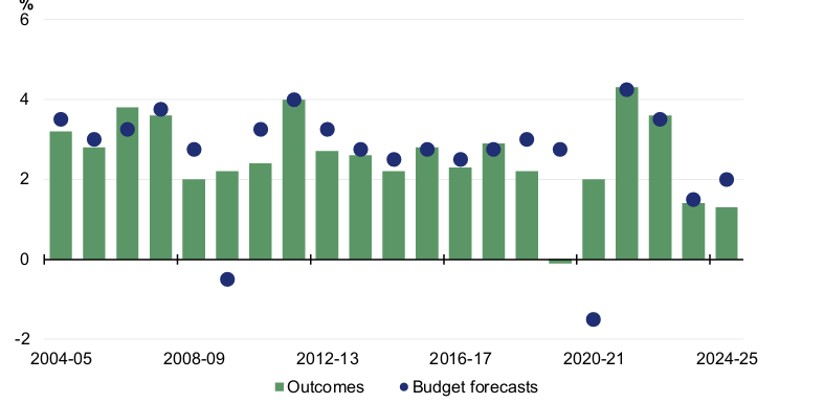
Treasury, whilst they do have a reasonable track record of forecasting Real GDP outcomes over time, have managed to seriously miss the mark in periods of elevated uncertainty including the Global Financial Crisis and COVID years as shown in the table below:[4]
GDP Forecasts vs Outcomes

The current environment, dominated by supply chain and energy market disruptions, is arguably equally uncertain.
Consequently, in the short term:
From an investment perspective:
The overarching private sector bias of the Budget is towards small to mid cap sized companies, both listed and unlisted. This was expressed in tax and productivity related measures, the most relevant being:
These measures are unlikely to uncover greenfield investment opportunity, however, may offer incremental benefits through:
At Collins St we prefer to invest in companies with robust business models that do not rely on financial engineering for taxation benefits or sit at the upper end of their industry cost curve due to wage inflation.
The consequences of conflict in the Middle East have been felt globally and highlighted the inelasticity of demand for traditional energy sources – a thematic Collins St have been investing in since 2021.
We note that Budget Paper No.2 states that the Federal Government will establish:
…a $3.2 billion Australian Fuel Security Reserve to increase long term fuel supply and storage in combination with an increase to the Minimum Stockholding Obligation (MSO), to increase Australia’s fuel reserves to 50 days.[8]
Whilst this announcement is, subject to securing supply, a temporary step in the right direction for domestic energy security; as portfolio managers, our key questions are:
Within both the Collins St Value Fund and the Collins St Global Fund we have expressed a high conviction view in favour of traditional energy companies, however investors need to be very selective within the sector as capital management, project execution, asset quality and cost curve positioning vary markedly across listed companies.
Collins St Asset Management has always taken a long-play approach to investing in listed stocks.
Much of our success over the last decade has been due to the ability of our Investment team to focus on fundamentals, strip the noise from decision making and stay true to a philosophy and process that has stood the test of time.
While these Budget announcements may be causing ripples at the moment, with a long term perspective, they fail to meaningfully impact our portfolios.
It is for this reason, irrespective of how the 2026 Federal Budget is eventually implemented, that we remain confident in the outlook for the companies within our funds and in the prospect of superior long term returns.
After all, style is timeless!
[1] Budget documents | Budget 2026–27. Accessed 13 May 2026.
[2] Budget Paper No. 2. Page 7. Accessed 13 May 2026.
[3] Outlook | Statement on Monetary Policy – May 2026 | RBA. Accessed 13 May 2026.
[4] Budget Paper No. 1. Page 272. Accessed 13 May 2026.
[5] Budget Paper No. 2. Page 20. Accessed 13 May 2026.
[6] Ibid.
[7] Budget Paper No. 2. Page 7. Accessed 13 May 2026.
[8] Budget Paper No. 2. Page 65. Accessed 13 May 2026.
Treasury forecasts real GDP growth of 2.25% for FY2027 and 2.5% for FY2028, while the Reserve Bank of Australia forecasts 1.3% and 1.4% for the same years. Collins St notes that Treasury has seriously missed the mark in past periods of elevated uncertainty, including the Global Financial Crisis and COVID years.
The team favours avoiding broad index exposures and focusing on asymmetrically priced stocks with strong fundamentals. Margins of safety are achieved at the point of purchase, through low price to earnings multiples (under 10X) for revenue earning businesses and conservative price to book ratios (under 1) for asset plays.
The Budget reintroduces Loss Carry Back provisions for companies with aggregated annual global turnover of less than $1 billion, and optimises immigration intake to align with workforce skill gaps. Collins St prefers companies with robust business models that do not rely on financial engineering for taxation benefits.
The Budget announced a $3.2 billion Australian Fuel Security Reserve, combined with an increase to the Minimum Stockholding Obligation, to lift Australia's fuel reserves to 50 days. Both the Collins St Value Fund and the Collins St Global Fund hold a high conviction view in favour of traditional energy companies, a thematic Collins St has invested in since 2021.
The team's view is that, with a long term perspective, the Budget announcements fail to meaningfully impact its portfolios. Collins St remains confident in the outlook for the companies within its funds.
The March 2026 Quarterly Report discusses the impact of the conflict in the Middle East from the perspective of fundamental investing and provides an overview of the portfolio positioning and quarterly performance for each of the Collins St Asset Management suite of managed funds.
The report discusses the impact of the conflict in the Middle East from the perspective of fundamental investing, and provides an overview of portfolio positioning and quarterly performance for each fund.
The March 2026 report considers the impact of the conflict in the Middle East through the lens of fundamental investing.
The report covers portfolio positioning and quarterly performance for each of the Collins St Asset Management suite of managed funds.
An discussion about the Global Fund investment approach and opportunities.
The Collins St Global Fund allows us to invest in any international market.
The Collins St Global Fund was opened to public wholesale investment in February 2026 after having been run for two years with private capital.
The June 2026 Quarterly Report discusses how to value SpaceX as a potential investment and provides an overview of the portfolio positioning and quarterly performance for each of the Collins St Asset Management suite of managed funds.
Andrew Georghegan from ausbiz interviewed Rob Hay on Collins St Asset Management's #1 commodity call for 2026 and three stock positions the Investment Team believe have the potential for a sharp re-rating if the thesis plays out favourably.
Andrew Georghegan from ausbiz interviewed Rob Hay of Collins St Asset Management in an interview recorded on 7 January 2026.
Rob discussed Collins St Asset Management's number one commodity call for 2026 and three stock positions the Investment Team believe have the potential for a sharp re-rating if the thesis plays out favourably.
The Quality at Value Team interview Managing Director Michael Goldberg about how value investing has fared through the turbulence of recent years, the AI-driven hype around the Magnificent Seven in the US, and how value investors can navigate an overheated tech market without losing their cool.
The Quality at Value (QAV) team interviewed Michael Goldberg, Managing Director of Collins St Asset Management.
The interview covered how value investing has fared through the turbulence of recent years, the AI-driven hype around the Magnificent Seven in the US, and how value investors can navigate an overheated tech market.
The September 2025 Quarterly Report shares insights into the Artificial Intelligence thematic from a Value investor’s perspective as well as an overview of the key holdings and contributors to performance across each of the Collins St Asset Management suite of managed funds.
The report shares insights into the Artificial Intelligence thematic from a value investor’s perspective, along with an overview of key holdings and contributors to performance across the Collins St suite of managed funds.
The September 2025 report examines the Artificial Intelligence thematic through the lens of a value investor.
The report covers each fund in the Collins St Asset Management suite of managed funds, including their key holdings and contributors to performance.
The June 2025 Quarterly Report provides an overview of our four funds and insights into the importance of independent thought and original fundamental research when making investment decisions.
Analysis on a selection of ASX listed holdings from within the flagship Collins St Value Fund is also provided in order to illustrate how our deep value, contrarian, high conviction and benchmark unaware investment philosophy is brought to life.
The report provides an overview of the four Collins St funds and insights into the importance of independent thought and original fundamental research when making investment decisions.
The team’s view is that independent thought and original fundamental research are important when making investment decisions.
Collins St Asset Management describes its investment philosophy as deep value, contrarian, high conviction and benchmark unaware.
The report analyses a selection of ASX listed holdings from the flagship Collins St Value Fund to illustrate how the investment philosophy is brought to life.
Michael Goldberg is interviewed by Greg Canavan from Fat Tail Investment Research about the current surge in gold prices and the impact it might have on gold equities.
Greg Canavan from Fat Tail Investment Research interviewed Michael Goldberg of Collins St Asset Management.
The interview covered the surge in gold prices and the impact it might have on gold equities.
The March 2025 Quarterly Report for the Collins St Asset Management suite of funds shares insights into the opportunity that undervalued gold companies currently present, as their share prices have not yet reflected the recent surge in gold prices.
An update is also provided on the performance of each of the listed equity funds and a selection of topical positions that have been invested in.
The report shares insights into the opportunity that undervalued gold companies present, along with a performance update on each listed equity fund and a selection of topical positions.
The team’s view is that undervalued gold companies present an opportunity because their share prices have not yet reflected the recent surge in gold prices.
Yes. The report provides an update on the performance of each of the Collins St listed equity funds and a selection of topical positions the funds have invested in.
Rob Hay from Collins St Asset Management is interviewed by Nadine Blayney from ausbiz on key insights into the ASX listed gold sector post the February 2025 reporting season (recorded 05 March 2025).
Rob Hay from Collins St Asset Management is interviewed by Nadine Blayney from ausbiz on the ‘one big idea’ ASX investors need to consider for 2025 (recorded 31 January 2025).
Rob Hay shares key insights into the ASX listed gold sector following the February 2025 reporting season.
Rob Hay from Collins St Asset Management is interviewed by Nadine Blayney from ausbiz.
The interview was recorded on 5 March 2025.
Rob Hay from Collins St Asset Management is interviewed by Nadine Blayney from ausbiz on the 'one big idea' ASX investors need to consider for 2025 (recorded 31 January 2025).
Rob Hay from Collins St Asset Management is interviewed by Nadine Blayney from ausbiz on the ‘one big idea’ ASX investors need to consider for 2025 (recorded 31 January 2025).
Rob Hay discusses the one big idea that, in the team's view, ASX investors need to consider for 2025.
Rob Hay from Collins St Asset Management is interviewed by Nadine Blayney from ausbiz.
The interview was recorded on 31 January 2025.
The December 2024 Quarterly Report for the Collins St Asset Management suite of funds shares insights into the importance of challenging conventional investing wisdom and how the combination of deep research and high conviction can lead to superior outcomes over the long-term. An update is also provided on the performance of each of the listed equity funds and a selection of topical positions that have been invested in.
The report shares insights into the importance of challenging conventional investing wisdom and how the combination of deep research and high conviction can lead to superior outcomes over the long term.
The team’s view is that combining deep research with high conviction can lead to superior investment outcomes over the long term.
The report provides a performance update on each of the Collins St listed equity funds and a selection of topical positions the funds have invested in.
Michael Goldberg was interviewed recently by leading Private Wealth Adviser Murdoch Gatti from York Wealth Management. In it, he shares Collins St Asset Management's distinctly different approach to value investing and his unusual research methods (recorded 18 November 2024).
Michael Goldberg was interviewed recently by leading Private Wealth Adviser Murdoch Gatti from York Wealth Management. In it, he shares Collins St Asset Management’s distinctly different approach to value investing and his unusual research methods (recorded 18 November 2024)
Listen to the full interview on The Rate Of Change
Michael Goldberg was interviewed by Murdoch Gatti, a leading private wealth adviser from York Wealth Management.
Michael Goldberg shares Collins St Asset Management's distinctly different approach to value investing and his unusual research methods.
The interview was recorded on 18 November 2024.
The September 2024 Quarterly Report for the Collins St Asset Management suite of funds shares insights into the ‘payoff for patience’ and how an acute focus on things within your control can deliver superior investment outcomes. An update is also provided on the performance of each of the listed equity funds and a selection of topical positions that have been invested in.
The report shares insights into the ‘payoff for patience’ and how an acute focus on things within your control can deliver superior investment outcomes.
The team’s view is that patience, combined with an acute focus on the things within your control, can deliver superior investment outcomes.
The report provides a performance update on each of the Collins St listed equity funds and a selection of topical positions the funds have invested in.
Rob Hay shares Collins St Asset Management’s insights into Astron Corporation Limited (ATR.ASX) on ausbiz (recorded 6th of November 2024).
Rob Hay shares Collins St Asset Management's insights into Astron Corporation Limited (ATR.ASX).
The interview was recorded on ausbiz on 6 November 2024.
Astron Corporation Limited trades on the ASX under the code ATR.
The June 2024 Quarterly Report for the Collins St Value Fund discusses the factors an investor might consider when looking to sell an investment and the challenges (and opportunities) associated with contrarian investing. An update is also provided on the fund’s performance which saw all three of the long only equities funds deliver > 10% net for the 2024 Financial Year.
The report discusses the factors an investor might consider when looking to sell an investment, and the challenges and opportunities associated with contrarian investing.
The June 2024 report outlines the factors an investor might weigh up when looking to sell an investment, alongside the team’s view on the challenges and opportunities of contrarian investing.
All three of the Collins St long only equities funds delivered more than 10% net for the 2024 financial year.
Rob Hay shares Collins St Asset Management’s insights into the ASX listed Tesoro Gold (TSO.ASX) on ausbiz (recorded 19th of June 2024).
Rob Hay shares Collins St Asset Management's insights into ASX listed Tesoro Gold (TSO.ASX).
The interview was recorded on ausbiz on 19 June 2024.
Tesoro Gold trades on the ASX under the code TSO.
The March 2024 Quarterly Report for the Collins St Value Fund discusses the role of the Board in an ASX listed company and some of the positive traits that Collins St Asset Management look for prior to investing in a company. An update is also provided on the fund’s performance (+18.6% net for the Financial Year to 31 March 2024) and a selection of high conviction positions including Carnarvon Energy, Boom Logistics and Litigation Capital Management.
The report discusses the role of the Board in an ASX listed company and some of the positive traits Collins St Asset Management looks for before investing in a company. It also provides an update on fund performance and a selection of high conviction positions.
The Collins St Value Fund returned +18.6% net for the financial year to 31 March 2024.
The report covers a selection of high conviction positions including Carnarvon Energy, Boom Logistics and Litigation Capital Management.
Michael Goldberg is interviewed by Chris Judd as part of the Talk Ya Book series on shareholder activism and Carnarvon Energy (CVN.ASX).
Michael Goldberg was interviewed by Chris Judd as part of the Talk Ya Book series.
The interview covers shareholder activism and Carnarvon Energy (CVN.ASX).
The interview was released in March 2024.
Vasilios Piperoglou and Rob Hay share Collins St Asset Management's insights into the February 2024 ASX reporting season with a special emphasis on the gold and traditional energy sectors.
Vasilios Piperoglou and Rob Hay share Collins St Asset Management’s insights into the February 2024 ASX reporting season with a special emphasis on the gold and traditional energy sectors.
The update shares Collins St Asset Management's insights into the February 2024 ASX reporting season.
The update is presented by Vasilios Piperoglou and Rob Hay from Collins St Asset Management.
The update places a special emphasis on the gold and traditional energy sectors.
The December 2023 Quarterly Report for the Collins St Value Fund discusses the concept of change as it relates to investment philosophy, research processes, portfolio construction and corporate activism. An update is also provided on the fund’s holdings in Carnarvon Energy and Link Administration Holdings.
The report discusses the concept of change as it relates to investment philosophy, research processes, portfolio construction and corporate activism.
The report provides an update on the fund's holdings in Carnarvon Energy and Link Administration Holdings.
Rob Hay is interviewed by Nadine Blayney from auzbis on the investment thesis underpinning a high conviction position in Ramelius Resources (RMS.ASX).
The interview covers the investment thesis underpinning a high conviction position in Ramelius Resources (RMS.ASX).
Rob Hay from Collins St Asset Management is interviewed by Nadine Blayney.
Ramelius Resources trades on the ASX under the code RMS.
The September 2023 Quarterly Report for the Collins St Value Fund discusses the distinction between investment risk and uncertainty, with some perspective on what it takes to be a successful investor over the long term alongside an update on the Fund’s holdings in Carnarvon Energy and MMA Offshore.
The report discusses the distinction between investment risk and uncertainty, with some perspective on what it takes to be a successful investor over the long term.
The report includes an update on the Fund's holdings in Carnarvon Energy and MMA Offshore.
Michael Goldberg is interviewed by Owen Rask on his unconventional approach to researching ASX listed companies.
Michael Goldberg is interviewed by Owen Rask on his unconventional approach to researching ASX listed companies. Recorded April 2023.
Listen to the full interview on the Australian Investors Podcast
Michael Goldberg was interviewed by Owen Rask on the Rask Report podcast.
Michael Goldberg talks about his unconventional approach to researching ASX listed companies.
The interview was recorded in April 2023.
An overview of the philosophy, process and positioning of the Collins St Value Fund as at March 2023.
The overview explains the philosophy, process and positioning of the Collins St Value Fund.
The overview presents the Collins St Value Fund as at March 2023.
A podcast our Managing Director Michael Goldberg recorded with leading independent Financial Adviser, David Clark from Koda Capital in November 2021.
The podcast features Collins St Asset Management's Managing Director, Michael Goldberg, in conversation with David Clark from Koda Capital.
David Clark is a leading independent financial adviser from Koda Capital.
Michael Goldberg recorded the podcast with David Clark in November 2021.
Michael Goldberg and the team at Collins St Value Fund know a thing or two about making money off unloved and out of favour stocks and sectors. Their investments in uranium and a then-unloved pharmaceutical stock (among others) have helped them outperform the ASX 200 by over 8% per annum in the 5 years to 30 June.
With both of these investments having seen some outstanding returns in recent years, the obvious question is where to look next? In this episode of The Rules of Investing podcast, he addresses exactly this question. His answer is unlikely to be popular among investors, but isn’t that the point? Tune in below and you’ll also hear about the ‘superinvestors’ he’s learned the most from, and he tells us about a founder-led company with outstanding prospects for growth.
The Collins St Value Fund outperformed the ASX 200 by over 8% per annum in the 5 years to 30 June referenced in the episode.
Investments in uranium and a then-unloved pharmaceutical stock, among others, helped the fund outperform.
Michael Goldberg addresses where to look next for opportunities, with an answer that is unlikely to be popular among investors. He also discusses the superinvestors he has learned the most from and a founder-led company with outstanding prospects for growth.
The team has a track record of making money from unloved and out of favour stocks and sectors.
Michael Goldberg is interviewed by Chris Judd on Retail Food Group, a high conviction stock position in the Collins St Value Fund. Filmed 13 July 2021.
In Talk Ya Book Episode 61, Chris Judd interviews Michael Goldberg about Retail Food Group. The interview was filmed on 13 July 2021.
Yes. Retail Food Group is described as a high conviction stock position in the Collins St Value Fund.
Michael Goldberg (Managing Director & Portfolio Manager) from Collins St Asset Management shares his insights into Litigation Capital Management on the ausbiz program.
Michael Goldberg, Managing Director and Portfolio Manager at Collins St Asset Management, appeared on the ausbiz program on 15 February 2021.
Michael Goldberg shared his insights into Litigation Capital Management.
Michael Goldberg (Managing Director & Portfolio Manager) from Collins St Asset Management shares his insights into Retail Food Group (RFG.ASX) on the ausbiz program.
Michael Goldberg, Managing Director and Portfolio Manager at Collins St Asset Management, appeared on the ausbiz program on 22 April 2021.
Michael Goldberg shared his insights into Retail Food Group (RFG.ASX).
Rob Hay (Head of Distribution & Investor Relations) speaks with Damen Purcell from Australian Fund Monitors in April 2021 about the outlook for interest rates, different perspectives on value investing and the process the team at Collins St Asset Management use to determine the intrinsic value of a stock.
Rob Hay, Head of Distribution and Investor Relations at Collins St Asset Management, spoke with Damen Purcell from Australian Fund Monitors in April 2021.
The discussion covered the outlook for interest rates and different perspectives on value investing.
Rob Hay explains the process the team at Collins St Asset Management use to determine the intrinsic value of a stock in this interview.
Rob Hay (Head of Distribution and Investor Relations) is interviewed by Damen Purcell from Australian Fund Monitors on the key features of the Collins St Value Fund\
Rob Hay, Head of Distribution and Investor Relations at Collins St Asset Management, was interviewed by Damen Purcell from Australian Fund Monitors.
The interview covers the key features of the Collins St Value Fund.
Rob Hay (Head of Distribution and Investor Relations) shares his insights into value investing and momentum trading as part of a 2021 Wholesale Investor panel discussion
It is a 2021 Wholesale Investor panel discussion on momentum versus value investing, featuring Rob Hay from Collins St Asset Management.
Rob Hay, Head of Distribution and Investor Relations, shared his insights into value investing and momentum trading.
Michael Goldberg (Managing Director & Portfolio Manager) from Collins St Asset Management shares three contrarian stock calls on the ausbiz program.
Michael Goldberg, Managing Director and Portfolio Manager at Collins St Asset Management, appeared on the ausbiz program on 1 June 2021.
Michael Goldberg shared three contrarian stock calls.
Rob Hay (Head of Distribution & Investor Relations) from Collins St Asset Management is interviewed by Damen Purcell (COO) from Australian Fund Monitors on the 2021 Financial Year, “what’s next” for investors and the differences between “value” and “contrarian” investing.
Rob Hay, Head of Distribution and Investor Relations at Collins St Asset Management, was interviewed by Damen Purcell, COO of Australian Fund Monitors.
The interview covered the 2021 Financial Year and what comes next for investors.
Yes. Rob Hay discusses the differences between value and contrarian investing.
Michael Goldberg, Managing Director and Portfolio Manager at Collins St Asset Management, provides an overview of the Collins St Value Fund. Recorded in July 2021.
It is a video overview of the Collins St Value Fund, recorded in July 2021.
The overview is presented by Michael Goldberg, Managing Director and Portfolio Manager at Collins St Asset Management.
Melbourne-based fundie Collins St Asset Management has extended its hot streak after its Collins St Value Fund returned 64.8 per cent net of fees for FY21.
As at the end of the June quarter some of the Michael Goldberg managed fund’s top holdings included Paladin, Orica, TPG Telecom, and Retail Food Group. The fund first started to invest in a basket of uranium companies in 2017 and attributed part of its success to this decision.
The Collins St Value Fund returned 64.8 per cent net of fees for FY21, extending a hot streak for Melbourne-based Collins St Asset Management.
The fund is managed by Michael Goldberg and Vasilios Piperoglou.
Top holdings included Paladin, Orica, TPG Telecom and Retail Food Group.
The fund first started investing in a basket of uranium companies in 2017 and attributed part of its success to this decision.
Rob Hay, Head of Distribution and Investor Relations at Collins St Asset Management participates in a panel discussion hosted by Wholesale Investor on value investing in the current economic climate.
The panel, hosted by Wholesale Investor, discussed momentum versus value investing and value investing in the economic climate of 2021.
Rob Hay, Head of Distribution and Investor Relations at Collins St Asset Management, took part in the panel.
Michael Goldberg, Managing Director and Portfolio Manager of the Collins St Value Fund is interviewed by Peter Switzer on the topics of value investing, stock analysis and current opportunities in the ASX listed uranium sector.
Peter Switzer interviewed Michael Goldberg, Managing Director and Portfolio Manager of the Collins St Value Fund.
The interview covered value investing and stock analysis, along with current opportunities in the ASX listed uranium sector.
Michael Goldberg, one of the principals and founders of Collins St Value Fund, was kind enough to talk to us for 90 minutes yesterday about how CSVF became one of the best performing funds in Australia, achieving a 13.5 percent return in 2019-20 compared with the ASX 200 Index which was down 7.7 percent.
QAV interviewed Michael Goldberg, one of the principals and founders of the Collins St Value Fund, for 90 minutes.
The Collins St Value Fund achieved a 13.5 percent return in 2019-20, while the ASX 200 Index was down 7.7 percent over the same period.
The interview covered how the Collins St Value Fund became one of the best performing funds in Australia.
Rob Hay, Head of Distribution and Investor Relations at Collins St Asset Management, is interviewed by Damen Purcell of Australian Fund Monitors with respect to the performance of the Collins St Value Fund in 2020 and the portfolio positioning for 2021.
Damen Purcell of Australian Fund Monitors interviewed Rob Hay, Head of Distribution and Investor Relations at Collins St Asset Management, in January 2021.
The interview covered the performance of the Collins St Value Fund in 2020 and the portfolio positioning for 2021.
Michael Goldberg from Collins St Value Fund is back on Talk Ya Book with an interesting construction engineering “turned around” story. With a very experienced management and a new focus on driving high margin, low-risk projects, he feels the company is well aligned to benefit from the infrastructure boom ahead of us. Proudly presented by Honan (www.honan.com.au)
Michael Goldberg from the Collins St Value Fund discussed a construction engineering turnaround story on Chris Judd's Talk Ya Book program.
The company has very experienced management and a new focus on driving high margin, low-risk projects. In his view, this leaves it well aligned to benefit from the infrastructure boom ahead.
The episode was presented by Honan.
The most extraordinary year for financial markets in living memory was a good one for active equity fund managers, particularly those who were wary of economic risk before COVID-19 struck and also took the opportunity to add structural-growth and cyclic exposures after the sell-off.
Passive funds made subpar returns in the year to the end of December as the S&P/ASX 300 fell 1.2 per cent and dividends were crimped by a combination of recession and the regulation of banking sector payouts. But the top 10 active equity funds returned 24 per cent on average, according to Mercer’s closely watched Australian Shares Investment Manager Performance Survey released on Tuesday.
According to Mercer's Australian Shares Investment Manager Performance Survey, the top 10 active equity funds returned 24 per cent on average in the year to the end of December 2020.
Passive funds made subpar returns as the S&P/ASX 300 fell 1.2 per cent and dividends were crimped by a combination of recession and the regulation of banking sector payouts.
The strongest performers were wary of economic risk before COVID-19 struck and took the opportunity to add structural growth and cyclical exposures after the sell-off.
Out-of-favour stocks with proven earnings are tipped to deliver this year says, the co-founders of Collins St Asset Management, Michael Goldberg, whose value fund was the top-performing long-only Australian shares strategy last year.
After a year dominated by a heated growth-led recovery, the value-oriented boutique is positioned to capitalise on renewed interest in cyclical exposures, backing names such as metallurgical coal miner Coronado Global Resources.
Collins St Value Fund beat 130 other strategies to take the top spot in Mercer’s survey of fund manager performance for 2020, with a 12-month return of 43.6 per cent before fees.
The Collins St Value Fund was the top-performing long-only Australian shares strategy of 2020, beating 130 other strategies in Mercer's survey with a 12-month return of 43.6 per cent before fees.
Michael Goldberg, co-founder of Collins St Asset Management, tipped out-of-favour stocks with proven earnings to deliver in 2021.
After a year dominated by a heated growth-led recovery, the value-oriented boutique is positioned to capitalise on renewed interest in cyclical exposures, backing names such as metallurgical coal miner Coronado Global Resources.
Michael Goldberg was interviewed by Alan Kohler from the Eureka Report about the Collins St Value Fund’s unique fee structure, investment philosophy and research process.
Michael Goldberg was interviewed by Alan Kohler from the Eureka Report.
The interview covers the Collins St Value Fund's unique fee structure, investment philosophy and research process.
Michael Goldberg, Managing Director and Portfolio Manager at Collins St Asset Management, is interviewed on the ausbiz program about his outlook for ASX listed uranium stocks.
Michael Goldberg, Managing Director and Portfolio Manager at Collins St Asset Management, was interviewed on the ausbiz program on 21 October 2020.
Michael Goldberg discussed his outlook for ASX listed uranium stocks.
Michael Goldberg was interviewed by Owen Raszkiewicz about his investment philosophy and what drives good investment decision making.
Michael Goldberg was interviewed by Owen Raszkiewicz on the Australian Investor Podcast.
Michael Goldberg talks about his investment philosophy and what drives good investment decision making.
Coronado Global Resources (CRN.ASX) has recently been added into the Collins St Value Fund.
Our analysis of the stock can be accessed by clicking here.
At the time of this September 2020 post, Coronado Global Resources (CRN.ASX) had recently been added to the Collins St Value Fund.
The full analysis was published on Livewire Markets and is linked in this post.
Rob Hay, Head of Distribution and Investor Relations at Collins St Asset Management, speaks with Nadine Blayney and David Scutt from ausbiz about Coronado Global Resources on 21 September 2020.
Rob Hay, Head of Distribution and Investor Relations at Collins St Asset Management, spoke with Nadine Blayney and David Scutt from ausbiz on 21 September 2020.
The interview focused on Coronado Global Resources, which is listed on the ASX under the code CRN.
Insights into a selection of key portfolio holdings within the Collins St Value Fund post their August 2020 ASX announcements.
Read the article by clicking here.
The update provides insights into a selection of key portfolio holdings within the Collins St Value Fund following their August 2020 ASX announcements.
The full update is available as a PDF linked in this post.
Michael Goldberg shares his investment philosophy / insights with the Australian Financial Review.
The article features Michael Goldberg of Collins St Asset Management, who shares his investment philosophy and insights with the Australian Financial Review.
As the title suggests, the piece explores how feeling uncomfortable as an investor can help to unlock value.
Michael Goldberg, Managing Director and Portfolio Manager at Collins St Asset Management is interviewed on the ausbiz business show about his views on the Buy Now Pay Later sector and also the dislocation between markets and the economy. Filmed on the 10th of August 2020.
Michael Goldberg, Managing Director and Portfolio Manager at Collins St Asset Management, was interviewed on the ausbiz business show. The interview was filmed on 10 August 2020.
Michael Goldberg shared his views on the Buy Now Pay Later sector and the dislocation between markets and the economy.
Michael Goldberg, Managing Director and Portfolio Manager at Collins St Asset Management, is interviewed on the ausbiz business program about his views on the Federal Government’s mini budget and the outlook for the ASX reporting season.
Michael Goldberg, Managing Director and Portfolio Manager at Collins St Asset Management, was interviewed on the ausbiz business program on 29 July 2020.
Michael Goldberg shared his views on the Federal Government's mini budget and the outlook for the ASX reporting season.
COVID-2019. OPEC. Capital raisings and removal of guidance. 13% intra-day swings.
Following what was a fairly benign ASX reporting season back in February there has certainly been a lot going on with ASX listed stocks.
For some investors this spells a buying opportunity, for others a heightened reason to be cautious. But which one is it? Does the current market represent a falling knife or is this the biggest and best free lunch since the GFC?
Following a fairly benign ASX reporting season in February 2020, the market has contended with COVID-19, OPEC, capital raisings, the removal of guidance and 13% intra-day swings.
For some investors it spells a buying opportunity and for others a heightened reason to be cautious. The article explores whether the market represents a falling knife or the biggest and best free lunch since the GFC.
The 2020 Financial Year certainly threw up some challenges. To think the biggest global issues investors were contemplating only 12 months ago included the UK’s dealing of Brexit and the transition of the Prime Ministership from Theresa May to Boris Johnson! Six months ago, the world was enthralled and slightly wary as the USA and North Korea continued to negotiate as North Korea tested its missile capabilities. Petty disagreements and general political unrest seemed to dominate the headlines. Uncertainty seemed to abound, but as we were about to discover, we hadn’t seen nothin’ yet.
Only 12 months earlier, investors were contemplating the UK's handling of Brexit and the change of Prime Minister from Theresa May to Boris Johnson. Six months earlier, attention was on negotiations between the USA and North Korea as North Korea tested its missile capabilities.
The 2020 financial year threw up challenges that went well beyond the petty disagreements and political unrest that had dominated headlines, with the author noting that "we hadn't seen nothin' yet".
COVID-19 has claimed many casualties however office life will not be one of them. Rather, our relationship with the office is likely to evolve into one that places an increased value on flexibility, cost efficiency and the ‘network economy’. Consequently, a strong structural tail wind supports future revenue growth in ASX listed stocks such as Victory Offices (VOL.ASX) who provide a premium product in the market place and are backed by a strong management team capable of assisting businesses adjust and thrive in the ‘new normal’.
Click here to read the full article in Livewire.
The team's view is that office life will not be a casualty of COVID-19. Rather, our relationship with the office is likely to evolve into one that places an increased value on flexibility, cost efficiency and the network economy.
A strong structural tailwind supports future revenue growth for ASX listed stocks such as Victory Offices (VOL.ASX). The company provides a premium product and is backed by a strong management team capable of helping businesses adjust and thrive in the new normal.
The full article was published on Livewire Markets and is linked in this post.
Rob Hay, Head of Distribution & Investor Relations at Collins St Asset Management appears on the ausbiz business program. Key stocks discussed include Victory Offices (VOL.ASX).
Rob Hay, Head of Distribution and Investor Relations at Collins St Asset Management, appeared on the ausbiz business program on 29 June 2020.
Key stocks discussed included Victory Offices (VOL.ASX).
Rob Hay, Head of Distribution & Investor Relations at Collins St Asset Management appears on the ausbiz business program to discuss ASX listed gold stocks.
Rob Hay, Head of Distribution and Investor Relations at Collins St Asset Management, appeared on the ausbiz business program on 15 June 2020.
Rob Hay discussed ASX listed gold stocks.
Extreme volatility has seen ASX listed gold stocks rally by nearly 40% over the last 12 months and, with the full economic impacts of COVID-19 starting to be felt many investors are looking at ways to increase their exposure to the precious metal. But, which of the wide array of physical, ETF and large / small cap stocks available to investors is the best path to take? How much gold is enough and what sort of due diligence should an investor undertake in order to fully understand the risks and opportunities on offer in the gold sector?
Michael Goldberg and Rob Hay from Collins St Asset Management share their investment thesis on gold, at a time when extreme volatility had seen ASX listed gold stocks rally by nearly 40% over 12 months.
With the full economic impacts of COVID-19 starting to be felt, many investors were looking at ways to increase their exposure to the precious metal.
It looks at which path is best among physical gold, ETFs and large or small cap gold stocks, how much gold is enough, and what due diligence an investor should undertake to fully understand the risks and opportunities in the gold sector.
Rob Hay, Head of Distribution & Investor Relations at Collins St Asset Management appears on the ausbiz business program to discuss ASX listed energy and resource stocks.
Rob Hay, Head of Distribution and Investor Relations at Collins St Asset Management, appeared on the ausbiz business program on 1 June 2020.
Rob Hay discussed ASX listed energy and resource stocks.
Paradigm Biopharmaceuticals (PAR.ASX) have $108M in cash, no debt and are well advanced in the progression of clinical trials in addressable markets worth up to as much as $36B p.a. The next two years are particularly exciting for Paradigm Biopharmaceuticals as they are set to announce:
Each of those pieces of news could drive significantly more interest in the company, and result in a materially higher share price.
Paradigm Biopharmaceuticals (PAR.ASX) has $108M in cash and no debt, according to the article.
Paradigm is well advanced in clinical trials in addressable markets worth up to as much as $36B per year.
The article lists complete recruitment of 1,150 patients for its stage 3 OA clinical trials, the start of stage 3 trials for MPS, potential Australian approval to begin treatment, addition to the ASX 300 and publication of results in peer-reviewed journals.
In the team's view, each piece of news could drive significantly more interest in the company and result in a materially higher share price. Potential Australian approval to begin treatment would lead to its first significant earnings.
We undoubtedly live in unusual times where long held assumptions are rapidly being eroded. But what does this all mean for ASX investors looking to preserve and grow their wealth? Will structural shifts in consumption patterns and ballooning public sector debt lead to some sectors rising above the rest, or is this all one great race to the bottom?
Anton Lawrence (Chief Strategist) and Rob Hay (Head of Distribution and Investor Relations) from Collins St Asset Management lead the discussion.
It considers what unusual times, where long held assumptions are rapidly being eroded, mean for ASX investors looking to preserve and grow their wealth.
The discussion asks whether structural shifts in consumption patterns and ballooning public sector debt will lead to some sectors rising above the rest, or whether this is one great race to the bottom.
Michael Goldberg, Managing Director & Portfolio Manager at Collins St Asset Management appears on the ausbiz business program. Key stocks discussed include iSelect (ISU.ASX) and National Tyre & Wheel (NTD.ASX).
Michael Goldberg, Managing Director and Portfolio Manager at Collins St Asset Management, appeared on the ausbiz business program on 18 May 2020.
Key stocks discussed included iSelect (ISU.ASX) and National Tyre & Wheel (NTD.ASX).
Michael Goldberg, Managing Director & Portfolio Manager at Collins St Asset Management appears on the ausbiz business program to talk about Ramsay Healthcare (RHC.ASX) and Sydney Airport (SYD.ASX).
Michael Goldberg, Managing Director and Portfolio Manager at Collins St Asset Management, appeared on the ausbiz business program on 27 April 2020.
Michael Goldberg talked about Ramsay Healthcare (RHC.ASX) and Sydney Airport (SYD.ASX).
While fully aware that very few commentators offering their opinion on the health and financial implications of COVID-19 are actually epidemiologists, GP’s and/or economists, it seems that people are nonetheless compelled to offer their views and opinions as if they were.
It is a piece published in April 2020 on understanding, overcoming and profiting from 2020 and beyond, written in the context of COVID-19.
The author notes that very few commentators offering opinions on the health and financial implications of COVID-19 are epidemiologists, GPs or economists, yet many offer their views as if they were.
Michael Goldberg, Managing Director & Portfolio Manager at Collins St Asset Management appears on the ausbiz business program. The discussion includes COVID-19 and uranium.
Michael Goldberg, Managing Director and Portfolio Manager at Collins St Asset Management, appeared on the ausbiz business program on 20 April 2020.
The discussion covered COVID-19 and uranium.
The March 2020 Quarterly Report for the Collins St Value Fund. This report provides an overview of the performance of the Fund as well as consideration of the impact of COVID-19 on ASX stocks and how the Fund is positioned to take advantage of any opportunities that may present themselves as a result.
It is the Collins St Value Fund's report for the March 2020 quarter, providing an overview of the Fund's performance.
The report considers the impact of COVID-19 on ASX stocks and how the Fund is positioned to take advantage of any opportunities that may present themselves as a result.
An interview by Managing Director and Portfolio Manager, Michael Goldberg, with Chris Judd regarding Peninsula Energy and the outlook for ASX listed uranium stocks.
The interview covers Peninsula Energy and the outlook for ASX listed uranium stocks.
Collins St Managing Director and Portfolio Manager Michael Goldberg speaks with Chris Judd.
The December 2019 Quarterly Report provides an overview of the performance of the Collins St Value Fund as well as a discussion of market timing / investor psychology and how positions are established within the Fund.
It is the Collins St Value Fund's report for the December 2019 quarter, providing an overview of the Fund's performance.
The report discusses market timing and investor psychology, and how positions are established within the Collins St Value Fund.
An interview between Managing Director and Portfolio Manager of the Collins St Value Fund, Michael Goldberg, with Chris Judd on ‘Talk Ya Book’ on the 19th of November 2019.
Michael Goldberg, Managing Director and Portfolio Manager of the Collins St Value Fund, was interviewed by Chris Judd on Talk Ya Book.
The interview took place on 19 November 2019.
An interview between Managing Director and Portfolio Manager of the Collins St Value Fund, Michael Goldberg, with Chris Judd on Nova Minerals.
Michael Goldberg, Managing Director and Portfolio Manager of the Collins St Value Fund, speaks with Chris Judd about Nova Minerals.
The interview is hosted by Chris Judd.
The September 2019 Quarterly Report provides an overview of the performance of the Collins St Value Fund as well as a summary of the ASX Reporting Season and some of the specialist capabilities the Fund is able to employ in the delivery of superior medium to long term returns.
It is the Collins St Value Fund's report for the September 2019 quarter, providing an overview of the Fund's performance.
The report summarises the ASX Reporting Season and some of the specialist capabilities the Collins St Value Fund is able to employ in the delivery of superior medium to long term returns.
Michael Goldberg (Managing Director and Portfolio Manager of the Collins St Value Fund) share some of his insights into the research process used to select ASX listed stocks.
Michael Goldberg shares insights into the research process the Collins St Value Fund uses to select ASX listed stocks.
Michael Goldberg, Managing Director and Portfolio Manager of the Collins St Value Fund, in an interview with Livewire.
Michael Goldberg (Managing Director and Portfolio Manager of the Collins St Value Fund) provides an overview of the investment thesis supporting the Funds’ investment into the ASX listed Paradigm Biopharmaceuticals.
In this Livewire interview, Michael Goldberg provides an overview of the investment thesis supporting the Collins St funds’ investment in ASX listed Paradigm Biopharmaceuticals.
Paradigm Biopharmaceuticals is listed on the ASX under the code PAR.
Michael Goldberg, Managing Director and Portfolio Manager of the Collins St Value Fund.
Michael Goldberg (Managing Director and Portfolio of the Collins St Value Fund) outlines the investment thesis for ASX listed uranium stocks.
In this Livewire interview, Michael Goldberg outlines the investment thesis for ASX listed uranium stocks.
Michael Goldberg, Managing Director of the Collins St Value Fund, presents the investment thesis.
Michael Goldberg (Managing Director and Portfolio Manager of the Collins St Value Fund) outlines the rationale (in mid 2019) for being invested outside of the ASX top 20 stocks.
In this Livewire presentation, Michael Goldberg outlines the rationale, as at mid 2019, for being invested outside of the ASX top 20 stocks.
Michael Goldberg, Managing Director and Portfolio Manager of the Collins St Value Fund.
Michael Goldberg (Managing Director and Portfolio Manager of the Collins St Value Fund) outlines the reason why a flexible investment mandate is essential in the delivery of superior medium to long term returns.
Michael Goldberg’s view is that a flexible investment mandate is essential in delivering superior medium to long term returns.
Michael Goldberg, Managing Director and Portfolio Manager of the Collins St Value Fund, in a Livewire presentation.
Michael Goldberg (Managing Director and Portfolio Manager of the Collins St Value Fund) explains how having a flexible mandate and a concentrated portfolio can make all the difference to an investor’s long term returns.
Michael Goldberg, Managing Director and Portfolio Manager of the Collins St Value Fund.
Michael Goldberg explains how having a flexible mandate and a concentrated portfolio can make all the difference to an investor’s long term returns.
A Livewire interview with Managing Director, Michael Goldberg, outlining his distinctive investment philosophy.
Collins St Asset Management Managing Director Michael Goldberg is interviewed by Livewire.
Michael Goldberg outlines his distinctive investment philosophy.
After years as a successful investment strategy, something has happened to blue chips over the last 5 years. Despite huge gains from global markets, Australia’s biggest companies have experienced zero capital growth since 2013.
In this wire, we discuss why Australia’s favourite companies have ceased generating positive returns, whether we can expect them to improve in the future, and where we might look to find the Blue Chips of tomorrow.
If you own the Big 4 Banks, BHP, RIO, Woolworths, Wesfarmers, or Telstra, this article will provide you with an essential re-evaluation of their prospects.
According to the article, Australia's biggest companies have experienced zero capital growth since 2013, despite huge gains from global markets.
The article is written for holders of the Big 4 Banks, BHP, RIO, Woolworths, Wesfarmers or Telstra, and provides a re-evaluation of their prospects.
It discusses why Australia's favourite companies have ceased generating positive returns, whether they can be expected to improve, and where investors might look to find the blue chips of tomorrow.
In early 2017 we identified debt and the unsustainably high property prices as the key risks to the Australian economy. In particular we were concerned about the unwinding of the wealth effect as investors began to feel the pinch of a weaker property market. We believed this would manifest itself through poorer consumer sentiment and consequent drop in spending.
In early 2017, the team identified debt and unsustainably high property prices as the key risks to the Australian economy.
The team was concerned about the wealth effect unwinding as investors began to feel the pinch of a weaker property market.
The team believed a weaker property market would show up through poorer consumer sentiment and a consequent drop in spending.
In my time at University (which seems like a lifetime ago) I recall two types of lecturers: Those that guided the students towards what to expect at exam time, and those that didn’t.
Unsurprisingly, there was a strong correlation between the type of lecturer, the student attendance late in the term, and the pass rate. Once students knew what to expect in an exam and where to find the answers, it would take a special kind of person to fail.
Management at Paradigm Biopharmaceuticals are the type of people that, had they been lecturers at University, would have had near 100% attendance in the final weeks of class, and a near 100% pass rate.
The article discusses Paradigm Biopharmaceuticals, which Collins St described as a company with massive near-term potential.
The author recalls two types of lecturers, those who guided students on what to expect at exam time and those who did not. The team's view is that Paradigm's management are the first type, who would have had near 100% attendance in the final weeks of class and a near 100% pass rate.
Once students knew what to expect in an exam and where to find the answers, it would take a special kind of person to fail. The analogy reflects the team's view that Paradigm's management clearly guides the market on what to expect.
Very few activities in life are both worthwhile and easy, and investing is no exception. While jumping on the latest high-flying momentum stock might win you the support of your friends and colleagues, such a strategy is unlikely to be profitable long-term.
Very few worthwhile activities in life are easy, and the article makes the point that investing is no exception.
Jumping on the latest high-flying momentum stock might win you the support of friends and colleagues, but in the team's view such a strategy is unlikely to be profitable over the long term.
The article points to the social cost, since contrarian investors give up the support of friends and colleagues that comes from backing popular momentum stocks.
10 years into a bull market, and with most major indices showing triple-digit percentage gains from their lows, finding value is tough. Compounding the challenges, ‘value stocks’ by the traditional definition have underperformed throughout this period. Despite this, some value investors are still posting outsized returns. If history is any guide, a ‘reversion to mean’ could result in strong returns for this investing style in the not-too-distant future. So, how do the contrarians and deep-value specialists of the world find their ideas in a market like today’s?
The article was written 10 years into a bull market, with most major indices showing triple-digit percentage gains from their lows, which makes value tough to find.
Value stocks by the traditional definition underperformed throughout this period, although some value investors were still posting outsized returns.
If history is any guide, a reversion to the mean could result in strong returns for the value investing style in the not-too-distant future.
It refers to how contrarians and deep-value specialists find their investment ideas in a market where traditional value stocks have been out of favour.
Much has been made of the increased popularity of passive investing, and rightfully so. Markets have generated excellent returns over the long term, and index tracking Funds or ETF’s provide very low-cost exposure to highly diversified portfolios. However, in this wire, we explain what it has in common with investing in the Titanic after receiving news of it sinking.
Passive investing uses index tracking funds or ETFs to provide very low-cost exposure to highly diversified portfolios. Its popularity has grown, and rightfully so, given markets have generated excellent returns over the long term.
The team acknowledges that markets have generated excellent returns over the long term and that index tracking funds and ETFs offer low-cost, highly diversified exposure.
The article explains what passive investing has in common with investing in the Titanic after receiving news of it sinking.
A few months ago we wrote on Livewire that the spot price of Uranium was far too low based on the fundamentals of the industry, and that it was like buying oil at $20/barrel. While prices have not moved higher yet, it is rare to see a commodity with so many fundamental factors working in its favour.
The commodity is uranium, which Collins St wrote about on Livewire a few months earlier, saying the uranium spot price was far too low based on the fundamentals of the industry.
Prices had not yet moved higher at the time of writing, even though the team viewed the spot price as far too low.
In the team's view, it is rare to see a commodity with so many fundamental factors working in its favour, which is why it compared uranium to buying oil at $20 a barrel.
Uranium stocks have been quietly gaining in recent months, however, we expect materially more from the sector as it continues to rationalise in the medium-term. To put the current price of uranium into terms more familiar: we believe it is trading at the equivalent of oil at US$20 per barrel.
Uranium stocks have been quietly gaining in recent months, and the team's view is that materially more can be expected from the sector as it continues to rationalise in the medium term.
It is the team's way of putting the current uranium price into more familiar terms. In our view, uranium is trading at the equivalent of oil at US$20 per barrel.
Our view is that the sector's ongoing rationalisation in the medium term should deliver materially more than the quiet gains uranium stocks have made in recent months.
Whether it is companies that have experienced share price declines due to regulatory uncertainty, or industries that are generally out of favour, our best returns have historically come from recognising opportunities where others have decided that the issues are simply “too hard”. One sector that currently ticks all the (wrong) boxes, and has grabbed our interest is retail.
Our best returns have historically come from recognising opportunities where others have decided the issues are simply too hard, such as companies with share price declines due to regulatory uncertainty or industries that are generally out of favour.
The team's view is that retail is the sector that ticks all the wrong boxes.
Retail ticks all the wrong boxes, and the team's best returns have historically come from areas that others consider too hard, which is why the sector has grabbed our interest.
A great deal of inefficiency exists at the small end of the market. And where there is inefficiency, there is opportunity. The trick is in knowing how to identify the genuine opportunities, while avoiding the risks. If you are able to do that, there is a great deal of alpha on the table for shrewd investors. So after we asked four small cap managers on their outlook for small caps, and how to avoid the blow-ups, we then asked each of them for a stock they think can perform well in the current market, and why they like it.
A great deal of inefficiency exists at the small end of the market, and where there is inefficiency, there is opportunity.
The trick is knowing how to identify the genuine opportunities while avoiding the risks, which can leave a great deal of alpha on the table for shrewd investors.
Four small cap managers were each asked for a stock they think can perform well in the current market, and why they like it.
After numerous recent small cap explosions, investors are now treading fearfully in the sector. But as Buffett famously said: “…be greedy when others are fearful”. So is it now a good time to take a look? This sector can usually provide outstanding opportunities – if you know how to navigate the minefield. With this in mind, we approached four nimble small cap managers to ask them what ‘red flags’ they use to identify, and avoid, the potential dusters when assessing an opportunity.
Four nimble small cap managers were asked which red flags they use to identify and avoid potential duds when assessing a small cap opportunity.
After numerous small cap explosions, investors were treading fearfully in the sector.
The article points to Buffett's advice to be greedy when others are fearful, noting that the sector can usually provide outstanding opportunities if you know how to navigate the minefield.
After a good run for small caps, the start of November 2016 marked the start of a period of under-performance: the Small Ords index has put in +2.4% vs. +10.1% for the ASX200 since then. We asked four small cap managers how they were thinking about this, and how things could unfold from here. One key message was that it is still a stock pickers market, and that there are still great opportunities in the space if you know how to find them. Valuations remain high though for certain groups of stocks, and the risk appetite that has supported the market needs to return soon.
After a good run, small caps entered a period of underperformance from the start of November 2016.
From the start of November 2016, the Small Ords index returned +2.4% compared with +10.1% for the ASX200.
A key message from the four small cap managers was that it is still a stock pickers market, with great opportunities for those who know how to find them.
Valuations remain high for certain groups of stocks, and the risk appetite that has supported the market needs to return soon.
The small cap index is essentially a proxy for the market’s appetite for growth, and a broad willingness to accept the risk associated with it. November saw the start of a rotation from small cap stocks into large caps triggered by a number of macro global events that created uncertainty and put a dent in investors’ willingness to take risk. These included the British High Courts intervention in Brexit, increased global terror activity, OPEC’s decision to cut production, the US elections, and the heightened sense of uncertainty and insecurity which all saw investors transition to ‘safer’ investments.
In our view, the small cap index is essentially a proxy for the market's appetite for growth and a broad willingness to accept the risk associated with it.
A number of macro global events created uncertainty and put a dent in investors' willingness to take risk, which saw investors transition to safer investments.
The events included the British High Court's intervention in Brexit, increased global terror activity, OPEC's decision to cut production and the US elections, along with a heightened sense of uncertainty and insecurity.

The September 2026 Quarterly Report discusses how to negate the trap of forming an 'inside view' when investing and quarterly performance for each of the Collins St Asset Management suite of managed funds.
The report discusses the concern of forming an 'inside view' when investing and the appropriate safeguards to remain objective when conducting research.
The September 2026 was a positive one for all Collins St's open funds. More detail is available within each individual report.
The report covers portfolio positioning and quarterly performance for the Collins St Global Fund, Value Fund and Special Situation Fund #2 (Gold Fund).

“If you find yourself in a fair fight, you didn't plan your mission properly”
- Colonel David Hackworth (U.S. Army, Retired)
Thoughtful planning, whether in warfare or investing, materially enhances the prospect of success. Asymmetric opportunities abound for those prepared to broaden their perspective of what is possible and bring to life strategies informed by insights into the ‘bigger picture’ — what it takes to actually win both the battle and the war.
At Collins St Asset Management, the planning and preparation we undertake before investing into an idea requires an equally broad lens. Genuine ‘Value’ centric opportunities are rarely understood in isolation from their global context, be they gold, media, uranium, infrastructure or even technology stocks.
The last of these examples is perhaps the most topical for Value investors, particularly those domiciled in Australia, as they are less frequently associated with Artificial Intelligence (AI) or Information Technology (IT) related portfolio holdings.
Historically this has been an outworking of valuation metrics where long dated cash flows and newly created key performance indicators such as Price to Sales saw share prices rewarded with little reference to profit or the moat that sits around it. The profound impact that AI and IT has had, and will continue to have, has always been accepted.
“AI is probably the most important thing humanity has ever worked on. I think of it as something more profound than electricity or fire.”
- Sundar Pichai (CEO, Google)
Recently, the valuation aspect of this narrative has flipped with the pace of AI and IT related disruption creating concern that Software as a Solution (SaaS) business models — that were themselves considered quite avant garde only a few years ago — are now at risk of obsolescence from newer AI generative systems.
The sell-off that resulted was savage with the share price of many SaaS stocks both domestically and abroad witnessing declines of around 60% throughout a highly volatile 12 month period as the selected stocks in the graph below demonstrate.

Source: Factset
As Value investors, this raised three key questions in our minds:
Firstly, our research led us to understand that not all SaaS businesses would be negatively impacted by AI, in fact, some may actually be net beneficiaries. This is because:
Examples of this include historical listing times/patterns for residential real estate, viewer engagement of online ads and, in the case of car sales businesses, historical sales prices which are not as readily available as they are in the property sector.
Examples of this include the co-dependent nature of the relationship between real estate agents and their online advertisers and also between car yards and their online advertisers.
Secondly, the value remaining in the sector was real, although not uniform across markets due to country specific dynamics and market structures. As Collins St Asset Management have both global and domestic mandates, this presented an opportunity to focus research efforts towards those stocks that were most prospective and which, in the eyes of Colonel David Hackworth, may have given us a well-earned advantage in the market.
By way of example, consider the following stocks:
Source: Factset
Each of the stocks shown above have significant market capitalisations, established networks within their country of listing, existing revenue streams and are paying a dividend, thus reflecting residual value in the business model.
The third question therefore is whether or not there is better opportunity domestically, globally, or across both markets for this set of SaaS sold off stocks.
As can be seen from the following table, the choice is clear.
Source: Factset
The key points to note are that:
Investing, much like the warfare experienced by Colonel Hackworth, does not exist in a vacuum. Looking at the bigger picture and, through thoughtful planning and an open mind, there is potential to unlock asymmetry that makes investing far from a ‘fair fight’.
It is this exact same mindset that we bring to life across all of our publicly listed equity strategies, most recently through the open ended Collins St Global Fund which has achieved over 20% per annum net returns since inception in February 2024 and which holds current positions in both Auto Trader and Right Move.
Disclaimer:
This article is provided as general commentary. It is not and must not be construed as advice whether specific advice or general advice. Past performance is not an indicator of future performance. Any performance figures included in this article have been accompanied by a description of the timeline relevant to that return and are net of fees.
Collins St Asset Management holds AFSL468935. Collins St Asset Management funds are open to wholesale and sophisticated investors only.
Concern that newer AI generative systems could make Software as a Solution (SaaS) business models obsolete triggered a savage sell-off. Many SaaS stocks in Australia and abroad fell around 60% over a highly volatile 12 month period.
The team's view is that not all SaaS businesses will be negatively impacted by AI, and some may be net beneficiaries. Businesses with privately sourced industry data and deep customer relationships, such as online real estate and car sales classifieds, can use internal AI systems to unlock value from that data.
Based on the Factset data in the article, Right Move and Auto Trader Group trade on price to earnings multiples of 17.4X and 15.7X, almost half those of REA Group (38.8X) and Car Group (28.1X). The UK stocks also had higher free cash flow yields and EBITDA margins, while the Australian stocks had higher 2026 earnings per share growth estimates.
Yes. The open ended Collins St Global Fund holds current positions in both Auto Trader and Right Move, and has achieved over 20% per annum net returns since inception in February 2024.
.png)
Intuit provides financial software and services in the US that help consumers and small businesses manage taxes, accounting, and payments. Their main two segments are QuickBooks and TurboTax, which we delve into below. The company is analogous to Xero used here in Australia.
The market tends to value the technology, while overlooking the harder-to-replicate foundation beneath it: trust, networks, and mission-critical workflows.
When a wave of fear sweeps through software investors, the instinct is to sell anything that looks like a subscription business sitting on top of a workflow that a machine could theoretically replicate. Intuit was not immune to this shift in sentiment, becoming caught up in the broader “SaaSpocalypse” narrative in early 2026 — a period of time where all software businesses sold off indiscriminately due to AI disruption fears.
This is a company that processes close to a trillion dollars of small-business financial activity each year, holds roughly 70% of the U.S. small-business accounting market, and has spent decades embedding itself in the tax and bookkeeping habits of more than 100 million consumers and businesses. Yet this year, the market priced it as though AI would commoditise its software and erode the value proposition built on decades of trust, embedded workflows, and customer relationships.
For investors focused on long-term fundamentals, as we are, the gap between perception and reality has created an opportunity.
Few companies have built a software franchise as durable as Intuit. QuickBooks is not simply an accounting application; it has become the financial operating system through which millions of small businesses run their payroll, invoicing, bill payments, and tax obligations, embedded in regulated workflows spanning payroll tax, multi‑state compliance, and audit exposure. Its position is reinforced by deep integrations with more than 700 third-party applications (such as Shopify, PayPal) and an ecosystem of accountants and advisors who actively recommend the platform to their clients. TurboTax, similarly, is far more than a digital form-filler; it is a trusted tax platform that millions of Americans rely on each year to navigate one of their most important financial obligations, particularly when accuracy, compliance, and confidence matter most.
That combination, dominant share, high switching costs, and recurring, mission-critical usage, has historically earned Intuit a premium valuation. Reflected in the average P/E multiple of approximately 32.0x over the past decade. The market no longer assigns Intuit the same valuation it once did.
2026 has been devastating for the share price. Intuit became one of the worst-performing large-cap software names of the year, down roughly 61% year-to-date at its lows in mid-June, with the crystallising moment being the Q3 FY2026 earnings report on May 20, when the stock fell roughly 20% in a single session. As of late July 2026, the share trades at a forward P/E of just 10.8x FY28 earnings, near its all time low.
The "SaaSpocalypse" narrative that hit Intuit was simple, and on the surface, plausible: generic AI would commoditise subscription software broadly, eroding pricing power across the sector as free or near-free large language models replicated much of the functionality that software companies had historically been able to monetise. Applied to Intuit specifically, the fear was that a free AI assistant could walk a taxpayer through a W-2 as competently as TurboTax, or that an AI-native accounting startup could ingest a small business's historical data and replace QuickBooks at a fraction of the price.
Our view, even at the height of that fear, was that this framing misunderstood where Intuit's value actually lies. The technology itself was never the primary source of value. The real moat lies in the networks, deeply integrated workflows, industry relationships and trust built over decades. The same qualities have allowed dominant online classifieds platforms, such as Rightmove and Auto Trader, to remain resilient amid fears of AI-driven disruption.
This distinction matters most in the parts of Intuit’s business that involve compliance and liability.
QuickBooks is entrenched in payroll tax, multi-state compliance, and audit exposure, areas where an error carries a real financial and legal cost, not just an inconvenience. TurboTax carries an accuracy guarantee; Intuit pays penalties if it makes a mistake and backs its ‘Live’ customers with licensed tax professionals in the event of an IRS audit. A generic AI chatbot offers neither of those protections. Given the complexity of payroll, deductions, multi-entity compliance, and financial reporting, a cheaper AI alternative alone is unlikely to be sufficient to pull consumers or businesses away from a platform where years of financial history, bank connections, and regulatory filings are already embedded.
For most businesses, trusting an unproven AI platform with their financial records and compliance obligations is a far higher hurdle than simply adopting a cheaper piece of software. That is precisely why churn for both products has remained extremely low, even as investor sentiment reached its most negative.
The May 2026 sell-off was the result of three developments unfolding simultaneously.
Management cut the TurboTax revenue outlook for FY2026 to $5.277–$5.282 billion, down from a prior range of $5.305–$5.330 billion. On a $5‑plus billion base, a $23–48 million reduction is immaterial in dollar terms, but it mattered symbolically: it was the first explicit downgrade to the segment investors were already viewing through an AI‑disruption lens.
The reaction was amplified after CEO Sasan Goodarzi acknowledged some pressure among the most price-sensitive DIY filers earning under $50,000, a segment where lower-cost and free alternatives are gaining traction. Crucially, this cohort contributes very little to Intuit’s earnings and primarily serves as an entry point into the broader Intuit ecosystem. Even if some of these low-income DIY customers leave the platform today for free alternatives, many are likely to return as their tax situations become more complex or their financial circumstances improve, at which point they can adopt higher-value products and services.
Layered on top of that came a 17% workforce reduction, roughly 3,000 jobs, with $320 million of restructuring charges. Management initially framed the cuts as an efficiency and AI-driven restructuring, a natural enough explanation on its own. But when a question came directly on whether AI played a role in the decision, the CEO pushed back defensively, insisting the cuts had nothing to do with AI. That framing created unnecessary scepticism rather than resolving it. It invited the obvious question — if growth is intact, why cut so much headcount — and left the market to fill in the gap with its own, more negative interpretation of what management was reluctant to say directly: AI is disrupting our business, and we need to cut costs to remain competitive. However, the more constructive interpretation is that Intuit is proactively simplifying its cost base and reallocating resources towards AI and higher-growth priorities.
This was poor optics and mishandled messaging, not imminent AI disruption.
Importantly, the competitive advantages that underpin the investment thesis remain as strong as ever.
QuickBooks remains considerably more insulated than the headlines suggested. The Global ‘Business Solutions’ segment, which houses QuickBooks and Mailchimp, generated $11.1 billion in FY2025, growing 16% year over year, with ‘Online Ecosystem’ revenue of $8.3 billion growing 20%. AI inside the platform has so far behaved as an enhancer rather than a disruptor. Intuit's own accounting agents categorised 237 million transactions in a single month, and QuickBooks Live, its bookkeeping-as-a-service offering, grew more than 50% in Q2 FY2026. The fastest-growing part of the QuickBooks base is customers graduating from basic bookkeeping plans into QuickBooks Advanced and the Intuit Enterprise Suite, where they pay several times more per month for additional users, automation, and mid-market features. A $90 billion addressable market Intuit is only beginning to penetrate.
TurboTax is the more actively contested part of the story, and it’s better to acknowledge that than pretend otherwise. The pressure has been concentrated among low-income, highly price-sensitive DIY filers earning under $50,000, with TurboTax shedding around 1 million free-tier users during the 2026 season as some simple returns shifted toward cheaper or free alternatives. The key nuance is that this cohort is also Intuit’s least profitable segment, as mentioned above, and management has been clear it is prepared to let those customers go for now. Although we expect a meaningful proportion of these individuals to return in the years ahead as their tax situations become more complex.
The growth engine within TurboTax is a very different product. Specifically, this refers to TurboTax Live. This is Intuit’s AI-enabled assisted-tax offering, combining its self-preparation software with access to tax experts who can provide advice, review a return, or prepare and file it on the customer’s behalf. Pleasingly, this grew 47% in FY2025 and is guided to grow a further 36% in FY2026 to roughly $2.8 billion, representing more than half of total TurboTax revenue. Structurally, this is the part of the franchise best insulated from pure AI commoditisation, as it combines software with licensed expertise, an accuracy guarantee, and audit support. The kind of professional accountability a chatbot cannot provide.
Two things are turning in Intuit's favour, and both point toward the same conclusion. Firstly, the market overreacted to a segment-specific pricing problem as though it were an existential threat to the entire platform.
As the narrative that "generic AI will eat all software" has evolved, investors have become more discerning, increasingly distinguishing between businesses built on easily replicated products and those with durable competitive advantages rooted in proprietary data, deeply embedded workflows, and regulatory complexity. Intuit falls firmly into the latter category. As this distinction has become more widely appreciated, the market has increasingly viewed the company as a beneficiary of the AI transition rather than a victim of it.
The second is a simple correction in how investors are reading the TurboTax commentary itself. The initial interpretation of the May earnings call was that AI is starting to commoditise the platform, full stop. The more measured read, and the one gaining traction as the dust settles, is that Intuit lost a low-margin, price-sensitive cohort it was willing to lose, while its highest-value, most defensible product line kept compounding at a rate most software companies would envy. That distinction is exactly what a market recovering from an overreaction typically re-prices.
The deeply discounted valuation is what makes this investment most compelling.
Intuit currently trades at around $335, on a current P/E of roughly 13.2x, and a forward multiple in the 10x-12x range depending on the fiscal year used. This is against a five-year average closer to 32x. Consensus still points to earnings growth around 18% FY2026, alongside an expected 30% return on equity, gross margins above 80%, and roughly $3.5 billion of buybacks planned for 2026, a figure management has signalled it intends to increase further in 2027.
Our base case does not require aggressive assumptions. It requires QuickBooks to keep compounding at its current mid-teens growth rate, TurboTax Live to continue taking share of TurboTax's mix as guided, and Intuit's earnings multiple to normalise around 17.5x. In our view, this is extremely conservative, given that it implies only a partial reversion towards Intuit’s historical valuation range. Under those conditions, we see roughly 60%+ upside over a two-year horizon, without assuming any recovery among the lower-value, price-sensitive DIY filers.
We anticipate that, in the not-too-distant future, Intuit will be priced to reflect its high-quality, deeply entrenched business that will continue to compound earnings over time.
This is among one of the highest quality businesses that the Fund currently owns. With the company’s moat built on trust, integration, and regulatory complexity rather than the underlying technology, this firmly remains intact. The company’s current deeply discounted valuation provides investors with a meaningful margin of safety while the market’s perception catches up with its underlying fundamentals.
Intuit Inc. remains a core holding for the Collins St Global Fund.
Disclaimer:
This article is provided as general commentary. It is not and must not be construed as advice whether specific advice or general advice. Past performance is not an indicator of future performance. Any performance figures included in this article have been accompanied by a description of the timeline relevant to that return and are net of fees.
Collins St Asset Management holds AFSL468935. Collins St Asset Management funds are open to wholesale and sophisticated investors only.
Intuit provides financial software and services in the US that help consumers and small businesses manage taxes, accounting and payments. Its two main products are QuickBooks and TurboTax, and the business is comparable to Xero in Australia.
Intuit was caught up in the broader "SaaSpocalypse" sell-off driven by AI disruption fears. The stock then fell roughly 20% after its Q3 FY2026 result on 20 May 2026, which combined a small TurboTax revenue downgrade, commentary on pressure among price-sensitive DIY filers and a 17% workforce reduction.
Our view is that Intuit's moat sits in trust, deeply embedded workflows, networks and regulatory complexity rather than the software itself. QuickBooks is entrenched in payroll tax, compliance and audit work, and TurboTax Live combines software with licensed tax experts, an accuracy guarantee and audit support.
At around $335, Intuit trades on a current P/E of roughly 13.2x and a forward multiple in the 10x to 12x range, against a five-year average closer to 32x.
Yes. Intuit Inc. remains a core holding for the Collins St Global Fund.

The June 2026 Quarterly Report discusses how to value SpaceX as a potential investment and provides an overview of the portfolio positioning and quarterly performance for each of the Collins St Asset Management suite of managed funds.
The report discusses how to value SpaceX as a potential investment, and provides an overview of portfolio positioning and quarterly performance for each fund.
The June 2026 report works through how to value SpaceX as a potential investment from the team’s fundamental perspective.
The report covers portfolio positioning and quarterly performance for each of the Collins St Asset Management suite of managed funds.
.webp)
Earlier this year, Collins St announced that their Global Fund was now open to public investment. In a recent interview with Money of Mine podcast, Chief Investment Officer Vasilios Piperoglou discussed a wide range of thematics and opportunities that lie within this expanded mandate.
Here are some highlights of Vas’ interview.
Collins St launched its global equities fund in early 2024, opening the door to opportunities beyond the Australian market.
Whilst we initially found value in a number of Chinese businesses listed in Hong Kong, such as online retailer JD.com. As these businesses reached their intrinsic value we reduced many of our positions.
Recent investments range from a Kazakh fintech company trading on six times earnings to UK-listed classified businesses caught in the AI sell-off and, perhaps most surprisingly, Australia's largest almond producer.
The common thread isn't geography or sector.
It is valuation.
In a market increasingly driven by momentum and narratives, some of the most compelling opportunities are emerging in places few investors are paying attention to.
Kaspi.kz is a dominant fintech, banking and payments platform that has become deeply embedded in the Kazakhstan economy.
If consumers pay utility bills online, there's a good chance they're using Kaspi. Retail payment terminals are powered by Kaspi infrastructure. The company also operates a major banking franchise and has expanded into logistics and e-commerce.
Despite generating earnings growth of roughly 15-20% annually, the company trades on around six times earnings.
Kaspi effectively holds a monopoly on handling financial transactions in the country.
But the market's concern stems largely from geopolitics.
Following Russia's invasion of Ukraine in 2022, investors began questioning whether Kazakhstan could become exposed to similar regional instability. As a result, Kaspi's valuation collapsed despite continued earnings growth.
That disconnect is precisely what attracted us.
After investment in achieving a banking license in Turkey, Kaspi has recently reinstated its dividend, with distributions equivalent to roughly 10% of its current share price, while still retaining substantial earnings to fund future growth.
For a business of its quality and market position, we believe the low valuation remains difficult to justify.
Artificial intelligence has become one of the market's most disruptive forces, prompting investors to reassess entire industries.
However, that fear might also have created opportunity.
The Global Fund recently invested in two UK-listed online classified businesses: Rightmove and Auto Trader, effectively Britain's equivalents of REA Group and Carsales.
Both companies have faced investor concerns that AI could eventually disrupt their business models.
Our belief is that those fears underestimate the complexity of what these businesses actually do.
The market has focused on the front end and forgotten about the back end. While AI may make it easier to build consumer-facing software, the underlying infrastructure supporting these platforms remains extraordinarily difficult to replicate.
Auto Trader, for example, maintains relationships with thousands of independent dealerships across the United Kingdom. The business employs hundreds of representatives who work directly with dealers, helping manage inventory, listings and advertising.
Similarly, property portals rely on extensive relationships with real estate agencies and agents built over decades.
These networks create powerful barriers to entry that cannot simply be recreated using newer technology.
The result is a market that may be overestimating disruption while underestimating competitive advantages.
The most attractive investments often emerge when supply and demand become badly misaligned. It's a framework that has driven our successful investments in uranium, oil services and gold.
Following this framework, where do we see a new thematic emerging?
Collins St has become increasingly bullish on Select Harvests, Australia's largest listed almond producer.
The underlying dynamics are surprisingly similar to many of the capital cycle opportunities we have successfully identified in the past.
Global demand for almonds continues to grow steadily, driven by rising consumption across China, India and the Gulf region.
At the same time, supply is beginning to contract.
Many almond orchards established during the previous boom are now reaching maturity and reducing productivity. Years of weak pricing have discouraged new plantings, while some growers have removed orchards altogether.
The situation is particularly acute in California, which accounts for approximately 70% of global almond production.
Water shortages, regulatory constraints and rising costs have further reduced the industry's ability to expand supply.
As a result, almond prices have begun recovering from cyclical lows.
And this might only be the beginning.
We are only one or two years into the almond bull market. Importantly, demand appears relatively resilient even if prices continue rising. Consumers may adjust behaviour at the margin, but almonds remain a staple ingredient across a wide range of food products.
Meanwhile, Select Harvests has strengthened its balance sheet and continues to trade at a substantial discount to the replacement value of its underlying assets.
For us, the attraction is easy to understand.
It's a capital-intensive industry. Supply has been constrained and demand continues growing. And the market has yet to fully appreciate the implications.
All these point to another successful thematic for our portfolio, except that there is only one listed business in this industry.
Could Almonds form a thematic of one?
Collins St launched its global equities fund in early 2024, opening the door to opportunities beyond the Australian market. In 2026, Collins St announced that the Global Fund was open to public investment.
Kaspi.kz is a dominant fintech, banking and payments platform in Kazakhstan that generates earnings growth of roughly 15 to 20% a year, yet trades on around six times earnings due largely to geopolitical concerns. The team believes this low valuation is difficult to justify for a business of its quality and market position.
Both UK listed online classified businesses were caught in the AI sell-off. The team's view is that the market has focused on the front end and underestimated the dealer and agency relationships behind these platforms, which create barriers to entry that newer technology cannot simply recreate.
Collins St has become increasingly bullish on Select Harvests, Australia's largest listed almond producer, as global almond demand grows while supply contracts, particularly in California, which accounts for approximately 70% of global production. Select Harvests has strengthened its balance sheet and trades at a substantial discount to the replacement value of its underlying assets.
The common thread is valuation rather than geography or sector.

This piece marks a return to Domino’s Pizza Group UK, the stock we first highlighted in our Global Fund introduction video. (Watch here)
With the 2026 FIFA World Cup now underway and the potential for improved performance, it feels like an apt moment to revisit a company in the portfolio that stands to benefit from the tournament. So, sit back, ideally with a Domino’s box on the table, as we walk through the thesis in more detail and bring everyone back up to speed on the story.
The market rarely leaves well-known category leaders lying around on depressed multiples for long.
When a company controls more than half of its core market, throws off dependable free cash flow, and has handed back around £500 million - equivalent to 65% of its market capitalization - to shareholders since 2021, investors usually do not hesitate to pay up for that certainty. For years, Domino's Pizza Group fitted that description neatly: a low-drama, cash-generative listed business with an easy-to-understand model and a long runway for store expansion.
That confidence has faded. The stock is trading around 9x forward earnings and near the bottom end of its multi-year range, placing the shares in a valuation range usually reserved for businesses facing structural decline. The market's message is clear: growth is slowing, store rollouts have lost momentum, and the unit economics that once looked self-evident are no longer being taken on trust.
That judgement looks too harsh.
For investors focused on long-term fundamentals, as we are, this has created an opportunity.
The issues weighing on Domino's appear temporary rather than terminal. The market seems to be treating a cyclical soft patch in UK consumer demand and franchisee economics as though it has broken the long-term earnings engine altogether. That is the gap worth examining.
Domino's Pizza Group has spent years building one of the most attractive business models in UK listed quick service restaurant (QSR) stocks.
At first glance, it looks like a pizza retailer. In practice, it is much closer to a branded platform with a captive supply chain. The group is the exclusive master franchisee for Domino's in the UK and Ireland, and it earns its economics not simply from pizzas sold to end customers, but from supplying the system itself. The company works with roughly ~130 franchise partners across its 1,400 stores, with more than 97% of outlets owned and operated by franchisees rather than run in-house.
Franchisees operating under the brand are required to buy dough, ingredients, packaging and equipment from the group, which turns the supply chain into the main profit engine of the business. In addition, the group receives a royalty stream linked to system sales, creating a layered earnings model tied directly to network activity.
This structure has important consequences. The company does not need to deploy large amounts of capital into each incremental store, because franchisees carry most of that burden. Instead, Domino's benefits as the network grows: every new outlet adds volume through the supply chain, adds royalty income, and does so without requiring a matching rise in central overhead. In FY2025, new stores delivered an average cash payback of roughly 3.5-4 years, implying an incremental return of around ~25% and highlighting just how cash-efficient the model remains even through a tougher trading patch.
That combination of predictability, scale, and capital-light growth once earned Domino's a premium rating. It no longer does.
The recent disappointment has come from cyclical macroeconomic pressure rather than a break in the model.
The most obvious evidence of this has been the slowdown in store openings. Domino's opened only 31 new stores in FY2025, down from 54 in FY2024 and below the pace needed to keep the long-term rollout story feeling effortless. This matters because the network expansion story is central to the bull case. More stores mean more system sales, more supply chain throughput, and greater central cost absorption.
Why has that cadence slowed? The answer sits mostly with franchisees. Rising labour costs, especially UK wage inflation and higher National Living Wage rates, have put pressure on store-level returns, making operators more cautious about committing capital to new openings. That does not mean the network has stopped working. It means franchisees are requiring clearer economics before pushing ahead with expansion.
Secondly, the like-for-like system sales in FY2025 rose just 0.2%, while total orders declined 0.9%. That is not what investors expect from a business that once looked like a reliable traffic compounder. A pressured UK consumer has become more selective, and some households have traded down, reduced frequency, or shifted toward collection over delivery to save money.
Taken together, these issues reflect temporary macroeconomic headwinds that will eventually abate. Nonetheless, they have been sufficient to sour the market’s perception of the stock.
The important point is that the franchise's underlying advantages remain intact.
Domino's holds a 52.6% share of the UK takeaway pizza market, making it more than three-and-a-half times the size of its nearest branded competitor. That kind of scale matters in a category where brand familiarity, delivery density, and logistical reliability all reinforce one another. It is not simply a recognisable name; it is an operating system built over decades.
The supply chain is a particularly underappreciated strength. Because the group is the mandatory supplier to the network, it captures economics that customers do not see and competitors struggle to match. Volume purchasing drives input-cost advantages, central manufacturing improves consistency, and each incremental order pushes more throughput across an already-built platform. A challenger would need to replicate the brand, the store network, the driver density, the digital ordering platform, and the supply chain all at once. That is a much higher hurdle than opening a few rival pizza shops.
Also, Domino’s Pizza Group UK competes in a structurally favourable market relative to its Australian and US cousins. With relatively few scaled independents offering meaningfully better pizza, there is less need to chase volume through aggressive vouchering. This has supported a structurally higher operating margin of 15–20%, versus the ASX‑listed Domino’s, where margins have oscillated in a lower 4–12% band. The UK‑listed stock is even competing with the US‑listed Domino’s, the global master franchisor that earns a royalty on every Domino’s pizza sold worldwide, whose own margins have sat in a 13–20% range over the last decade.
In short, the moat is still there. The market is simply choosing not to pay for it right now.
The long-term case for Domino's is still built around a simple formula: more stores, more orders, more supply chain volume, and more profit flowing through a largely fixed central infrastructure.
Encouragingly, management’s latest Q1 2026 trading update showed clear progress, with system sales up around 5.8% and like-for-like system sales rising 4.5%, while total orders increased 2.3% and like-for-like orders edged 0.9% higher. App engagement also remained strong, and early performance from Chick ‘N’ Dip was ahead of internal expectations, suggesting top line is being driven by both volume recovery and pricing mix.
Management continues to target at least 1,550 stores by 2028 and 2,000 by 2033, compared with 1,400 stores at the end of FY2025. That remains a meaningful runway. If achieved, it would imply years of network-led growth before even considering pricing, mix, or additional order occasions.
At the same time, the competitive backdrop is steadily tilting in Domino’s favour. Papa John’s and Pizza Hut continue to rationalise their UK estates, both closing ~70 underperforming sites and retreating from weaker catchments. As these legacy stores disappear, Domino’s inherits both delivery “white space” and incremental consumer demand without needing to outlay additional capital.
There are also product-led drivers that could support sales growth. As mentioned above, Chick 'N' Dip gives the group exposure to the UK chicken delivery market without requiring a separate store estate, effectively widening the menu and increasing the number of meal occasions Domino's can capture. This matters because the easiest growth in consumer businesses often comes not from finding new customers, but from giving existing customers more reasons to order.
A smaller, but still relevant, near-term tailwind may come from the 2026 FIFA World Cup. Domino's has benefited from major football tournaments before, as big televised events tend to create exactly the sort of group ordering occasions that play to its strengths. With the 2026 tournament hosted in North America, many matches should fall into attractive UK evening time slots, which could create a modest uplift in order frequency and basket size during the competition. This is not central to the thesis, but it is one of several reasons why the next twelve months may look better than the market currently assumes.
The bearish interpretation is that Domino's has entered a slower-growth era in which labour inflation, aggregator competition, and weaker consumer demand permanently reduce returns on new stores and cap the upside from the model.
That conclusion looks premature.
Franchisee economics, while pressured, are still far from broken. The core proposition remains: Domino’s continues to offer some of the fastest delivery times in the market, a sharp price point that keeps it firmly in the “good value” bucket for most households, and consistently strong customer feedback on reliability and convenience.
That distinction matters. If sales softness were being caused by a broken proposition, market share would likely be slipping. Instead, the evidence suggests Domino's is winning within its category, while the category itself is experiencing a consumer-led wobble. Those conditions can, and are starting to, reverse.
This is ultimately where the case becomes most compelling.
Domino’s now trades on roughly 9x forward earnings, versus a history of being valued between 15x-20x earnings when the market was happy to underwrite its growth and margins. At the same time, the business still sits on dominant share in a resilient category, throws off healthy free cash flow and pays a 5.8% dividend, a cash return profile more reminiscent of a structurally challenged asset than a franchise with a long runway.
Our base case does not require heroic assumptions. A gradual recovery in store opening cadence, like‑for‑like sales stabilising in low single digits, and a moderate uplift in operating margins back toward 16–18%, still below the 20%+ levels Domino’s has earned historically, should, in our view, justify a meaningful re‑rating in the multiple investors are prepared to pay on those earnings. Layer on the growing likelihood of a renewed buyback, with the CEO and Board signalling a preference for returning surplus capital over pursuing large distracting M&A, and the total shareholder return potential becomes difficult to ignore.
To be specific, valuing the business at 15x FY28 earnings, the bottom of its historical range, and layering the impact of dividends and prospective buybacks implies roughly 75% upside from today’s £1.92 share price.
Only a short time ago, Domino’s Pizza Group was priced as a steady compounding franchise. Today it is priced as though the economics have permanently rolled over. We think the reality sits somewhere very different: the moat remains, whilst competitors are falling away, and investors are being paid handsomely to wait while sentiment normalises.
Domino’s Pizza Group PLC remains a core holding within the Collins St Global Fund.

The stock trades around 9x forward earnings, compared with a history of 15x to 20x, after store openings slowed to 31 in FY2025 from 54 in FY2024 and like-for-like system sales rose just 0.2%. The team's view is that these issues reflect temporary macroeconomic headwinds rather than a break in the business model.
Domino's holds a 52.6% share of the UK takeaway pizza market and is the mandatory supplier to its franchise network, which makes the supply chain the main profit engine of the business. More than 97% of its 1,400 stores are owned and operated by franchisees.
With the tournament hosted in North America, many matches should fall into attractive UK evening time slots, which could create a modest uplift in order frequency and basket size. The team sees this as a smaller near-term tailwind rather than central to the thesis.
In the team's view, valuing the business at 15x FY28 earnings, the bottom of its historical range, and adding dividends and prospective buybacks implies roughly 75% upside from a £1.92 share price.
Yes. Domino's Pizza Group PLC remains a core holding within the Collins St Global Fund.

%20(1).png)
It's In our Blood
Stocks with cult-like followings are often significantly influenced by the prevailing emotion of the day.
When this overarching sentiment is one of amplified exuberance, many investors are quick to discount near-term risks whilst underwriting perpetual above-market growth rates.
If these moments of peak psychological dislocation are combined with unexpected negative business or industry momentum, the impact on sentiment can be profound and lasting.
Every stumble is magnified and every downgrade extrapolated as the market prices the business as though its best days are permanently behind it.
As contrarian value investors, we are paid to identify when the market’s psychology is wrong in either direction and to have the intestinal fortitude “to be fearful when others are greedy, and greedy when others are fearful” as Buffett so aptly put it.
Off the back of a perfect concoction of bad news in the form of downgrades, industry headwinds, capital allocation woes and abrupt management changes, we believe CSL offers investors a highly asymmetric opportunity for precisely this psychological arbitrage.
For decades, CSL was arguably the cleanest compounding story on the ASX.
A quality biopharmaceutical franchise and owner of the most efficient and highly integrated plasma collection network in the world, CSL was a reliable engine of double-digit earnings growth that mums and dads, superfunds, and global generalists alike were happy to pay 30-40x earnings to own.
The business has three main divisions.
CSL Behring is the crown jewel and runs the world's largest integrated plasma operation. Human plasma is collected and fractionated into life-saving proteins such as immunoglobulin (Ig) and albumin for immunocompromised patients around the world. These proteins have no patent cliffs or biosimilar pathways and are supplied to the world through a five-firm global oligopoly. Behring comprises 69% of CSL’s Operating Income.
CSL Seqirus is the world's second largest flu vaccine manufacturer, comprising 15% of group EBIT.
CSL Vifor was acquired in 2022 for ~US$11.7B at 18x trailing EBITDA right at the top of its industry cycle. The segment markets intravenous iron and a nephrology portfolio. To put it kindly, this acquisition has proved nothing short of a capital allocation disaster. The segment comprises 16% of CSL’s EBIT.
For years, the dominance and consistent double-digit growth profile of Behring commanded a near-permanent premium multiple for CSL shares.
However, in August 2025, the wheels started rapidly falling off.
Since August 2025, CSL have downgraded earnings twice.
The board abruptly stood down its CEO on the eve of its first half earnings call, with no permanent successor announced.
The company, and industry at large, was also hit with a permanent U.S. Medicare restructuring via the Inflation Reduction Act's Part D redesign. This mechanically reset U.S. Medicare-funded immunoglobulin pricing 20% lower under a new manufacturer discounting regime causing a US$200M headwind for CSL’s FY26 revenues.
Albumin also experienced severe pressure across the industry as Chinese government volume-based centralised procurement initiatives structurally weakened the per-unit economics of what was previously a higher margin franchise.
Moreover, the ghosts of CSL’s capital allocation past continued to haunt them through FY26, having now impaired >40% of its only recently acquired Vifor business - arguably one of the worst acquisitions in Australian corporate history.
This headache arrived at the same time the industry faced unprecedented new Ig releases throughout 2024 and 2025, with aggressive 15-20% Average Selling Price discounting from CSL’s competitors. Increasingly distracted by the challenges of Vifor’s integration, CSL dropped the ball on protecting its market share as competitors began eating into the company’s lunch.
Moreover, it was discovered that mid-channel distributors were quietly channel stuffing inventory over the past 1-2 years. CSL therefore took another US$300M upfront hit to projected revenues to ensure a normalized selling cadence reset.
Lastly, Behring's growth has always been powered by an R&D flywheel - not the conventional pharma kind that scrambles to replace molecules falling off patent - but instead the continual opening of new indications for its patent-immune core alongside a steady cadence of premium specialty launches. Distracted by Vifor, CSL let this flywheel stall as late-stage pipeline disappointments and lost innovation momentum allowed competitors to close the gap.
This resulted in a previously entrenched sense of euphoria associated with CSL shares rapidly turning to fear. The stock sold off from its 52-week high of ~$276 to $98 today, a jaw-dropping 64% drawdown for a stock once widely viewed as infallible.
The question for our global fund was simple: Do CSL's troubles represent permanent structural impairment, as the daily headlines suggest? Or merely a cyclical downturn mispriced as permanent structural erosion, offering our global fund a rare chance to buy a high-quality, moat-entrenched business at fire-sale prices?
We believe CSL at today’s price represents the latter.
The global plasma collection and fractionation industry is comprised of a five-firm oligopoly and characterized by significant barriers to entry.
CSL, Grifols, Takeda, Kedrion and Octapharma collectively control 80% of global plasma fractionation (Source: GM Insights) and 60-70% of global plasma collection, with 70% of global plasma collected in the U.S. There has not been a single meaningful new entrant in the industry for over 25 years.
CSL remains the global market leader in fractionation with a ~28% share. (Source GM Insights)
The cost to replicate the scale of the Big 5’s asset base, vertical integration and intellectual property provides structural reinforcement for this oligopoly.
It would require many billions of dollars just to build, qualify and get global regulatory approval for the vast collection centres and specialized fractionation sites that would match CSL’s scale. And this says nothing for matching CSL’s plasma yield in an economically efficient manner – a capacity backstopped by highly valuable intellectual property developed over many decades.
CSL extracts the highest yield of finished therapy per litre of plasma collected, grounded in its iNomi yield programme and Rika collection platform. It also does so at the lowest cost per litre, evidenced by Behring gross margins that are 10-12 percentage points higher than that of its nearest competitor Grifols.
Both advantages stem from CSL's full vertical integration and its proprietary collection and fractionation technology.
Moreover, CSL’s Hizentra commands >50% (Source: Market Access) market share in the high-growth subcutaneous Ig category.
CSL is modestly levered at 1.95x Net Debt/EBITDA and have acknowledged their historic missteps whilst indicating a clear refocus towards reinvigorating the Behring R&D flywheel under caretaker CEO Gordon Naylor.
As such, despite recent headwinds, it is unquestionable that CSL remain the clear market leaders in Global Plasma.
Our analysis of annual plasma collection versus demand suggests a healthy balance of plasma storage in the market.
Long-term end-market demand is characterized by steady 6–8% annual growth – structurally underpinned by an ageing population, expanding label indications, rising diagnosis rates and steady geographic penetration.
Grifols’ Ig segment has seen mid-teens annual percentage growth in both 2024 and 2025 due to recent aggressive Average Selling Price (ASP) discounting of its newly released Ig products. This growth is far ahead of end market demand of 6-8% annually and indicates clear market share gains taken from CSL.
However, we have good reason to believe discounting is irrational and unsustainable, thus needing to subside within the next 12 months.
Our thesis is backstopped by Grifols’ recent Capital Markets Day, where an explicit guidance of moderated U.S. Ig growth in line with the broader market of 6-8% from FY26 onwards was issued.
Additionally, Grifols openly signalled its shift in focus to expansion of group EBITDA margins from 24.8% in FY25 to 29–30% by FY29 as it gears up for a potential IPO of its U.S. plasma business. Given Grifols’ plasma segment comprises >85% of group earnings, this margin expansion cannot be achieved as the company continues to torch ASP with double-digit discounts.
As CSL’s main competitor has now signalled the conclusion of its irrational and unsustainable discounting in the near-term, the picture becomes clear that the recent headwinds plaguing CSL are cyclical rather than structural.
Despite being burdened by the perfect storm of transitory issues likely to subside within the next 12 months, CSL still represents a high-moat franchise in an oligopoly industry with structural demand tailwinds.
Prior to recent headwinds, CSL historically traded at 30-40x earnings. We believe this is far too expensive.
However, at 10.9x FY26 earnings, the market is pricing CSL as though its structurally moat-entrenched, oligopoly protected, demand-growing crown jewel in Behring is permanently impaired.
We conservatively assume no recovery in CSL’s Seqirus division, another segment impacted by a cyclical downturn given U.S. flu vaccine policy uncertainty associated with RFK Jr's appointment as US Health Secretary. We also assume Vifor remains in long-term structural decline.
Despite these assumptions, we believe the fear surrounding CSL’s market position in plasma will subside as its Ig franchise returns to mid-single-digit annual growth and the perfect storm of cyclical headwinds subsides.
Despite the visibility into industry normalization, CSL’s stock price remains dominated by fears surrounding short-term transitory noise.
At just 15x FY29 earnings – a multiple we deem as highly conservative given CSL’s dominant position in this industry oligopoly – the stock represents a highly attractive 61% upside from its last traded price of $98.
We believe there is a large margin of safety baked into the prevailing share price and that downside risk is largely capped over a medium-term investment horizon given the recent mass panic selling combined with clear visibility into industry normalization.
Only one year ago, CSL was priced for perfection. Today, it is priced for permanent decline. Our thesis is that both assumptions are untrue.
We are confident the market has mistaken a cyclical fever for a terminal diagnosis. In that misdiagnosis lies the psychological arbitrage opportunity we are constantly on the hunt for: buying a dominant, moat-entrenched franchise at all-time-low earnings multiples while the crowd focusses on short-term noise and sells in fear.
Since August 2025, CSL has downgraded earnings twice, stood down its CEO, absorbed US Medicare immunoglobulin pricing changes and Chinese albumin procurement pressure, and impaired more than 40% of its Vifor business. The stock fell from a 52-week high of around $276 to $98, a 64% drawdown.
The team's view is that CSL's headwinds are cyclical rather than structural. Its main competitor Grifols has guided to US immunoglobulin growth in line with the broader market of 6 to 8% and is targeting higher margins, which signals an end to its aggressive price discounting.
CSL is the global market leader in plasma fractionation with around a 28% share, within a five-firm oligopoly that has seen no meaningful new entrant for over 25 years. Its Behring gross margins are 10 to 12 percentage points higher than those of its nearest competitor, Grifols.
CSL trades at 10.9x FY26 earnings, compared with a historical range of 30 to 40x. At 15x FY29 earnings, a multiple the team considers highly conservative, the stock represents 61% upside from its last traded price of $98.
It means buying a dominant, moat-entrenched business at low earnings multiples when market sentiment has swung too far. Our view is that CSL has gone from being priced for perfection to being priced for permanent decline, and that both assumptions are untrue.

Fashion fades, only style remains the same. - Coco Chanel
Within the 2026 Federal Budget Papers[1] we identified three key insights relevant to Value investors.
Australia’s Gross Domestic Product (“GDP”), adjusted for inflation, is one of the broadest measures of national economic activity, yet Treasury[2] and the Reserve Bank of Australia[3] differ substantially in their outlook as shown in the table below.
Real GDP Forecast Comparisons
Treasury, whilst they do have a reasonable track record of forecasting Real GDP outcomes over time, have managed to seriously miss the mark in periods of elevated uncertainty including the Global Financial Crisis and COVID years as shown in the table below:[4]
GDP Forecasts vs Outcomes

The current environment, dominated by supply chain and energy market disruptions, is arguably equally uncertain.
Consequently, in the short term:
From an investment perspective:
The overarching private sector bias of the Budget is towards small to mid cap sized companies, both listed and unlisted. This was expressed in tax and productivity related measures, the most relevant being:
These measures are unlikely to uncover greenfield investment opportunity, however, may offer incremental benefits through:
At Collins St we prefer to invest in companies with robust business models that do not rely on financial engineering for taxation benefits or sit at the upper end of their industry cost curve due to wage inflation.
The consequences of conflict in the Middle East have been felt globally and highlighted the inelasticity of demand for traditional energy sources – a thematic Collins St have been investing in since 2021.
We note that Budget Paper No.2 states that the Federal Government will establish:
…a $3.2 billion Australian Fuel Security Reserve to increase long term fuel supply and storage in combination with an increase to the Minimum Stockholding Obligation (MSO), to increase Australia’s fuel reserves to 50 days.[8]
Whilst this announcement is, subject to securing supply, a temporary step in the right direction for domestic energy security; as portfolio managers, our key questions are:
Within both the Collins St Value Fund and the Collins St Global Fund we have expressed a high conviction view in favour of traditional energy companies, however investors need to be very selective within the sector as capital management, project execution, asset quality and cost curve positioning vary markedly across listed companies.
Collins St Asset Management has always taken a long-play approach to investing in listed stocks.
Much of our success over the last decade has been due to the ability of our Investment team to focus on fundamentals, strip the noise from decision making and stay true to a philosophy and process that has stood the test of time.
While these Budget announcements may be causing ripples at the moment, with a long term perspective, they fail to meaningfully impact our portfolios.
It is for this reason, irrespective of how the 2026 Federal Budget is eventually implemented, that we remain confident in the outlook for the companies within our funds and in the prospect of superior long term returns.
After all, style is timeless!
[1] Budget documents | Budget 2026–27. Accessed 13 May 2026.
[2] Budget Paper No. 2. Page 7. Accessed 13 May 2026.
[3] Outlook | Statement on Monetary Policy – May 2026 | RBA. Accessed 13 May 2026.
[4] Budget Paper No. 1. Page 272. Accessed 13 May 2026.
[5] Budget Paper No. 2. Page 20. Accessed 13 May 2026.
[6] Ibid.
[7] Budget Paper No. 2. Page 7. Accessed 13 May 2026.
[8] Budget Paper No. 2. Page 65. Accessed 13 May 2026.
Treasury forecasts real GDP growth of 2.25% for FY2027 and 2.5% for FY2028, while the Reserve Bank of Australia forecasts 1.3% and 1.4% for the same years. Collins St notes that Treasury has seriously missed the mark in past periods of elevated uncertainty, including the Global Financial Crisis and COVID years.
The team favours avoiding broad index exposures and focusing on asymmetrically priced stocks with strong fundamentals. Margins of safety are achieved at the point of purchase, through low price to earnings multiples (under 10X) for revenue earning businesses and conservative price to book ratios (under 1) for asset plays.
The Budget reintroduces Loss Carry Back provisions for companies with aggregated annual global turnover of less than $1 billion, and optimises immigration intake to align with workforce skill gaps. Collins St prefers companies with robust business models that do not rely on financial engineering for taxation benefits.
The Budget announced a $3.2 billion Australian Fuel Security Reserve, combined with an increase to the Minimum Stockholding Obligation, to lift Australia's fuel reserves to 50 days. Both the Collins St Value Fund and the Collins St Global Fund hold a high conviction view in favour of traditional energy companies, a thematic Collins St has invested in since 2021.
The team's view is that, with a long term perspective, the Budget announcements fail to meaningfully impact its portfolios. Collins St remains confident in the outlook for the companies within its funds.

The March 2026 Quarterly Report discusses the impact of the conflict in the Middle East from the perspective of fundamental investing and provides an overview of the portfolio positioning and quarterly performance for each of the Collins St Asset Management suite of managed funds.
The report discusses the impact of the conflict in the Middle East from the perspective of fundamental investing, and provides an overview of portfolio positioning and quarterly performance for each fund.
The March 2026 report considers the impact of the conflict in the Middle East through the lens of fundamental investing.
The report covers portfolio positioning and quarterly performance for each of the Collins St Asset Management suite of managed funds.
An discussion about the Global Fund investment approach and opportunities.
The Collins St Global Fund allows us to invest in any international market.
The Collins St Global Fund was opened to public wholesale investment in February 2026 after having been run for two years with private capital.
%20(1).webp)
The June 2026 Quarterly Report discusses how to value SpaceX as a potential investment and provides an overview of the portfolio positioning and quarterly performance for each of the Collins St Asset Management suite of managed funds.

Andrew Georghegan from ausbiz interviewed Rob Hay on Collins St Asset Management's #1 commodity call for 2026 and three stock positions the Investment Team believe have the potential for a sharp re-rating if the thesis plays out favourably.
Andrew Georghegan from ausbiz interviewed Rob Hay of Collins St Asset Management in an interview recorded on 7 January 2026.
Rob discussed Collins St Asset Management's number one commodity call for 2026 and three stock positions the Investment Team believe have the potential for a sharp re-rating if the thesis plays out favourably.

The Quality at Value Team interview Managing Director Michael Goldberg about how value investing has fared through the turbulence of recent years, the AI-driven hype around the Magnificent Seven in the US, and how value investors can navigate an overheated tech market without losing their cool.
The Quality at Value (QAV) team interviewed Michael Goldberg, Managing Director of Collins St Asset Management.
The interview covered how value investing has fared through the turbulence of recent years, the AI-driven hype around the Magnificent Seven in the US, and how value investors can navigate an overheated tech market.

The September 2025 Quarterly Report shares insights into the Artificial Intelligence thematic from a Value investor’s perspective as well as an overview of the key holdings and contributors to performance across each of the Collins St Asset Management suite of managed funds.
The report shares insights into the Artificial Intelligence thematic from a value investor’s perspective, along with an overview of key holdings and contributors to performance across the Collins St suite of managed funds.
The September 2025 report examines the Artificial Intelligence thematic through the lens of a value investor.
The report covers each fund in the Collins St Asset Management suite of managed funds, including their key holdings and contributors to performance.

The June 2025 Quarterly Report provides an overview of our four funds and insights into the importance of independent thought and original fundamental research when making investment decisions.
Analysis on a selection of ASX listed holdings from within the flagship Collins St Value Fund is also provided in order to illustrate how our deep value, contrarian, high conviction and benchmark unaware investment philosophy is brought to life.
The report provides an overview of the four Collins St funds and insights into the importance of independent thought and original fundamental research when making investment decisions.
The team’s view is that independent thought and original fundamental research are important when making investment decisions.
Collins St Asset Management describes its investment philosophy as deep value, contrarian, high conviction and benchmark unaware.
The report analyses a selection of ASX listed holdings from the flagship Collins St Value Fund to illustrate how the investment philosophy is brought to life.

Michael Goldberg is interviewed by Greg Canavan from Fat Tail Investment Research about the current surge in gold prices and the impact it might have on gold equities.
Greg Canavan from Fat Tail Investment Research interviewed Michael Goldberg of Collins St Asset Management.
The interview covered the surge in gold prices and the impact it might have on gold equities.

The March 2025 Quarterly Report for the Collins St Asset Management suite of funds shares insights into the opportunity that undervalued gold companies currently present, as their share prices have not yet reflected the recent surge in gold prices.
An update is also provided on the performance of each of the listed equity funds and a selection of topical positions that have been invested in.
The report shares insights into the opportunity that undervalued gold companies present, along with a performance update on each listed equity fund and a selection of topical positions.
The team’s view is that undervalued gold companies present an opportunity because their share prices have not yet reflected the recent surge in gold prices.
Yes. The report provides an update on the performance of each of the Collins St listed equity funds and a selection of topical positions the funds have invested in.

Rob Hay from Collins St Asset Management is interviewed by Nadine Blayney from ausbiz on key insights into the ASX listed gold sector post the February 2025 reporting season (recorded 05 March 2025).
Rob Hay from Collins St Asset Management is interviewed by Nadine Blayney from ausbiz on the ‘one big idea’ ASX investors need to consider for 2025 (recorded 31 January 2025).
Rob Hay shares key insights into the ASX listed gold sector following the February 2025 reporting season.
Rob Hay from Collins St Asset Management is interviewed by Nadine Blayney from ausbiz.
The interview was recorded on 5 March 2025.

Rob Hay from Collins St Asset Management is interviewed by Nadine Blayney from ausbiz on the 'one big idea' ASX investors need to consider for 2025 (recorded 31 January 2025).
Rob Hay from Collins St Asset Management is interviewed by Nadine Blayney from ausbiz on the ‘one big idea’ ASX investors need to consider for 2025 (recorded 31 January 2025).
Rob Hay discusses the one big idea that, in the team's view, ASX investors need to consider for 2025.
Rob Hay from Collins St Asset Management is interviewed by Nadine Blayney from ausbiz.
The interview was recorded on 31 January 2025.

The December 2024 Quarterly Report for the Collins St Asset Management suite of funds shares insights into the importance of challenging conventional investing wisdom and how the combination of deep research and high conviction can lead to superior outcomes over the long-term. An update is also provided on the performance of each of the listed equity funds and a selection of topical positions that have been invested in.
The report shares insights into the importance of challenging conventional investing wisdom and how the combination of deep research and high conviction can lead to superior outcomes over the long term.
The team’s view is that combining deep research with high conviction can lead to superior investment outcomes over the long term.
The report provides a performance update on each of the Collins St listed equity funds and a selection of topical positions the funds have invested in.

Michael Goldberg was interviewed recently by leading Private Wealth Adviser Murdoch Gatti from York Wealth Management. In it, he shares Collins St Asset Management's distinctly different approach to value investing and his unusual research methods (recorded 18 November 2024).
Michael Goldberg was interviewed recently by leading Private Wealth Adviser Murdoch Gatti from York Wealth Management. In it, he shares Collins St Asset Management’s distinctly different approach to value investing and his unusual research methods (recorded 18 November 2024)
Listen to the full interview on The Rate Of Change
Michael Goldberg was interviewed by Murdoch Gatti, a leading private wealth adviser from York Wealth Management.
Michael Goldberg shares Collins St Asset Management's distinctly different approach to value investing and his unusual research methods.
The interview was recorded on 18 November 2024.

The September 2024 Quarterly Report for the Collins St Asset Management suite of funds shares insights into the ‘payoff for patience’ and how an acute focus on things within your control can deliver superior investment outcomes. An update is also provided on the performance of each of the listed equity funds and a selection of topical positions that have been invested in.
The report shares insights into the ‘payoff for patience’ and how an acute focus on things within your control can deliver superior investment outcomes.
The team’s view is that patience, combined with an acute focus on the things within your control, can deliver superior investment outcomes.
The report provides a performance update on each of the Collins St listed equity funds and a selection of topical positions the funds have invested in.

Rob Hay shares Collins St Asset Management’s insights into Astron Corporation Limited (ATR.ASX) on ausbiz (recorded 6th of November 2024).
Rob Hay shares Collins St Asset Management's insights into Astron Corporation Limited (ATR.ASX).
The interview was recorded on ausbiz on 6 November 2024.
Astron Corporation Limited trades on the ASX under the code ATR.
%20(1).webp)
The June 2024 Quarterly Report for the Collins St Value Fund discusses the factors an investor might consider when looking to sell an investment and the challenges (and opportunities) associated with contrarian investing. An update is also provided on the fund’s performance which saw all three of the long only equities funds deliver > 10% net for the 2024 Financial Year.
The report discusses the factors an investor might consider when looking to sell an investment, and the challenges and opportunities associated with contrarian investing.
The June 2024 report outlines the factors an investor might weigh up when looking to sell an investment, alongside the team’s view on the challenges and opportunities of contrarian investing.
All three of the Collins St long only equities funds delivered more than 10% net for the 2024 financial year.

Rob Hay shares Collins St Asset Management’s insights into the ASX listed Tesoro Gold (TSO.ASX) on ausbiz (recorded 19th of June 2024).
Rob Hay shares Collins St Asset Management's insights into ASX listed Tesoro Gold (TSO.ASX).
The interview was recorded on ausbiz on 19 June 2024.
Tesoro Gold trades on the ASX under the code TSO.

The March 2024 Quarterly Report for the Collins St Value Fund discusses the role of the Board in an ASX listed company and some of the positive traits that Collins St Asset Management look for prior to investing in a company. An update is also provided on the fund’s performance (+18.6% net for the Financial Year to 31 March 2024) and a selection of high conviction positions including Carnarvon Energy, Boom Logistics and Litigation Capital Management.
The report discusses the role of the Board in an ASX listed company and some of the positive traits Collins St Asset Management looks for before investing in a company. It also provides an update on fund performance and a selection of high conviction positions.
The Collins St Value Fund returned +18.6% net for the financial year to 31 March 2024.
The report covers a selection of high conviction positions including Carnarvon Energy, Boom Logistics and Litigation Capital Management.

Michael Goldberg is interviewed by Chris Judd as part of the Talk Ya Book series on shareholder activism and Carnarvon Energy (CVN.ASX).
Michael Goldberg was interviewed by Chris Judd as part of the Talk Ya Book series.
The interview covers shareholder activism and Carnarvon Energy (CVN.ASX).
The interview was released in March 2024.

Vasilios Piperoglou and Rob Hay share Collins St Asset Management's insights into the February 2024 ASX reporting season with a special emphasis on the gold and traditional energy sectors.
Vasilios Piperoglou and Rob Hay share Collins St Asset Management’s insights into the February 2024 ASX reporting season with a special emphasis on the gold and traditional energy sectors.
The update shares Collins St Asset Management's insights into the February 2024 ASX reporting season.
The update is presented by Vasilios Piperoglou and Rob Hay from Collins St Asset Management.
The update places a special emphasis on the gold and traditional energy sectors.

The December 2023 Quarterly Report for the Collins St Value Fund discusses the concept of change as it relates to investment philosophy, research processes, portfolio construction and corporate activism. An update is also provided on the fund’s holdings in Carnarvon Energy and Link Administration Holdings.
The report discusses the concept of change as it relates to investment philosophy, research processes, portfolio construction and corporate activism.
The report provides an update on the fund's holdings in Carnarvon Energy and Link Administration Holdings.

Rob Hay is interviewed by Nadine Blayney from auzbis on the investment thesis underpinning a high conviction position in Ramelius Resources (RMS.ASX).
The interview covers the investment thesis underpinning a high conviction position in Ramelius Resources (RMS.ASX).
Rob Hay from Collins St Asset Management is interviewed by Nadine Blayney.
Ramelius Resources trades on the ASX under the code RMS.

The September 2023 Quarterly Report for the Collins St Value Fund discusses the distinction between investment risk and uncertainty, with some perspective on what it takes to be a successful investor over the long term alongside an update on the Fund’s holdings in Carnarvon Energy and MMA Offshore.
The report discusses the distinction between investment risk and uncertainty, with some perspective on what it takes to be a successful investor over the long term.
The report includes an update on the Fund's holdings in Carnarvon Energy and MMA Offshore.

Michael Goldberg is interviewed by Owen Rask on his unconventional approach to researching ASX listed companies.
Michael Goldberg is interviewed by Owen Rask on his unconventional approach to researching ASX listed companies. Recorded April 2023.
Listen to the full interview on the Australian Investors Podcast
Michael Goldberg was interviewed by Owen Rask on the Rask Report podcast.
Michael Goldberg talks about his unconventional approach to researching ASX listed companies.
The interview was recorded in April 2023.

An overview of the philosophy, process and positioning of the Collins St Value Fund as at March 2023.
The overview explains the philosophy, process and positioning of the Collins St Value Fund.
The overview presents the Collins St Value Fund as at March 2023.

A podcast our Managing Director Michael Goldberg recorded with leading independent Financial Adviser, David Clark from Koda Capital in November 2021.
The podcast features Collins St Asset Management's Managing Director, Michael Goldberg, in conversation with David Clark from Koda Capital.
David Clark is a leading independent financial adviser from Koda Capital.
Michael Goldberg recorded the podcast with David Clark in November 2021.

Michael Goldberg and the team at Collins St Value Fund know a thing or two about making money off unloved and out of favour stocks and sectors. Their investments in uranium and a then-unloved pharmaceutical stock (among others) have helped them outperform the ASX 200 by over 8% per annum in the 5 years to 30 June.
With both of these investments having seen some outstanding returns in recent years, the obvious question is where to look next? In this episode of The Rules of Investing podcast, he addresses exactly this question. His answer is unlikely to be popular among investors, but isn’t that the point? Tune in below and you’ll also hear about the ‘superinvestors’ he’s learned the most from, and he tells us about a founder-led company with outstanding prospects for growth.
The Collins St Value Fund outperformed the ASX 200 by over 8% per annum in the 5 years to 30 June referenced in the episode.
Investments in uranium and a then-unloved pharmaceutical stock, among others, helped the fund outperform.
Michael Goldberg addresses where to look next for opportunities, with an answer that is unlikely to be popular among investors. He also discusses the superinvestors he has learned the most from and a founder-led company with outstanding prospects for growth.
The team has a track record of making money from unloved and out of favour stocks and sectors.

Michael Goldberg is interviewed by Chris Judd on Retail Food Group, a high conviction stock position in the Collins St Value Fund. Filmed 13 July 2021.
In Talk Ya Book Episode 61, Chris Judd interviews Michael Goldberg about Retail Food Group. The interview was filmed on 13 July 2021.
Yes. Retail Food Group is described as a high conviction stock position in the Collins St Value Fund.

Michael Goldberg (Managing Director & Portfolio Manager) from Collins St Asset Management shares his insights into Litigation Capital Management on the ausbiz program.
Michael Goldberg, Managing Director and Portfolio Manager at Collins St Asset Management, appeared on the ausbiz program on 15 February 2021.
Michael Goldberg shared his insights into Litigation Capital Management.

Michael Goldberg (Managing Director & Portfolio Manager) from Collins St Asset Management shares his insights into Retail Food Group (RFG.ASX) on the ausbiz program.
Michael Goldberg, Managing Director and Portfolio Manager at Collins St Asset Management, appeared on the ausbiz program on 22 April 2021.
Michael Goldberg shared his insights into Retail Food Group (RFG.ASX).

Rob Hay (Head of Distribution & Investor Relations) speaks with Damen Purcell from Australian Fund Monitors in April 2021 about the outlook for interest rates, different perspectives on value investing and the process the team at Collins St Asset Management use to determine the intrinsic value of a stock.
Rob Hay, Head of Distribution and Investor Relations at Collins St Asset Management, spoke with Damen Purcell from Australian Fund Monitors in April 2021.
The discussion covered the outlook for interest rates and different perspectives on value investing.
Rob Hay explains the process the team at Collins St Asset Management use to determine the intrinsic value of a stock in this interview.

Rob Hay (Head of Distribution and Investor Relations) is interviewed by Damen Purcell from Australian Fund Monitors on the key features of the Collins St Value Fund\
Rob Hay, Head of Distribution and Investor Relations at Collins St Asset Management, was interviewed by Damen Purcell from Australian Fund Monitors.
The interview covers the key features of the Collins St Value Fund.

Rob Hay (Head of Distribution and Investor Relations) shares his insights into value investing and momentum trading as part of a 2021 Wholesale Investor panel discussion
It is a 2021 Wholesale Investor panel discussion on momentum versus value investing, featuring Rob Hay from Collins St Asset Management.
Rob Hay, Head of Distribution and Investor Relations, shared his insights into value investing and momentum trading.

Michael Goldberg (Managing Director & Portfolio Manager) from Collins St Asset Management shares three contrarian stock calls on the ausbiz program.
Michael Goldberg, Managing Director and Portfolio Manager at Collins St Asset Management, appeared on the ausbiz program on 1 June 2021.
Michael Goldberg shared three contrarian stock calls.

Rob Hay (Head of Distribution & Investor Relations) from Collins St Asset Management is interviewed by Damen Purcell (COO) from Australian Fund Monitors on the 2021 Financial Year, “what’s next” for investors and the differences between “value” and “contrarian” investing.
Rob Hay, Head of Distribution and Investor Relations at Collins St Asset Management, was interviewed by Damen Purcell, COO of Australian Fund Monitors.
The interview covered the 2021 Financial Year and what comes next for investors.
Yes. Rob Hay discusses the differences between value and contrarian investing.

Michael Goldberg, Managing Director and Portfolio Manager at Collins St Asset Management, provides an overview of the Collins St Value Fund. Recorded in July 2021.
It is a video overview of the Collins St Value Fund, recorded in July 2021.
The overview is presented by Michael Goldberg, Managing Director and Portfolio Manager at Collins St Asset Management.

Melbourne-based fundie Collins St Asset Management has extended its hot streak after its Collins St Value Fund returned 64.8 per cent net of fees for FY21.
As at the end of the June quarter some of the Michael Goldberg managed fund’s top holdings included Paladin, Orica, TPG Telecom, and Retail Food Group. The fund first started to invest in a basket of uranium companies in 2017 and attributed part of its success to this decision.
The Collins St Value Fund returned 64.8 per cent net of fees for FY21, extending a hot streak for Melbourne-based Collins St Asset Management.
The fund is managed by Michael Goldberg and Vasilios Piperoglou.
Top holdings included Paladin, Orica, TPG Telecom and Retail Food Group.
The fund first started investing in a basket of uranium companies in 2017 and attributed part of its success to this decision.

Rob Hay, Head of Distribution and Investor Relations at Collins St Asset Management participates in a panel discussion hosted by Wholesale Investor on value investing in the current economic climate.
The panel, hosted by Wholesale Investor, discussed momentum versus value investing and value investing in the economic climate of 2021.
Rob Hay, Head of Distribution and Investor Relations at Collins St Asset Management, took part in the panel.

Michael Goldberg, Managing Director and Portfolio Manager of the Collins St Value Fund is interviewed by Peter Switzer on the topics of value investing, stock analysis and current opportunities in the ASX listed uranium sector.
Peter Switzer interviewed Michael Goldberg, Managing Director and Portfolio Manager of the Collins St Value Fund.
The interview covered value investing and stock analysis, along with current opportunities in the ASX listed uranium sector.

Michael Goldberg, one of the principals and founders of Collins St Value Fund, was kind enough to talk to us for 90 minutes yesterday about how CSVF became one of the best performing funds in Australia, achieving a 13.5 percent return in 2019-20 compared with the ASX 200 Index which was down 7.7 percent.
QAV interviewed Michael Goldberg, one of the principals and founders of the Collins St Value Fund, for 90 minutes.
The Collins St Value Fund achieved a 13.5 percent return in 2019-20, while the ASX 200 Index was down 7.7 percent over the same period.
The interview covered how the Collins St Value Fund became one of the best performing funds in Australia.

Rob Hay, Head of Distribution and Investor Relations at Collins St Asset Management, is interviewed by Damen Purcell of Australian Fund Monitors with respect to the performance of the Collins St Value Fund in 2020 and the portfolio positioning for 2021.
Damen Purcell of Australian Fund Monitors interviewed Rob Hay, Head of Distribution and Investor Relations at Collins St Asset Management, in January 2021.
The interview covered the performance of the Collins St Value Fund in 2020 and the portfolio positioning for 2021.

Michael Goldberg from Collins St Value Fund is back on Talk Ya Book with an interesting construction engineering “turned around” story. With a very experienced management and a new focus on driving high margin, low-risk projects, he feels the company is well aligned to benefit from the infrastructure boom ahead of us. Proudly presented by Honan (www.honan.com.au)
Michael Goldberg from the Collins St Value Fund discussed a construction engineering turnaround story on Chris Judd's Talk Ya Book program.
The company has very experienced management and a new focus on driving high margin, low-risk projects. In his view, this leaves it well aligned to benefit from the infrastructure boom ahead.
The episode was presented by Honan.

The most extraordinary year for financial markets in living memory was a good one for active equity fund managers, particularly those who were wary of economic risk before COVID-19 struck and also took the opportunity to add structural-growth and cyclic exposures after the sell-off.
Passive funds made subpar returns in the year to the end of December as the S&P/ASX 300 fell 1.2 per cent and dividends were crimped by a combination of recession and the regulation of banking sector payouts. But the top 10 active equity funds returned 24 per cent on average, according to Mercer’s closely watched Australian Shares Investment Manager Performance Survey released on Tuesday.
According to Mercer's Australian Shares Investment Manager Performance Survey, the top 10 active equity funds returned 24 per cent on average in the year to the end of December 2020.
Passive funds made subpar returns as the S&P/ASX 300 fell 1.2 per cent and dividends were crimped by a combination of recession and the regulation of banking sector payouts.
The strongest performers were wary of economic risk before COVID-19 struck and took the opportunity to add structural growth and cyclical exposures after the sell-off.

Out-of-favour stocks with proven earnings are tipped to deliver this year says, the co-founders of Collins St Asset Management, Michael Goldberg, whose value fund was the top-performing long-only Australian shares strategy last year.
After a year dominated by a heated growth-led recovery, the value-oriented boutique is positioned to capitalise on renewed interest in cyclical exposures, backing names such as metallurgical coal miner Coronado Global Resources.
Collins St Value Fund beat 130 other strategies to take the top spot in Mercer’s survey of fund manager performance for 2020, with a 12-month return of 43.6 per cent before fees.
The Collins St Value Fund was the top-performing long-only Australian shares strategy of 2020, beating 130 other strategies in Mercer's survey with a 12-month return of 43.6 per cent before fees.
Michael Goldberg, co-founder of Collins St Asset Management, tipped out-of-favour stocks with proven earnings to deliver in 2021.
After a year dominated by a heated growth-led recovery, the value-oriented boutique is positioned to capitalise on renewed interest in cyclical exposures, backing names such as metallurgical coal miner Coronado Global Resources.

Michael Goldberg was interviewed by Alan Kohler from the Eureka Report about the Collins St Value Fund’s unique fee structure, investment philosophy and research process.
Michael Goldberg was interviewed by Alan Kohler from the Eureka Report.
The interview covers the Collins St Value Fund's unique fee structure, investment philosophy and research process.

Michael Goldberg, Managing Director and Portfolio Manager at Collins St Asset Management, is interviewed on the ausbiz program about his outlook for ASX listed uranium stocks.
Michael Goldberg, Managing Director and Portfolio Manager at Collins St Asset Management, was interviewed on the ausbiz program on 21 October 2020.
Michael Goldberg discussed his outlook for ASX listed uranium stocks.

Michael Goldberg was interviewed by Owen Raszkiewicz about his investment philosophy and what drives good investment decision making.
Michael Goldberg was interviewed by Owen Raszkiewicz on the Australian Investor Podcast.
Michael Goldberg talks about his investment philosophy and what drives good investment decision making.

Coronado Global Resources (CRN.ASX) has recently been added into the Collins St Value Fund.
Our analysis of the stock can be accessed by clicking here.
At the time of this September 2020 post, Coronado Global Resources (CRN.ASX) had recently been added to the Collins St Value Fund.
The full analysis was published on Livewire Markets and is linked in this post.

Rob Hay, Head of Distribution and Investor Relations at Collins St Asset Management, speaks with Nadine Blayney and David Scutt from ausbiz about Coronado Global Resources on 21 September 2020.
Rob Hay, Head of Distribution and Investor Relations at Collins St Asset Management, spoke with Nadine Blayney and David Scutt from ausbiz on 21 September 2020.
The interview focused on Coronado Global Resources, which is listed on the ASX under the code CRN.

Insights into a selection of key portfolio holdings within the Collins St Value Fund post their August 2020 ASX announcements.
Read the article by clicking here.
The update provides insights into a selection of key portfolio holdings within the Collins St Value Fund following their August 2020 ASX announcements.
The full update is available as a PDF linked in this post.

Michael Goldberg shares his investment philosophy / insights with the Australian Financial Review.
The article features Michael Goldberg of Collins St Asset Management, who shares his investment philosophy and insights with the Australian Financial Review.
As the title suggests, the piece explores how feeling uncomfortable as an investor can help to unlock value.

Michael Goldberg, Managing Director and Portfolio Manager at Collins St Asset Management is interviewed on the ausbiz business show about his views on the Buy Now Pay Later sector and also the dislocation between markets and the economy. Filmed on the 10th of August 2020.
Michael Goldberg, Managing Director and Portfolio Manager at Collins St Asset Management, was interviewed on the ausbiz business show. The interview was filmed on 10 August 2020.
Michael Goldberg shared his views on the Buy Now Pay Later sector and the dislocation between markets and the economy.

Michael Goldberg, Managing Director and Portfolio Manager at Collins St Asset Management, is interviewed on the ausbiz business program about his views on the Federal Government’s mini budget and the outlook for the ASX reporting season.
Michael Goldberg, Managing Director and Portfolio Manager at Collins St Asset Management, was interviewed on the ausbiz business program on 29 July 2020.
Michael Goldberg shared his views on the Federal Government's mini budget and the outlook for the ASX reporting season.

COVID-2019. OPEC. Capital raisings and removal of guidance. 13% intra-day swings.
Following what was a fairly benign ASX reporting season back in February there has certainly been a lot going on with ASX listed stocks.
For some investors this spells a buying opportunity, for others a heightened reason to be cautious. But which one is it? Does the current market represent a falling knife or is this the biggest and best free lunch since the GFC?
Following a fairly benign ASX reporting season in February 2020, the market has contended with COVID-19, OPEC, capital raisings, the removal of guidance and 13% intra-day swings.
For some investors it spells a buying opportunity and for others a heightened reason to be cautious. The article explores whether the market represents a falling knife or the biggest and best free lunch since the GFC.

The 2020 Financial Year certainly threw up some challenges. To think the biggest global issues investors were contemplating only 12 months ago included the UK’s dealing of Brexit and the transition of the Prime Ministership from Theresa May to Boris Johnson! Six months ago, the world was enthralled and slightly wary as the USA and North Korea continued to negotiate as North Korea tested its missile capabilities. Petty disagreements and general political unrest seemed to dominate the headlines. Uncertainty seemed to abound, but as we were about to discover, we hadn’t seen nothin’ yet.
Only 12 months earlier, investors were contemplating the UK's handling of Brexit and the change of Prime Minister from Theresa May to Boris Johnson. Six months earlier, attention was on negotiations between the USA and North Korea as North Korea tested its missile capabilities.
The 2020 financial year threw up challenges that went well beyond the petty disagreements and political unrest that had dominated headlines, with the author noting that "we hadn't seen nothin' yet".
COVID-19 has claimed many casualties however office life will not be one of them. Rather, our relationship with the office is likely to evolve into one that places an increased value on flexibility, cost efficiency and the ‘network economy’. Consequently, a strong structural tail wind supports future revenue growth in ASX listed stocks such as Victory Offices (VOL.ASX) who provide a premium product in the market place and are backed by a strong management team capable of assisting businesses adjust and thrive in the ‘new normal’.
Click here to read the full article in Livewire.
The team's view is that office life will not be a casualty of COVID-19. Rather, our relationship with the office is likely to evolve into one that places an increased value on flexibility, cost efficiency and the network economy.
A strong structural tailwind supports future revenue growth for ASX listed stocks such as Victory Offices (VOL.ASX). The company provides a premium product and is backed by a strong management team capable of helping businesses adjust and thrive in the new normal.
The full article was published on Livewire Markets and is linked in this post.

Rob Hay, Head of Distribution & Investor Relations at Collins St Asset Management appears on the ausbiz business program. Key stocks discussed include Victory Offices (VOL.ASX).
Rob Hay, Head of Distribution and Investor Relations at Collins St Asset Management, appeared on the ausbiz business program on 29 June 2020.
Key stocks discussed included Victory Offices (VOL.ASX).

Rob Hay, Head of Distribution & Investor Relations at Collins St Asset Management appears on the ausbiz business program to discuss ASX listed gold stocks.
Rob Hay, Head of Distribution and Investor Relations at Collins St Asset Management, appeared on the ausbiz business program on 15 June 2020.
Rob Hay discussed ASX listed gold stocks.
.webp)
Extreme volatility has seen ASX listed gold stocks rally by nearly 40% over the last 12 months and, with the full economic impacts of COVID-19 starting to be felt many investors are looking at ways to increase their exposure to the precious metal. But, which of the wide array of physical, ETF and large / small cap stocks available to investors is the best path to take? How much gold is enough and what sort of due diligence should an investor undertake in order to fully understand the risks and opportunities on offer in the gold sector?
Michael Goldberg and Rob Hay from Collins St Asset Management share their investment thesis on gold, at a time when extreme volatility had seen ASX listed gold stocks rally by nearly 40% over 12 months.
With the full economic impacts of COVID-19 starting to be felt, many investors were looking at ways to increase their exposure to the precious metal.
It looks at which path is best among physical gold, ETFs and large or small cap gold stocks, how much gold is enough, and what due diligence an investor should undertake to fully understand the risks and opportunities in the gold sector.

Rob Hay, Head of Distribution & Investor Relations at Collins St Asset Management appears on the ausbiz business program to discuss ASX listed energy and resource stocks.
Rob Hay, Head of Distribution and Investor Relations at Collins St Asset Management, appeared on the ausbiz business program on 1 June 2020.
Rob Hay discussed ASX listed energy and resource stocks.

Paradigm Biopharmaceuticals (PAR.ASX) have $108M in cash, no debt and are well advanced in the progression of clinical trials in addressable markets worth up to as much as $36B p.a. The next two years are particularly exciting for Paradigm Biopharmaceuticals as they are set to announce:
Each of those pieces of news could drive significantly more interest in the company, and result in a materially higher share price.
Paradigm Biopharmaceuticals (PAR.ASX) has $108M in cash and no debt, according to the article.
Paradigm is well advanced in clinical trials in addressable markets worth up to as much as $36B per year.
The article lists complete recruitment of 1,150 patients for its stage 3 OA clinical trials, the start of stage 3 trials for MPS, potential Australian approval to begin treatment, addition to the ASX 300 and publication of results in peer-reviewed journals.
In the team's view, each piece of news could drive significantly more interest in the company and result in a materially higher share price. Potential Australian approval to begin treatment would lead to its first significant earnings.

We undoubtedly live in unusual times where long held assumptions are rapidly being eroded. But what does this all mean for ASX investors looking to preserve and grow their wealth? Will structural shifts in consumption patterns and ballooning public sector debt lead to some sectors rising above the rest, or is this all one great race to the bottom?
Anton Lawrence (Chief Strategist) and Rob Hay (Head of Distribution and Investor Relations) from Collins St Asset Management lead the discussion.
It considers what unusual times, where long held assumptions are rapidly being eroded, mean for ASX investors looking to preserve and grow their wealth.
The discussion asks whether structural shifts in consumption patterns and ballooning public sector debt will lead to some sectors rising above the rest, or whether this is one great race to the bottom.

Michael Goldberg, Managing Director & Portfolio Manager at Collins St Asset Management appears on the ausbiz business program. Key stocks discussed include iSelect (ISU.ASX) and National Tyre & Wheel (NTD.ASX).
Michael Goldberg, Managing Director and Portfolio Manager at Collins St Asset Management, appeared on the ausbiz business program on 18 May 2020.
Key stocks discussed included iSelect (ISU.ASX) and National Tyre & Wheel (NTD.ASX).

Michael Goldberg, Managing Director & Portfolio Manager at Collins St Asset Management appears on the ausbiz business program to talk about Ramsay Healthcare (RHC.ASX) and Sydney Airport (SYD.ASX).
Michael Goldberg, Managing Director and Portfolio Manager at Collins St Asset Management, appeared on the ausbiz business program on 27 April 2020.
Michael Goldberg talked about Ramsay Healthcare (RHC.ASX) and Sydney Airport (SYD.ASX).

While fully aware that very few commentators offering their opinion on the health and financial implications of COVID-19 are actually epidemiologists, GP’s and/or economists, it seems that people are nonetheless compelled to offer their views and opinions as if they were.
It is a piece published in April 2020 on understanding, overcoming and profiting from 2020 and beyond, written in the context of COVID-19.
The author notes that very few commentators offering opinions on the health and financial implications of COVID-19 are epidemiologists, GPs or economists, yet many offer their views as if they were.

Michael Goldberg, Managing Director & Portfolio Manager at Collins St Asset Management appears on the ausbiz business program. The discussion includes COVID-19 and uranium.
Michael Goldberg, Managing Director and Portfolio Manager at Collins St Asset Management, appeared on the ausbiz business program on 20 April 2020.
The discussion covered COVID-19 and uranium.
The March 2020 Quarterly Report for the Collins St Value Fund. This report provides an overview of the performance of the Fund as well as consideration of the impact of COVID-19 on ASX stocks and how the Fund is positioned to take advantage of any opportunities that may present themselves as a result.
It is the Collins St Value Fund's report for the March 2020 quarter, providing an overview of the Fund's performance.
The report considers the impact of COVID-19 on ASX stocks and how the Fund is positioned to take advantage of any opportunities that may present themselves as a result.
An interview by Managing Director and Portfolio Manager, Michael Goldberg, with Chris Judd regarding Peninsula Energy and the outlook for ASX listed uranium stocks.
The interview covers Peninsula Energy and the outlook for ASX listed uranium stocks.
Collins St Managing Director and Portfolio Manager Michael Goldberg speaks with Chris Judd.

The December 2019 Quarterly Report provides an overview of the performance of the Collins St Value Fund as well as a discussion of market timing / investor psychology and how positions are established within the Fund.
It is the Collins St Value Fund's report for the December 2019 quarter, providing an overview of the Fund's performance.
The report discusses market timing and investor psychology, and how positions are established within the Collins St Value Fund.

An interview between Managing Director and Portfolio Manager of the Collins St Value Fund, Michael Goldberg, with Chris Judd on ‘Talk Ya Book’ on the 19th of November 2019.
Michael Goldberg, Managing Director and Portfolio Manager of the Collins St Value Fund, was interviewed by Chris Judd on Talk Ya Book.
The interview took place on 19 November 2019.

An interview between Managing Director and Portfolio Manager of the Collins St Value Fund, Michael Goldberg, with Chris Judd on Nova Minerals.
Michael Goldberg, Managing Director and Portfolio Manager of the Collins St Value Fund, speaks with Chris Judd about Nova Minerals.
The interview is hosted by Chris Judd.

The September 2019 Quarterly Report provides an overview of the performance of the Collins St Value Fund as well as a summary of the ASX Reporting Season and some of the specialist capabilities the Fund is able to employ in the delivery of superior medium to long term returns.
It is the Collins St Value Fund's report for the September 2019 quarter, providing an overview of the Fund's performance.
The report summarises the ASX Reporting Season and some of the specialist capabilities the Collins St Value Fund is able to employ in the delivery of superior medium to long term returns.

Michael Goldberg (Managing Director and Portfolio Manager of the Collins St Value Fund) share some of his insights into the research process used to select ASX listed stocks.
Michael Goldberg shares insights into the research process the Collins St Value Fund uses to select ASX listed stocks.
Michael Goldberg, Managing Director and Portfolio Manager of the Collins St Value Fund, in an interview with Livewire.

Michael Goldberg (Managing Director and Portfolio Manager of the Collins St Value Fund) provides an overview of the investment thesis supporting the Funds’ investment into the ASX listed Paradigm Biopharmaceuticals.
In this Livewire interview, Michael Goldberg provides an overview of the investment thesis supporting the Collins St funds’ investment in ASX listed Paradigm Biopharmaceuticals.
Paradigm Biopharmaceuticals is listed on the ASX under the code PAR.
Michael Goldberg, Managing Director and Portfolio Manager of the Collins St Value Fund.

Michael Goldberg (Managing Director and Portfolio of the Collins St Value Fund) outlines the investment thesis for ASX listed uranium stocks.
In this Livewire interview, Michael Goldberg outlines the investment thesis for ASX listed uranium stocks.
Michael Goldberg, Managing Director of the Collins St Value Fund, presents the investment thesis.

Michael Goldberg (Managing Director and Portfolio Manager of the Collins St Value Fund) outlines the rationale (in mid 2019) for being invested outside of the ASX top 20 stocks.
In this Livewire presentation, Michael Goldberg outlines the rationale, as at mid 2019, for being invested outside of the ASX top 20 stocks.
Michael Goldberg, Managing Director and Portfolio Manager of the Collins St Value Fund.

Michael Goldberg (Managing Director and Portfolio Manager of the Collins St Value Fund) outlines the reason why a flexible investment mandate is essential in the delivery of superior medium to long term returns.
Michael Goldberg’s view is that a flexible investment mandate is essential in delivering superior medium to long term returns.
Michael Goldberg, Managing Director and Portfolio Manager of the Collins St Value Fund, in a Livewire presentation.

Michael Goldberg (Managing Director and Portfolio Manager of the Collins St Value Fund) explains how having a flexible mandate and a concentrated portfolio can make all the difference to an investor’s long term returns.
Michael Goldberg, Managing Director and Portfolio Manager of the Collins St Value Fund.
Michael Goldberg explains how having a flexible mandate and a concentrated portfolio can make all the difference to an investor’s long term returns.

A Livewire interview with Managing Director, Michael Goldberg, outlining his distinctive investment philosophy.
Collins St Asset Management Managing Director Michael Goldberg is interviewed by Livewire.
Michael Goldberg outlines his distinctive investment philosophy.

After years as a successful investment strategy, something has happened to blue chips over the last 5 years. Despite huge gains from global markets, Australia’s biggest companies have experienced zero capital growth since 2013.
In this wire, we discuss why Australia’s favourite companies have ceased generating positive returns, whether we can expect them to improve in the future, and where we might look to find the Blue Chips of tomorrow.
If you own the Big 4 Banks, BHP, RIO, Woolworths, Wesfarmers, or Telstra, this article will provide you with an essential re-evaluation of their prospects.
According to the article, Australia's biggest companies have experienced zero capital growth since 2013, despite huge gains from global markets.
The article is written for holders of the Big 4 Banks, BHP, RIO, Woolworths, Wesfarmers or Telstra, and provides a re-evaluation of their prospects.
It discusses why Australia's favourite companies have ceased generating positive returns, whether they can be expected to improve, and where investors might look to find the blue chips of tomorrow.

In early 2017 we identified debt and the unsustainably high property prices as the key risks to the Australian economy. In particular we were concerned about the unwinding of the wealth effect as investors began to feel the pinch of a weaker property market. We believed this would manifest itself through poorer consumer sentiment and consequent drop in spending.
In early 2017, the team identified debt and unsustainably high property prices as the key risks to the Australian economy.
The team was concerned about the wealth effect unwinding as investors began to feel the pinch of a weaker property market.
The team believed a weaker property market would show up through poorer consumer sentiment and a consequent drop in spending.

In my time at University (which seems like a lifetime ago) I recall two types of lecturers: Those that guided the students towards what to expect at exam time, and those that didn’t.
Unsurprisingly, there was a strong correlation between the type of lecturer, the student attendance late in the term, and the pass rate. Once students knew what to expect in an exam and where to find the answers, it would take a special kind of person to fail.
Management at Paradigm Biopharmaceuticals are the type of people that, had they been lecturers at University, would have had near 100% attendance in the final weeks of class, and a near 100% pass rate.
The article discusses Paradigm Biopharmaceuticals, which Collins St described as a company with massive near-term potential.
The author recalls two types of lecturers, those who guided students on what to expect at exam time and those who did not. The team's view is that Paradigm's management are the first type, who would have had near 100% attendance in the final weeks of class and a near 100% pass rate.
Once students knew what to expect in an exam and where to find the answers, it would take a special kind of person to fail. The analogy reflects the team's view that Paradigm's management clearly guides the market on what to expect.

Very few activities in life are both worthwhile and easy, and investing is no exception. While jumping on the latest high-flying momentum stock might win you the support of your friends and colleagues, such a strategy is unlikely to be profitable long-term.
Very few worthwhile activities in life are easy, and the article makes the point that investing is no exception.
Jumping on the latest high-flying momentum stock might win you the support of friends and colleagues, but in the team's view such a strategy is unlikely to be profitable over the long term.
The article points to the social cost, since contrarian investors give up the support of friends and colleagues that comes from backing popular momentum stocks.

10 years into a bull market, and with most major indices showing triple-digit percentage gains from their lows, finding value is tough. Compounding the challenges, ‘value stocks’ by the traditional definition have underperformed throughout this period. Despite this, some value investors are still posting outsized returns. If history is any guide, a ‘reversion to mean’ could result in strong returns for this investing style in the not-too-distant future. So, how do the contrarians and deep-value specialists of the world find their ideas in a market like today’s?
The article was written 10 years into a bull market, with most major indices showing triple-digit percentage gains from their lows, which makes value tough to find.
Value stocks by the traditional definition underperformed throughout this period, although some value investors were still posting outsized returns.
If history is any guide, a reversion to the mean could result in strong returns for the value investing style in the not-too-distant future.
It refers to how contrarians and deep-value specialists find their investment ideas in a market where traditional value stocks have been out of favour.

Much has been made of the increased popularity of passive investing, and rightfully so. Markets have generated excellent returns over the long term, and index tracking Funds or ETF’s provide very low-cost exposure to highly diversified portfolios. However, in this wire, we explain what it has in common with investing in the Titanic after receiving news of it sinking.
Passive investing uses index tracking funds or ETFs to provide very low-cost exposure to highly diversified portfolios. Its popularity has grown, and rightfully so, given markets have generated excellent returns over the long term.
The team acknowledges that markets have generated excellent returns over the long term and that index tracking funds and ETFs offer low-cost, highly diversified exposure.
The article explains what passive investing has in common with investing in the Titanic after receiving news of it sinking.

A few months ago we wrote on Livewire that the spot price of Uranium was far too low based on the fundamentals of the industry, and that it was like buying oil at $20/barrel. While prices have not moved higher yet, it is rare to see a commodity with so many fundamental factors working in its favour.
The commodity is uranium, which Collins St wrote about on Livewire a few months earlier, saying the uranium spot price was far too low based on the fundamentals of the industry.
Prices had not yet moved higher at the time of writing, even though the team viewed the spot price as far too low.
In the team's view, it is rare to see a commodity with so many fundamental factors working in its favour, which is why it compared uranium to buying oil at $20 a barrel.

Uranium stocks have been quietly gaining in recent months, however, we expect materially more from the sector as it continues to rationalise in the medium-term. To put the current price of uranium into terms more familiar: we believe it is trading at the equivalent of oil at US$20 per barrel.
Uranium stocks have been quietly gaining in recent months, and the team's view is that materially more can be expected from the sector as it continues to rationalise in the medium term.
It is the team's way of putting the current uranium price into more familiar terms. In our view, uranium is trading at the equivalent of oil at US$20 per barrel.
Our view is that the sector's ongoing rationalisation in the medium term should deliver materially more than the quiet gains uranium stocks have made in recent months.

Whether it is companies that have experienced share price declines due to regulatory uncertainty, or industries that are generally out of favour, our best returns have historically come from recognising opportunities where others have decided that the issues are simply “too hard”. One sector that currently ticks all the (wrong) boxes, and has grabbed our interest is retail.
Our best returns have historically come from recognising opportunities where others have decided the issues are simply too hard, such as companies with share price declines due to regulatory uncertainty or industries that are generally out of favour.
The team's view is that retail is the sector that ticks all the wrong boxes.
Retail ticks all the wrong boxes, and the team's best returns have historically come from areas that others consider too hard, which is why the sector has grabbed our interest.

A great deal of inefficiency exists at the small end of the market. And where there is inefficiency, there is opportunity. The trick is in knowing how to identify the genuine opportunities, while avoiding the risks. If you are able to do that, there is a great deal of alpha on the table for shrewd investors. So after we asked four small cap managers on their outlook for small caps, and how to avoid the blow-ups, we then asked each of them for a stock they think can perform well in the current market, and why they like it.
A great deal of inefficiency exists at the small end of the market, and where there is inefficiency, there is opportunity.
The trick is knowing how to identify the genuine opportunities while avoiding the risks, which can leave a great deal of alpha on the table for shrewd investors.
Four small cap managers were each asked for a stock they think can perform well in the current market, and why they like it.

After numerous recent small cap explosions, investors are now treading fearfully in the sector. But as Buffett famously said: “…be greedy when others are fearful”. So is it now a good time to take a look? This sector can usually provide outstanding opportunities – if you know how to navigate the minefield. With this in mind, we approached four nimble small cap managers to ask them what ‘red flags’ they use to identify, and avoid, the potential dusters when assessing an opportunity.
Four nimble small cap managers were asked which red flags they use to identify and avoid potential duds when assessing a small cap opportunity.
After numerous small cap explosions, investors were treading fearfully in the sector.
The article points to Buffett's advice to be greedy when others are fearful, noting that the sector can usually provide outstanding opportunities if you know how to navigate the minefield.

After a good run for small caps, the start of November 2016 marked the start of a period of under-performance: the Small Ords index has put in +2.4% vs. +10.1% for the ASX200 since then. We asked four small cap managers how they were thinking about this, and how things could unfold from here. One key message was that it is still a stock pickers market, and that there are still great opportunities in the space if you know how to find them. Valuations remain high though for certain groups of stocks, and the risk appetite that has supported the market needs to return soon.
After a good run, small caps entered a period of underperformance from the start of November 2016.
From the start of November 2016, the Small Ords index returned +2.4% compared with +10.1% for the ASX200.
A key message from the four small cap managers was that it is still a stock pickers market, with great opportunities for those who know how to find them.
Valuations remain high for certain groups of stocks, and the risk appetite that has supported the market needs to return soon.

The small cap index is essentially a proxy for the market’s appetite for growth, and a broad willingness to accept the risk associated with it. November saw the start of a rotation from small cap stocks into large caps triggered by a number of macro global events that created uncertainty and put a dent in investors’ willingness to take risk. These included the British High Courts intervention in Brexit, increased global terror activity, OPEC’s decision to cut production, the US elections, and the heightened sense of uncertainty and insecurity which all saw investors transition to ‘safer’ investments.
In our view, the small cap index is essentially a proxy for the market's appetite for growth and a broad willingness to accept the risk associated with it.
A number of macro global events created uncertainty and put a dent in investors' willingness to take risk, which saw investors transition to safer investments.
The events included the British High Court's intervention in Brexit, increased global terror activity, OPEC's decision to cut production and the US elections, along with a heightened sense of uncertainty and insecurity.

The September 2026 Quarterly Report discusses how to negate the trap of forming an 'inside view' when investing and quarterly performance for each of the Collins St Asset Management suite of managed funds.
The report discusses the concern of forming an 'inside view' when investing and the appropriate safeguards to remain objective when conducting research.
The September 2026 was a positive one for all Collins St's open funds. More detail is available within each individual report.
The report covers portfolio positioning and quarterly performance for the Collins St Global Fund, Value Fund and Special Situation Fund #2 (Gold Fund).
“If you find yourself in a fair fight, you didn't plan your mission properly”
- Colonel David Hackworth (U.S. Army, Retired)
Thoughtful planning, whether in warfare or investing, materially enhances the prospect of success. Asymmetric opportunities abound for those prepared to broaden their perspective of what is possible and bring to life strategies informed by insights into the ‘bigger picture’ — what it takes to actually win both the battle and the war.
At Collins St Asset Management, the planning and preparation we undertake before investing into an idea requires an equally broad lens. Genuine ‘Value’ centric opportunities are rarely understood in isolation from their global context, be they gold, media, uranium, infrastructure or even technology stocks.
The last of these examples is perhaps the most topical for Value investors, particularly those domiciled in Australia, as they are less frequently associated with Artificial Intelligence (AI) or Information Technology (IT) related portfolio holdings.
Historically this has been an outworking of valuation metrics where long dated cash flows and newly created key performance indicators such as Price to Sales saw share prices rewarded with little reference to profit or the moat that sits around it. The profound impact that AI and IT has had, and will continue to have, has always been accepted.
“AI is probably the most important thing humanity has ever worked on. I think of it as something more profound than electricity or fire.”
- Sundar Pichai (CEO, Google)
Recently, the valuation aspect of this narrative has flipped with the pace of AI and IT related disruption creating concern that Software as a Solution (SaaS) business models — that were themselves considered quite avant garde only a few years ago — are now at risk of obsolescence from newer AI generative systems.
The sell-off that resulted was savage with the share price of many SaaS stocks both domestically and abroad witnessing declines of around 60% throughout a highly volatile 12 month period as the selected stocks in the graph below demonstrate.

Source: Factset
As Value investors, this raised three key questions in our minds:
Firstly, our research led us to understand that not all SaaS businesses would be negatively impacted by AI, in fact, some may actually be net beneficiaries. This is because:
Examples of this include historical listing times/patterns for residential real estate, viewer engagement of online ads and, in the case of car sales businesses, historical sales prices which are not as readily available as they are in the property sector.
Examples of this include the co-dependent nature of the relationship between real estate agents and their online advertisers and also between car yards and their online advertisers.
Secondly, the value remaining in the sector was real, although not uniform across markets due to country specific dynamics and market structures. As Collins St Asset Management have both global and domestic mandates, this presented an opportunity to focus research efforts towards those stocks that were most prospective and which, in the eyes of Colonel David Hackworth, may have given us a well-earned advantage in the market.
By way of example, consider the following stocks:
Source: Factset
Each of the stocks shown above have significant market capitalisations, established networks within their country of listing, existing revenue streams and are paying a dividend, thus reflecting residual value in the business model.
The third question therefore is whether or not there is better opportunity domestically, globally, or across both markets for this set of SaaS sold off stocks.
As can be seen from the following table, the choice is clear.
Source: Factset
The key points to note are that:
Investing, much like the warfare experienced by Colonel Hackworth, does not exist in a vacuum. Looking at the bigger picture and, through thoughtful planning and an open mind, there is potential to unlock asymmetry that makes investing far from a ‘fair fight’.
It is this exact same mindset that we bring to life across all of our publicly listed equity strategies, most recently through the open ended Collins St Global Fund which has achieved over 20% per annum net returns since inception in February 2024 and which holds current positions in both Auto Trader and Right Move.
Disclaimer:
This article is provided as general commentary. It is not and must not be construed as advice whether specific advice or general advice. Past performance is not an indicator of future performance. Any performance figures included in this article have been accompanied by a description of the timeline relevant to that return and are net of fees.
Collins St Asset Management holds AFSL468935. Collins St Asset Management funds are open to wholesale and sophisticated investors only.
Concern that newer AI generative systems could make Software as a Solution (SaaS) business models obsolete triggered a savage sell-off. Many SaaS stocks in Australia and abroad fell around 60% over a highly volatile 12 month period.
The team's view is that not all SaaS businesses will be negatively impacted by AI, and some may be net beneficiaries. Businesses with privately sourced industry data and deep customer relationships, such as online real estate and car sales classifieds, can use internal AI systems to unlock value from that data.
Based on the Factset data in the article, Right Move and Auto Trader Group trade on price to earnings multiples of 17.4X and 15.7X, almost half those of REA Group (38.8X) and Car Group (28.1X). The UK stocks also had higher free cash flow yields and EBITDA margins, while the Australian stocks had higher 2026 earnings per share growth estimates.
Yes. The open ended Collins St Global Fund holds current positions in both Auto Trader and Right Move, and has achieved over 20% per annum net returns since inception in February 2024.
Intuit provides financial software and services in the US that help consumers and small businesses manage taxes, accounting, and payments. Their main two segments are QuickBooks and TurboTax, which we delve into below. The company is analogous to Xero used here in Australia.
The market tends to value the technology, while overlooking the harder-to-replicate foundation beneath it: trust, networks, and mission-critical workflows.
When a wave of fear sweeps through software investors, the instinct is to sell anything that looks like a subscription business sitting on top of a workflow that a machine could theoretically replicate. Intuit was not immune to this shift in sentiment, becoming caught up in the broader “SaaSpocalypse” narrative in early 2026 — a period of time where all software businesses sold off indiscriminately due to AI disruption fears.
This is a company that processes close to a trillion dollars of small-business financial activity each year, holds roughly 70% of the U.S. small-business accounting market, and has spent decades embedding itself in the tax and bookkeeping habits of more than 100 million consumers and businesses. Yet this year, the market priced it as though AI would commoditise its software and erode the value proposition built on decades of trust, embedded workflows, and customer relationships.
For investors focused on long-term fundamentals, as we are, the gap between perception and reality has created an opportunity.
Few companies have built a software franchise as durable as Intuit. QuickBooks is not simply an accounting application; it has become the financial operating system through which millions of small businesses run their payroll, invoicing, bill payments, and tax obligations, embedded in regulated workflows spanning payroll tax, multi‑state compliance, and audit exposure. Its position is reinforced by deep integrations with more than 700 third-party applications (such as Shopify, PayPal) and an ecosystem of accountants and advisors who actively recommend the platform to their clients. TurboTax, similarly, is far more than a digital form-filler; it is a trusted tax platform that millions of Americans rely on each year to navigate one of their most important financial obligations, particularly when accuracy, compliance, and confidence matter most.
That combination, dominant share, high switching costs, and recurring, mission-critical usage, has historically earned Intuit a premium valuation. Reflected in the average P/E multiple of approximately 32.0x over the past decade. The market no longer assigns Intuit the same valuation it once did.
2026 has been devastating for the share price. Intuit became one of the worst-performing large-cap software names of the year, down roughly 61% year-to-date at its lows in mid-June, with the crystallising moment being the Q3 FY2026 earnings report on May 20, when the stock fell roughly 20% in a single session. As of late July 2026, the share trades at a forward P/E of just 10.8x FY28 earnings, near its all time low.
The "SaaSpocalypse" narrative that hit Intuit was simple, and on the surface, plausible: generic AI would commoditise subscription software broadly, eroding pricing power across the sector as free or near-free large language models replicated much of the functionality that software companies had historically been able to monetise. Applied to Intuit specifically, the fear was that a free AI assistant could walk a taxpayer through a W-2 as competently as TurboTax, or that an AI-native accounting startup could ingest a small business's historical data and replace QuickBooks at a fraction of the price.
Our view, even at the height of that fear, was that this framing misunderstood where Intuit's value actually lies. The technology itself was never the primary source of value. The real moat lies in the networks, deeply integrated workflows, industry relationships and trust built over decades. The same qualities have allowed dominant online classifieds platforms, such as Rightmove and Auto Trader, to remain resilient amid fears of AI-driven disruption.
This distinction matters most in the parts of Intuit’s business that involve compliance and liability.
QuickBooks is entrenched in payroll tax, multi-state compliance, and audit exposure, areas where an error carries a real financial and legal cost, not just an inconvenience. TurboTax carries an accuracy guarantee; Intuit pays penalties if it makes a mistake and backs its ‘Live’ customers with licensed tax professionals in the event of an IRS audit. A generic AI chatbot offers neither of those protections. Given the complexity of payroll, deductions, multi-entity compliance, and financial reporting, a cheaper AI alternative alone is unlikely to be sufficient to pull consumers or businesses away from a platform where years of financial history, bank connections, and regulatory filings are already embedded.
For most businesses, trusting an unproven AI platform with their financial records and compliance obligations is a far higher hurdle than simply adopting a cheaper piece of software. That is precisely why churn for both products has remained extremely low, even as investor sentiment reached its most negative.
The May 2026 sell-off was the result of three developments unfolding simultaneously.
Management cut the TurboTax revenue outlook for FY2026 to $5.277–$5.282 billion, down from a prior range of $5.305–$5.330 billion. On a $5‑plus billion base, a $23–48 million reduction is immaterial in dollar terms, but it mattered symbolically: it was the first explicit downgrade to the segment investors were already viewing through an AI‑disruption lens.
The reaction was amplified after CEO Sasan Goodarzi acknowledged some pressure among the most price-sensitive DIY filers earning under $50,000, a segment where lower-cost and free alternatives are gaining traction. Crucially, this cohort contributes very little to Intuit’s earnings and primarily serves as an entry point into the broader Intuit ecosystem. Even if some of these low-income DIY customers leave the platform today for free alternatives, many are likely to return as their tax situations become more complex or their financial circumstances improve, at which point they can adopt higher-value products and services.
Layered on top of that came a 17% workforce reduction, roughly 3,000 jobs, with $320 million of restructuring charges. Management initially framed the cuts as an efficiency and AI-driven restructuring, a natural enough explanation on its own. But when a question came directly on whether AI played a role in the decision, the CEO pushed back defensively, insisting the cuts had nothing to do with AI. That framing created unnecessary scepticism rather than resolving it. It invited the obvious question — if growth is intact, why cut so much headcount — and left the market to fill in the gap with its own, more negative interpretation of what management was reluctant to say directly: AI is disrupting our business, and we need to cut costs to remain competitive. However, the more constructive interpretation is that Intuit is proactively simplifying its cost base and reallocating resources towards AI and higher-growth priorities.
This was poor optics and mishandled messaging, not imminent AI disruption.
Importantly, the competitive advantages that underpin the investment thesis remain as strong as ever.
QuickBooks remains considerably more insulated than the headlines suggested. The Global ‘Business Solutions’ segment, which houses QuickBooks and Mailchimp, generated $11.1 billion in FY2025, growing 16% year over year, with ‘Online Ecosystem’ revenue of $8.3 billion growing 20%. AI inside the platform has so far behaved as an enhancer rather than a disruptor. Intuit's own accounting agents categorised 237 million transactions in a single month, and QuickBooks Live, its bookkeeping-as-a-service offering, grew more than 50% in Q2 FY2026. The fastest-growing part of the QuickBooks base is customers graduating from basic bookkeeping plans into QuickBooks Advanced and the Intuit Enterprise Suite, where they pay several times more per month for additional users, automation, and mid-market features. A $90 billion addressable market Intuit is only beginning to penetrate.
TurboTax is the more actively contested part of the story, and it’s better to acknowledge that than pretend otherwise. The pressure has been concentrated among low-income, highly price-sensitive DIY filers earning under $50,000, with TurboTax shedding around 1 million free-tier users during the 2026 season as some simple returns shifted toward cheaper or free alternatives. The key nuance is that this cohort is also Intuit’s least profitable segment, as mentioned above, and management has been clear it is prepared to let those customers go for now. Although we expect a meaningful proportion of these individuals to return in the years ahead as their tax situations become more complex.
The growth engine within TurboTax is a very different product. Specifically, this refers to TurboTax Live. This is Intuit’s AI-enabled assisted-tax offering, combining its self-preparation software with access to tax experts who can provide advice, review a return, or prepare and file it on the customer’s behalf. Pleasingly, this grew 47% in FY2025 and is guided to grow a further 36% in FY2026 to roughly $2.8 billion, representing more than half of total TurboTax revenue. Structurally, this is the part of the franchise best insulated from pure AI commoditisation, as it combines software with licensed expertise, an accuracy guarantee, and audit support. The kind of professional accountability a chatbot cannot provide.
Two things are turning in Intuit's favour, and both point toward the same conclusion. Firstly, the market overreacted to a segment-specific pricing problem as though it were an existential threat to the entire platform.
As the narrative that "generic AI will eat all software" has evolved, investors have become more discerning, increasingly distinguishing between businesses built on easily replicated products and those with durable competitive advantages rooted in proprietary data, deeply embedded workflows, and regulatory complexity. Intuit falls firmly into the latter category. As this distinction has become more widely appreciated, the market has increasingly viewed the company as a beneficiary of the AI transition rather than a victim of it.
The second is a simple correction in how investors are reading the TurboTax commentary itself. The initial interpretation of the May earnings call was that AI is starting to commoditise the platform, full stop. The more measured read, and the one gaining traction as the dust settles, is that Intuit lost a low-margin, price-sensitive cohort it was willing to lose, while its highest-value, most defensible product line kept compounding at a rate most software companies would envy. That distinction is exactly what a market recovering from an overreaction typically re-prices.
The deeply discounted valuation is what makes this investment most compelling.
Intuit currently trades at around $335, on a current P/E of roughly 13.2x, and a forward multiple in the 10x-12x range depending on the fiscal year used. This is against a five-year average closer to 32x. Consensus still points to earnings growth around 18% FY2026, alongside an expected 30% return on equity, gross margins above 80%, and roughly $3.5 billion of buybacks planned for 2026, a figure management has signalled it intends to increase further in 2027.
Our base case does not require aggressive assumptions. It requires QuickBooks to keep compounding at its current mid-teens growth rate, TurboTax Live to continue taking share of TurboTax's mix as guided, and Intuit's earnings multiple to normalise around 17.5x. In our view, this is extremely conservative, given that it implies only a partial reversion towards Intuit’s historical valuation range. Under those conditions, we see roughly 60%+ upside over a two-year horizon, without assuming any recovery among the lower-value, price-sensitive DIY filers.
We anticipate that, in the not-too-distant future, Intuit will be priced to reflect its high-quality, deeply entrenched business that will continue to compound earnings over time.
This is among one of the highest quality businesses that the Fund currently owns. With the company’s moat built on trust, integration, and regulatory complexity rather than the underlying technology, this firmly remains intact. The company’s current deeply discounted valuation provides investors with a meaningful margin of safety while the market’s perception catches up with its underlying fundamentals.
Intuit Inc. remains a core holding for the Collins St Global Fund.
Disclaimer:
This article is provided as general commentary. It is not and must not be construed as advice whether specific advice or general advice. Past performance is not an indicator of future performance. Any performance figures included in this article have been accompanied by a description of the timeline relevant to that return and are net of fees.
Collins St Asset Management holds AFSL468935. Collins St Asset Management funds are open to wholesale and sophisticated investors only.
Intuit provides financial software and services in the US that help consumers and small businesses manage taxes, accounting and payments. Its two main products are QuickBooks and TurboTax, and the business is comparable to Xero in Australia.
Intuit was caught up in the broader "SaaSpocalypse" sell-off driven by AI disruption fears. The stock then fell roughly 20% after its Q3 FY2026 result on 20 May 2026, which combined a small TurboTax revenue downgrade, commentary on pressure among price-sensitive DIY filers and a 17% workforce reduction.
Our view is that Intuit's moat sits in trust, deeply embedded workflows, networks and regulatory complexity rather than the software itself. QuickBooks is entrenched in payroll tax, compliance and audit work, and TurboTax Live combines software with licensed tax experts, an accuracy guarantee and audit support.
At around $335, Intuit trades on a current P/E of roughly 13.2x and a forward multiple in the 10x to 12x range, against a five-year average closer to 32x.
Yes. Intuit Inc. remains a core holding for the Collins St Global Fund.

The June 2026 Quarterly Report discusses how to value SpaceX as a potential investment and provides an overview of the portfolio positioning and quarterly performance for each of the Collins St Asset Management suite of managed funds.
The report discusses how to value SpaceX as a potential investment, and provides an overview of portfolio positioning and quarterly performance for each fund.
The June 2026 report works through how to value SpaceX as a potential investment from the team’s fundamental perspective.
The report covers portfolio positioning and quarterly performance for each of the Collins St Asset Management suite of managed funds.
Earlier this year, Collins St announced that their Global Fund was now open to public investment. In a recent interview with Money of Mine podcast, Chief Investment Officer Vasilios Piperoglou discussed a wide range of thematics and opportunities that lie within this expanded mandate.
Here are some highlights of Vas’ interview.
Collins St launched its global equities fund in early 2024, opening the door to opportunities beyond the Australian market.
Whilst we initially found value in a number of Chinese businesses listed in Hong Kong, such as online retailer JD.com. As these businesses reached their intrinsic value we reduced many of our positions.
Recent investments range from a Kazakh fintech company trading on six times earnings to UK-listed classified businesses caught in the AI sell-off and, perhaps most surprisingly, Australia's largest almond producer.
The common thread isn't geography or sector.
It is valuation.
In a market increasingly driven by momentum and narratives, some of the most compelling opportunities are emerging in places few investors are paying attention to.
Kaspi.kz is a dominant fintech, banking and payments platform that has become deeply embedded in the Kazakhstan economy.
If consumers pay utility bills online, there's a good chance they're using Kaspi. Retail payment terminals are powered by Kaspi infrastructure. The company also operates a major banking franchise and has expanded into logistics and e-commerce.
Despite generating earnings growth of roughly 15-20% annually, the company trades on around six times earnings.
Kaspi effectively holds a monopoly on handling financial transactions in the country.
But the market's concern stems largely from geopolitics.
Following Russia's invasion of Ukraine in 2022, investors began questioning whether Kazakhstan could become exposed to similar regional instability. As a result, Kaspi's valuation collapsed despite continued earnings growth.
That disconnect is precisely what attracted us.
After investment in achieving a banking license in Turkey, Kaspi has recently reinstated its dividend, with distributions equivalent to roughly 10% of its current share price, while still retaining substantial earnings to fund future growth.
For a business of its quality and market position, we believe the low valuation remains difficult to justify.
Artificial intelligence has become one of the market's most disruptive forces, prompting investors to reassess entire industries.
However, that fear might also have created opportunity.
The Global Fund recently invested in two UK-listed online classified businesses: Rightmove and Auto Trader, effectively Britain's equivalents of REA Group and Carsales.
Both companies have faced investor concerns that AI could eventually disrupt their business models.
Our belief is that those fears underestimate the complexity of what these businesses actually do.
The market has focused on the front end and forgotten about the back end. While AI may make it easier to build consumer-facing software, the underlying infrastructure supporting these platforms remains extraordinarily difficult to replicate.
Auto Trader, for example, maintains relationships with thousands of independent dealerships across the United Kingdom. The business employs hundreds of representatives who work directly with dealers, helping manage inventory, listings and advertising.
Similarly, property portals rely on extensive relationships with real estate agencies and agents built over decades.
These networks create powerful barriers to entry that cannot simply be recreated using newer technology.
The result is a market that may be overestimating disruption while underestimating competitive advantages.
The most attractive investments often emerge when supply and demand become badly misaligned. It's a framework that has driven our successful investments in uranium, oil services and gold.
Following this framework, where do we see a new thematic emerging?
Collins St has become increasingly bullish on Select Harvests, Australia's largest listed almond producer.
The underlying dynamics are surprisingly similar to many of the capital cycle opportunities we have successfully identified in the past.
Global demand for almonds continues to grow steadily, driven by rising consumption across China, India and the Gulf region.
At the same time, supply is beginning to contract.
Many almond orchards established during the previous boom are now reaching maturity and reducing productivity. Years of weak pricing have discouraged new plantings, while some growers have removed orchards altogether.
The situation is particularly acute in California, which accounts for approximately 70% of global almond production.
Water shortages, regulatory constraints and rising costs have further reduced the industry's ability to expand supply.
As a result, almond prices have begun recovering from cyclical lows.
And this might only be the beginning.
We are only one or two years into the almond bull market. Importantly, demand appears relatively resilient even if prices continue rising. Consumers may adjust behaviour at the margin, but almonds remain a staple ingredient across a wide range of food products.
Meanwhile, Select Harvests has strengthened its balance sheet and continues to trade at a substantial discount to the replacement value of its underlying assets.
For us, the attraction is easy to understand.
It's a capital-intensive industry. Supply has been constrained and demand continues growing. And the market has yet to fully appreciate the implications.
All these point to another successful thematic for our portfolio, except that there is only one listed business in this industry.
Could Almonds form a thematic of one?
Collins St launched its global equities fund in early 2024, opening the door to opportunities beyond the Australian market. In 2026, Collins St announced that the Global Fund was open to public investment.
Kaspi.kz is a dominant fintech, banking and payments platform in Kazakhstan that generates earnings growth of roughly 15 to 20% a year, yet trades on around six times earnings due largely to geopolitical concerns. The team believes this low valuation is difficult to justify for a business of its quality and market position.
Both UK listed online classified businesses were caught in the AI sell-off. The team's view is that the market has focused on the front end and underestimated the dealer and agency relationships behind these platforms, which create barriers to entry that newer technology cannot simply recreate.
Collins St has become increasingly bullish on Select Harvests, Australia's largest listed almond producer, as global almond demand grows while supply contracts, particularly in California, which accounts for approximately 70% of global production. Select Harvests has strengthened its balance sheet and trades at a substantial discount to the replacement value of its underlying assets.
The common thread is valuation rather than geography or sector.
This piece marks a return to Domino’s Pizza Group UK, the stock we first highlighted in our Global Fund introduction video. (Watch here)
With the 2026 FIFA World Cup now underway and the potential for improved performance, it feels like an apt moment to revisit a company in the portfolio that stands to benefit from the tournament. So, sit back, ideally with a Domino’s box on the table, as we walk through the thesis in more detail and bring everyone back up to speed on the story.
The market rarely leaves well-known category leaders lying around on depressed multiples for long.
When a company controls more than half of its core market, throws off dependable free cash flow, and has handed back around £500 million - equivalent to 65% of its market capitalization - to shareholders since 2021, investors usually do not hesitate to pay up for that certainty. For years, Domino's Pizza Group fitted that description neatly: a low-drama, cash-generative listed business with an easy-to-understand model and a long runway for store expansion.
That confidence has faded. The stock is trading around 9x forward earnings and near the bottom end of its multi-year range, placing the shares in a valuation range usually reserved for businesses facing structural decline. The market's message is clear: growth is slowing, store rollouts have lost momentum, and the unit economics that once looked self-evident are no longer being taken on trust.
That judgement looks too harsh.
For investors focused on long-term fundamentals, as we are, this has created an opportunity.
The issues weighing on Domino's appear temporary rather than terminal. The market seems to be treating a cyclical soft patch in UK consumer demand and franchisee economics as though it has broken the long-term earnings engine altogether. That is the gap worth examining.
Domino's Pizza Group has spent years building one of the most attractive business models in UK listed quick service restaurant (QSR) stocks.
At first glance, it looks like a pizza retailer. In practice, it is much closer to a branded platform with a captive supply chain. The group is the exclusive master franchisee for Domino's in the UK and Ireland, and it earns its economics not simply from pizzas sold to end customers, but from supplying the system itself. The company works with roughly ~130 franchise partners across its 1,400 stores, with more than 97% of outlets owned and operated by franchisees rather than run in-house.
Franchisees operating under the brand are required to buy dough, ingredients, packaging and equipment from the group, which turns the supply chain into the main profit engine of the business. In addition, the group receives a royalty stream linked to system sales, creating a layered earnings model tied directly to network activity.
This structure has important consequences. The company does not need to deploy large amounts of capital into each incremental store, because franchisees carry most of that burden. Instead, Domino's benefits as the network grows: every new outlet adds volume through the supply chain, adds royalty income, and does so without requiring a matching rise in central overhead. In FY2025, new stores delivered an average cash payback of roughly 3.5-4 years, implying an incremental return of around ~25% and highlighting just how cash-efficient the model remains even through a tougher trading patch.
That combination of predictability, scale, and capital-light growth once earned Domino's a premium rating. It no longer does.
The recent disappointment has come from cyclical macroeconomic pressure rather than a break in the model.
The most obvious evidence of this has been the slowdown in store openings. Domino's opened only 31 new stores in FY2025, down from 54 in FY2024 and below the pace needed to keep the long-term rollout story feeling effortless. This matters because the network expansion story is central to the bull case. More stores mean more system sales, more supply chain throughput, and greater central cost absorption.
Why has that cadence slowed? The answer sits mostly with franchisees. Rising labour costs, especially UK wage inflation and higher National Living Wage rates, have put pressure on store-level returns, making operators more cautious about committing capital to new openings. That does not mean the network has stopped working. It means franchisees are requiring clearer economics before pushing ahead with expansion.
Secondly, the like-for-like system sales in FY2025 rose just 0.2%, while total orders declined 0.9%. That is not what investors expect from a business that once looked like a reliable traffic compounder. A pressured UK consumer has become more selective, and some households have traded down, reduced frequency, or shifted toward collection over delivery to save money.
Taken together, these issues reflect temporary macroeconomic headwinds that will eventually abate. Nonetheless, they have been sufficient to sour the market’s perception of the stock.
The important point is that the franchise's underlying advantages remain intact.
Domino's holds a 52.6% share of the UK takeaway pizza market, making it more than three-and-a-half times the size of its nearest branded competitor. That kind of scale matters in a category where brand familiarity, delivery density, and logistical reliability all reinforce one another. It is not simply a recognisable name; it is an operating system built over decades.
The supply chain is a particularly underappreciated strength. Because the group is the mandatory supplier to the network, it captures economics that customers do not see and competitors struggle to match. Volume purchasing drives input-cost advantages, central manufacturing improves consistency, and each incremental order pushes more throughput across an already-built platform. A challenger would need to replicate the brand, the store network, the driver density, the digital ordering platform, and the supply chain all at once. That is a much higher hurdle than opening a few rival pizza shops.
Also, Domino’s Pizza Group UK competes in a structurally favourable market relative to its Australian and US cousins. With relatively few scaled independents offering meaningfully better pizza, there is less need to chase volume through aggressive vouchering. This has supported a structurally higher operating margin of 15–20%, versus the ASX‑listed Domino’s, where margins have oscillated in a lower 4–12% band. The UK‑listed stock is even competing with the US‑listed Domino’s, the global master franchisor that earns a royalty on every Domino’s pizza sold worldwide, whose own margins have sat in a 13–20% range over the last decade.
In short, the moat is still there. The market is simply choosing not to pay for it right now.
The long-term case for Domino's is still built around a simple formula: more stores, more orders, more supply chain volume, and more profit flowing through a largely fixed central infrastructure.
Encouragingly, management’s latest Q1 2026 trading update showed clear progress, with system sales up around 5.8% and like-for-like system sales rising 4.5%, while total orders increased 2.3% and like-for-like orders edged 0.9% higher. App engagement also remained strong, and early performance from Chick ‘N’ Dip was ahead of internal expectations, suggesting top line is being driven by both volume recovery and pricing mix.
Management continues to target at least 1,550 stores by 2028 and 2,000 by 2033, compared with 1,400 stores at the end of FY2025. That remains a meaningful runway. If achieved, it would imply years of network-led growth before even considering pricing, mix, or additional order occasions.
At the same time, the competitive backdrop is steadily tilting in Domino’s favour. Papa John’s and Pizza Hut continue to rationalise their UK estates, both closing ~70 underperforming sites and retreating from weaker catchments. As these legacy stores disappear, Domino’s inherits both delivery “white space” and incremental consumer demand without needing to outlay additional capital.
There are also product-led drivers that could support sales growth. As mentioned above, Chick 'N' Dip gives the group exposure to the UK chicken delivery market without requiring a separate store estate, effectively widening the menu and increasing the number of meal occasions Domino's can capture. This matters because the easiest growth in consumer businesses often comes not from finding new customers, but from giving existing customers more reasons to order.
A smaller, but still relevant, near-term tailwind may come from the 2026 FIFA World Cup. Domino's has benefited from major football tournaments before, as big televised events tend to create exactly the sort of group ordering occasions that play to its strengths. With the 2026 tournament hosted in North America, many matches should fall into attractive UK evening time slots, which could create a modest uplift in order frequency and basket size during the competition. This is not central to the thesis, but it is one of several reasons why the next twelve months may look better than the market currently assumes.
The bearish interpretation is that Domino's has entered a slower-growth era in which labour inflation, aggregator competition, and weaker consumer demand permanently reduce returns on new stores and cap the upside from the model.
That conclusion looks premature.
Franchisee economics, while pressured, are still far from broken. The core proposition remains: Domino’s continues to offer some of the fastest delivery times in the market, a sharp price point that keeps it firmly in the “good value” bucket for most households, and consistently strong customer feedback on reliability and convenience.
That distinction matters. If sales softness were being caused by a broken proposition, market share would likely be slipping. Instead, the evidence suggests Domino's is winning within its category, while the category itself is experiencing a consumer-led wobble. Those conditions can, and are starting to, reverse.
This is ultimately where the case becomes most compelling.
Domino’s now trades on roughly 9x forward earnings, versus a history of being valued between 15x-20x earnings when the market was happy to underwrite its growth and margins. At the same time, the business still sits on dominant share in a resilient category, throws off healthy free cash flow and pays a 5.8% dividend, a cash return profile more reminiscent of a structurally challenged asset than a franchise with a long runway.
Our base case does not require heroic assumptions. A gradual recovery in store opening cadence, like‑for‑like sales stabilising in low single digits, and a moderate uplift in operating margins back toward 16–18%, still below the 20%+ levels Domino’s has earned historically, should, in our view, justify a meaningful re‑rating in the multiple investors are prepared to pay on those earnings. Layer on the growing likelihood of a renewed buyback, with the CEO and Board signalling a preference for returning surplus capital over pursuing large distracting M&A, and the total shareholder return potential becomes difficult to ignore.
To be specific, valuing the business at 15x FY28 earnings, the bottom of its historical range, and layering the impact of dividends and prospective buybacks implies roughly 75% upside from today’s £1.92 share price.
Only a short time ago, Domino’s Pizza Group was priced as a steady compounding franchise. Today it is priced as though the economics have permanently rolled over. We think the reality sits somewhere very different: the moat remains, whilst competitors are falling away, and investors are being paid handsomely to wait while sentiment normalises.
Domino’s Pizza Group PLC remains a core holding within the Collins St Global Fund.

The stock trades around 9x forward earnings, compared with a history of 15x to 20x, after store openings slowed to 31 in FY2025 from 54 in FY2024 and like-for-like system sales rose just 0.2%. The team's view is that these issues reflect temporary macroeconomic headwinds rather than a break in the business model.
Domino's holds a 52.6% share of the UK takeaway pizza market and is the mandatory supplier to its franchise network, which makes the supply chain the main profit engine of the business. More than 97% of its 1,400 stores are owned and operated by franchisees.
With the tournament hosted in North America, many matches should fall into attractive UK evening time slots, which could create a modest uplift in order frequency and basket size. The team sees this as a smaller near-term tailwind rather than central to the thesis.
In the team's view, valuing the business at 15x FY28 earnings, the bottom of its historical range, and adding dividends and prospective buybacks implies roughly 75% upside from a £1.92 share price.
Yes. Domino's Pizza Group PLC remains a core holding within the Collins St Global Fund.
It's In our Blood
Stocks with cult-like followings are often significantly influenced by the prevailing emotion of the day.
When this overarching sentiment is one of amplified exuberance, many investors are quick to discount near-term risks whilst underwriting perpetual above-market growth rates.
If these moments of peak psychological dislocation are combined with unexpected negative business or industry momentum, the impact on sentiment can be profound and lasting.
Every stumble is magnified and every downgrade extrapolated as the market prices the business as though its best days are permanently behind it.
As contrarian value investors, we are paid to identify when the market’s psychology is wrong in either direction and to have the intestinal fortitude “to be fearful when others are greedy, and greedy when others are fearful” as Buffett so aptly put it.
Off the back of a perfect concoction of bad news in the form of downgrades, industry headwinds, capital allocation woes and abrupt management changes, we believe CSL offers investors a highly asymmetric opportunity for precisely this psychological arbitrage.
For decades, CSL was arguably the cleanest compounding story on the ASX.
A quality biopharmaceutical franchise and owner of the most efficient and highly integrated plasma collection network in the world, CSL was a reliable engine of double-digit earnings growth that mums and dads, superfunds, and global generalists alike were happy to pay 30-40x earnings to own.
The business has three main divisions.
CSL Behring is the crown jewel and runs the world's largest integrated plasma operation. Human plasma is collected and fractionated into life-saving proteins such as immunoglobulin (Ig) and albumin for immunocompromised patients around the world. These proteins have no patent cliffs or biosimilar pathways and are supplied to the world through a five-firm global oligopoly. Behring comprises 69% of CSL’s Operating Income.
CSL Seqirus is the world's second largest flu vaccine manufacturer, comprising 15% of group EBIT.
CSL Vifor was acquired in 2022 for ~US$11.7B at 18x trailing EBITDA right at the top of its industry cycle. The segment markets intravenous iron and a nephrology portfolio. To put it kindly, this acquisition has proved nothing short of a capital allocation disaster. The segment comprises 16% of CSL’s EBIT.
For years, the dominance and consistent double-digit growth profile of Behring commanded a near-permanent premium multiple for CSL shares.
However, in August 2025, the wheels started rapidly falling off.
Since August 2025, CSL have downgraded earnings twice.
The board abruptly stood down its CEO on the eve of its first half earnings call, with no permanent successor announced.
The company, and industry at large, was also hit with a permanent U.S. Medicare restructuring via the Inflation Reduction Act's Part D redesign. This mechanically reset U.S. Medicare-funded immunoglobulin pricing 20% lower under a new manufacturer discounting regime causing a US$200M headwind for CSL’s FY26 revenues.
Albumin also experienced severe pressure across the industry as Chinese government volume-based centralised procurement initiatives structurally weakened the per-unit economics of what was previously a higher margin franchise.
Moreover, the ghosts of CSL’s capital allocation past continued to haunt them through FY26, having now impaired >40% of its only recently acquired Vifor business - arguably one of the worst acquisitions in Australian corporate history.
This headache arrived at the same time the industry faced unprecedented new Ig releases throughout 2024 and 2025, with aggressive 15-20% Average Selling Price discounting from CSL’s competitors. Increasingly distracted by the challenges of Vifor’s integration, CSL dropped the ball on protecting its market share as competitors began eating into the company’s lunch.
Moreover, it was discovered that mid-channel distributors were quietly channel stuffing inventory over the past 1-2 years. CSL therefore took another US$300M upfront hit to projected revenues to ensure a normalized selling cadence reset.
Lastly, Behring's growth has always been powered by an R&D flywheel - not the conventional pharma kind that scrambles to replace molecules falling off patent - but instead the continual opening of new indications for its patent-immune core alongside a steady cadence of premium specialty launches. Distracted by Vifor, CSL let this flywheel stall as late-stage pipeline disappointments and lost innovation momentum allowed competitors to close the gap.
This resulted in a previously entrenched sense of euphoria associated with CSL shares rapidly turning to fear. The stock sold off from its 52-week high of ~$276 to $98 today, a jaw-dropping 64% drawdown for a stock once widely viewed as infallible.
The question for our global fund was simple: Do CSL's troubles represent permanent structural impairment, as the daily headlines suggest? Or merely a cyclical downturn mispriced as permanent structural erosion, offering our global fund a rare chance to buy a high-quality, moat-entrenched business at fire-sale prices?
We believe CSL at today’s price represents the latter.
The global plasma collection and fractionation industry is comprised of a five-firm oligopoly and characterized by significant barriers to entry.
CSL, Grifols, Takeda, Kedrion and Octapharma collectively control 80% of global plasma fractionation (Source: GM Insights) and 60-70% of global plasma collection, with 70% of global plasma collected in the U.S. There has not been a single meaningful new entrant in the industry for over 25 years.
CSL remains the global market leader in fractionation with a ~28% share. (Source GM Insights)
The cost to replicate the scale of the Big 5’s asset base, vertical integration and intellectual property provides structural reinforcement for this oligopoly.
It would require many billions of dollars just to build, qualify and get global regulatory approval for the vast collection centres and specialized fractionation sites that would match CSL’s scale. And this says nothing for matching CSL’s plasma yield in an economically efficient manner – a capacity backstopped by highly valuable intellectual property developed over many decades.
CSL extracts the highest yield of finished therapy per litre of plasma collected, grounded in its iNomi yield programme and Rika collection platform. It also does so at the lowest cost per litre, evidenced by Behring gross margins that are 10-12 percentage points higher than that of its nearest competitor Grifols.
Both advantages stem from CSL's full vertical integration and its proprietary collection and fractionation technology.
Moreover, CSL’s Hizentra commands >50% (Source: Market Access) market share in the high-growth subcutaneous Ig category.
CSL is modestly levered at 1.95x Net Debt/EBITDA and have acknowledged their historic missteps whilst indicating a clear refocus towards reinvigorating the Behring R&D flywheel under caretaker CEO Gordon Naylor.
As such, despite recent headwinds, it is unquestionable that CSL remain the clear market leaders in Global Plasma.
Our analysis of annual plasma collection versus demand suggests a healthy balance of plasma storage in the market.
Long-term end-market demand is characterized by steady 6–8% annual growth – structurally underpinned by an ageing population, expanding label indications, rising diagnosis rates and steady geographic penetration.
Grifols’ Ig segment has seen mid-teens annual percentage growth in both 2024 and 2025 due to recent aggressive Average Selling Price (ASP) discounting of its newly released Ig products. This growth is far ahead of end market demand of 6-8% annually and indicates clear market share gains taken from CSL.
However, we have good reason to believe discounting is irrational and unsustainable, thus needing to subside within the next 12 months.
Our thesis is backstopped by Grifols’ recent Capital Markets Day, where an explicit guidance of moderated U.S. Ig growth in line with the broader market of 6-8% from FY26 onwards was issued.
Additionally, Grifols openly signalled its shift in focus to expansion of group EBITDA margins from 24.8% in FY25 to 29–30% by FY29 as it gears up for a potential IPO of its U.S. plasma business. Given Grifols’ plasma segment comprises >85% of group earnings, this margin expansion cannot be achieved as the company continues to torch ASP with double-digit discounts.
As CSL’s main competitor has now signalled the conclusion of its irrational and unsustainable discounting in the near-term, the picture becomes clear that the recent headwinds plaguing CSL are cyclical rather than structural.
Despite being burdened by the perfect storm of transitory issues likely to subside within the next 12 months, CSL still represents a high-moat franchise in an oligopoly industry with structural demand tailwinds.
Prior to recent headwinds, CSL historically traded at 30-40x earnings. We believe this is far too expensive.
However, at 10.9x FY26 earnings, the market is pricing CSL as though its structurally moat-entrenched, oligopoly protected, demand-growing crown jewel in Behring is permanently impaired.
We conservatively assume no recovery in CSL’s Seqirus division, another segment impacted by a cyclical downturn given U.S. flu vaccine policy uncertainty associated with RFK Jr's appointment as US Health Secretary. We also assume Vifor remains in long-term structural decline.
Despite these assumptions, we believe the fear surrounding CSL’s market position in plasma will subside as its Ig franchise returns to mid-single-digit annual growth and the perfect storm of cyclical headwinds subsides.
Despite the visibility into industry normalization, CSL’s stock price remains dominated by fears surrounding short-term transitory noise.
At just 15x FY29 earnings – a multiple we deem as highly conservative given CSL’s dominant position in this industry oligopoly – the stock represents a highly attractive 61% upside from its last traded price of $98.
We believe there is a large margin of safety baked into the prevailing share price and that downside risk is largely capped over a medium-term investment horizon given the recent mass panic selling combined with clear visibility into industry normalization.
Only one year ago, CSL was priced for perfection. Today, it is priced for permanent decline. Our thesis is that both assumptions are untrue.
We are confident the market has mistaken a cyclical fever for a terminal diagnosis. In that misdiagnosis lies the psychological arbitrage opportunity we are constantly on the hunt for: buying a dominant, moat-entrenched franchise at all-time-low earnings multiples while the crowd focusses on short-term noise and sells in fear.
Since August 2025, CSL has downgraded earnings twice, stood down its CEO, absorbed US Medicare immunoglobulin pricing changes and Chinese albumin procurement pressure, and impaired more than 40% of its Vifor business. The stock fell from a 52-week high of around $276 to $98, a 64% drawdown.
The team's view is that CSL's headwinds are cyclical rather than structural. Its main competitor Grifols has guided to US immunoglobulin growth in line with the broader market of 6 to 8% and is targeting higher margins, which signals an end to its aggressive price discounting.
CSL is the global market leader in plasma fractionation with around a 28% share, within a five-firm oligopoly that has seen no meaningful new entrant for over 25 years. Its Behring gross margins are 10 to 12 percentage points higher than those of its nearest competitor, Grifols.
CSL trades at 10.9x FY26 earnings, compared with a historical range of 30 to 40x. At 15x FY29 earnings, a multiple the team considers highly conservative, the stock represents 61% upside from its last traded price of $98.
It means buying a dominant, moat-entrenched business at low earnings multiples when market sentiment has swung too far. Our view is that CSL has gone from being priced for perfection to being priced for permanent decline, and that both assumptions are untrue.
Fashion fades, only style remains the same. - Coco Chanel
Within the 2026 Federal Budget Papers[1] we identified three key insights relevant to Value investors.
Australia’s Gross Domestic Product (“GDP”), adjusted for inflation, is one of the broadest measures of national economic activity, yet Treasury[2] and the Reserve Bank of Australia[3] differ substantially in their outlook as shown in the table below.
Real GDP Forecast Comparisons
Treasury, whilst they do have a reasonable track record of forecasting Real GDP outcomes over time, have managed to seriously miss the mark in periods of elevated uncertainty including the Global Financial Crisis and COVID years as shown in the table below:[4]
GDP Forecasts vs Outcomes

The current environment, dominated by supply chain and energy market disruptions, is arguably equally uncertain.
Consequently, in the short term:
From an investment perspective:
The overarching private sector bias of the Budget is towards small to mid cap sized companies, both listed and unlisted. This was expressed in tax and productivity related measures, the most relevant being:
These measures are unlikely to uncover greenfield investment opportunity, however, may offer incremental benefits through:
At Collins St we prefer to invest in companies with robust business models that do not rely on financial engineering for taxation benefits or sit at the upper end of their industry cost curve due to wage inflation.
The consequences of conflict in the Middle East have been felt globally and highlighted the inelasticity of demand for traditional energy sources – a thematic Collins St have been investing in since 2021.
We note that Budget Paper No.2 states that the Federal Government will establish:
…a $3.2 billion Australian Fuel Security Reserve to increase long term fuel supply and storage in combination with an increase to the Minimum Stockholding Obligation (MSO), to increase Australia’s fuel reserves to 50 days.[8]
Whilst this announcement is, subject to securing supply, a temporary step in the right direction for domestic energy security; as portfolio managers, our key questions are:
Within both the Collins St Value Fund and the Collins St Global Fund we have expressed a high conviction view in favour of traditional energy companies, however investors need to be very selective within the sector as capital management, project execution, asset quality and cost curve positioning vary markedly across listed companies.
Collins St Asset Management has always taken a long-play approach to investing in listed stocks.
Much of our success over the last decade has been due to the ability of our Investment team to focus on fundamentals, strip the noise from decision making and stay true to a philosophy and process that has stood the test of time.
While these Budget announcements may be causing ripples at the moment, with a long term perspective, they fail to meaningfully impact our portfolios.
It is for this reason, irrespective of how the 2026 Federal Budget is eventually implemented, that we remain confident in the outlook for the companies within our funds and in the prospect of superior long term returns.
After all, style is timeless!
[1] Budget documents | Budget 2026–27. Accessed 13 May 2026.
[2] Budget Paper No. 2. Page 7. Accessed 13 May 2026.
[3] Outlook | Statement on Monetary Policy – May 2026 | RBA. Accessed 13 May 2026.
[4] Budget Paper No. 1. Page 272. Accessed 13 May 2026.
[5] Budget Paper No. 2. Page 20. Accessed 13 May 2026.
[6] Ibid.
[7] Budget Paper No. 2. Page 7. Accessed 13 May 2026.
[8] Budget Paper No. 2. Page 65. Accessed 13 May 2026.
Treasury forecasts real GDP growth of 2.25% for FY2027 and 2.5% for FY2028, while the Reserve Bank of Australia forecasts 1.3% and 1.4% for the same years. Collins St notes that Treasury has seriously missed the mark in past periods of elevated uncertainty, including the Global Financial Crisis and COVID years.
The team favours avoiding broad index exposures and focusing on asymmetrically priced stocks with strong fundamentals. Margins of safety are achieved at the point of purchase, through low price to earnings multiples (under 10X) for revenue earning businesses and conservative price to book ratios (under 1) for asset plays.
The Budget reintroduces Loss Carry Back provisions for companies with aggregated annual global turnover of less than $1 billion, and optimises immigration intake to align with workforce skill gaps. Collins St prefers companies with robust business models that do not rely on financial engineering for taxation benefits.
The Budget announced a $3.2 billion Australian Fuel Security Reserve, combined with an increase to the Minimum Stockholding Obligation, to lift Australia's fuel reserves to 50 days. Both the Collins St Value Fund and the Collins St Global Fund hold a high conviction view in favour of traditional energy companies, a thematic Collins St has invested in since 2021.
The team's view is that, with a long term perspective, the Budget announcements fail to meaningfully impact its portfolios. Collins St remains confident in the outlook for the companies within its funds.
The March 2026 Quarterly Report discusses the impact of the conflict in the Middle East from the perspective of fundamental investing and provides an overview of the portfolio positioning and quarterly performance for each of the Collins St Asset Management suite of managed funds.
The report discusses the impact of the conflict in the Middle East from the perspective of fundamental investing, and provides an overview of portfolio positioning and quarterly performance for each fund.
The March 2026 report considers the impact of the conflict in the Middle East through the lens of fundamental investing.
The report covers portfolio positioning and quarterly performance for each of the Collins St Asset Management suite of managed funds.
An discussion about the Global Fund investment approach and opportunities.
The Collins St Global Fund allows us to invest in any international market.
The Collins St Global Fund was opened to public wholesale investment in February 2026 after having been run for two years with private capital.
The June 2026 Quarterly Report discusses how to value SpaceX as a potential investment and provides an overview of the portfolio positioning and quarterly performance for each of the Collins St Asset Management suite of managed funds.
Andrew Georghegan from ausbiz interviewed Rob Hay on Collins St Asset Management's #1 commodity call for 2026 and three stock positions the Investment Team believe have the potential for a sharp re-rating if the thesis plays out favourably.
Andrew Georghegan from ausbiz interviewed Rob Hay of Collins St Asset Management in an interview recorded on 7 January 2026.
Rob discussed Collins St Asset Management's number one commodity call for 2026 and three stock positions the Investment Team believe have the potential for a sharp re-rating if the thesis plays out favourably.
The Quality at Value Team interview Managing Director Michael Goldberg about how value investing has fared through the turbulence of recent years, the AI-driven hype around the Magnificent Seven in the US, and how value investors can navigate an overheated tech market without losing their cool.
The Quality at Value (QAV) team interviewed Michael Goldberg, Managing Director of Collins St Asset Management.
The interview covered how value investing has fared through the turbulence of recent years, the AI-driven hype around the Magnificent Seven in the US, and how value investors can navigate an overheated tech market.
The September 2025 Quarterly Report shares insights into the Artificial Intelligence thematic from a Value investor’s perspective as well as an overview of the key holdings and contributors to performance across each of the Collins St Asset Management suite of managed funds.
The report shares insights into the Artificial Intelligence thematic from a value investor’s perspective, along with an overview of key holdings and contributors to performance across the Collins St suite of managed funds.
The September 2025 report examines the Artificial Intelligence thematic through the lens of a value investor.
The report covers each fund in the Collins St Asset Management suite of managed funds, including their key holdings and contributors to performance.
The June 2025 Quarterly Report provides an overview of our four funds and insights into the importance of independent thought and original fundamental research when making investment decisions.
Analysis on a selection of ASX listed holdings from within the flagship Collins St Value Fund is also provided in order to illustrate how our deep value, contrarian, high conviction and benchmark unaware investment philosophy is brought to life.
The report provides an overview of the four Collins St funds and insights into the importance of independent thought and original fundamental research when making investment decisions.
The team’s view is that independent thought and original fundamental research are important when making investment decisions.
Collins St Asset Management describes its investment philosophy as deep value, contrarian, high conviction and benchmark unaware.
The report analyses a selection of ASX listed holdings from the flagship Collins St Value Fund to illustrate how the investment philosophy is brought to life.
Michael Goldberg is interviewed by Greg Canavan from Fat Tail Investment Research about the current surge in gold prices and the impact it might have on gold equities.
Greg Canavan from Fat Tail Investment Research interviewed Michael Goldberg of Collins St Asset Management.
The interview covered the surge in gold prices and the impact it might have on gold equities.
The March 2025 Quarterly Report for the Collins St Asset Management suite of funds shares insights into the opportunity that undervalued gold companies currently present, as their share prices have not yet reflected the recent surge in gold prices.
An update is also provided on the performance of each of the listed equity funds and a selection of topical positions that have been invested in.
The report shares insights into the opportunity that undervalued gold companies present, along with a performance update on each listed equity fund and a selection of topical positions.
The team’s view is that undervalued gold companies present an opportunity because their share prices have not yet reflected the recent surge in gold prices.
Yes. The report provides an update on the performance of each of the Collins St listed equity funds and a selection of topical positions the funds have invested in.
Rob Hay from Collins St Asset Management is interviewed by Nadine Blayney from ausbiz on key insights into the ASX listed gold sector post the February 2025 reporting season (recorded 05 March 2025).
Rob Hay from Collins St Asset Management is interviewed by Nadine Blayney from ausbiz on the ‘one big idea’ ASX investors need to consider for 2025 (recorded 31 January 2025).
Rob Hay shares key insights into the ASX listed gold sector following the February 2025 reporting season.
Rob Hay from Collins St Asset Management is interviewed by Nadine Blayney from ausbiz.
The interview was recorded on 5 March 2025.
Rob Hay from Collins St Asset Management is interviewed by Nadine Blayney from ausbiz on the 'one big idea' ASX investors need to consider for 2025 (recorded 31 January 2025).
Rob Hay from Collins St Asset Management is interviewed by Nadine Blayney from ausbiz on the ‘one big idea’ ASX investors need to consider for 2025 (recorded 31 January 2025).
Rob Hay discusses the one big idea that, in the team's view, ASX investors need to consider for 2025.
Rob Hay from Collins St Asset Management is interviewed by Nadine Blayney from ausbiz.
The interview was recorded on 31 January 2025.
The December 2024 Quarterly Report for the Collins St Asset Management suite of funds shares insights into the importance of challenging conventional investing wisdom and how the combination of deep research and high conviction can lead to superior outcomes over the long-term. An update is also provided on the performance of each of the listed equity funds and a selection of topical positions that have been invested in.
The report shares insights into the importance of challenging conventional investing wisdom and how the combination of deep research and high conviction can lead to superior outcomes over the long term.
The team’s view is that combining deep research with high conviction can lead to superior investment outcomes over the long term.
The report provides a performance update on each of the Collins St listed equity funds and a selection of topical positions the funds have invested in.
Michael Goldberg was interviewed recently by leading Private Wealth Adviser Murdoch Gatti from York Wealth Management. In it, he shares Collins St Asset Management's distinctly different approach to value investing and his unusual research methods (recorded 18 November 2024).
Michael Goldberg was interviewed recently by leading Private Wealth Adviser Murdoch Gatti from York Wealth Management. In it, he shares Collins St Asset Management’s distinctly different approach to value investing and his unusual research methods (recorded 18 November 2024)
Listen to the full interview on The Rate Of Change
Michael Goldberg was interviewed by Murdoch Gatti, a leading private wealth adviser from York Wealth Management.
Michael Goldberg shares Collins St Asset Management's distinctly different approach to value investing and his unusual research methods.
The interview was recorded on 18 November 2024.
The September 2024 Quarterly Report for the Collins St Asset Management suite of funds shares insights into the ‘payoff for patience’ and how an acute focus on things within your control can deliver superior investment outcomes. An update is also provided on the performance of each of the listed equity funds and a selection of topical positions that have been invested in.
The report shares insights into the ‘payoff for patience’ and how an acute focus on things within your control can deliver superior investment outcomes.
The team’s view is that patience, combined with an acute focus on the things within your control, can deliver superior investment outcomes.
The report provides a performance update on each of the Collins St listed equity funds and a selection of topical positions the funds have invested in.
Rob Hay shares Collins St Asset Management’s insights into Astron Corporation Limited (ATR.ASX) on ausbiz (recorded 6th of November 2024).
Rob Hay shares Collins St Asset Management's insights into Astron Corporation Limited (ATR.ASX).
The interview was recorded on ausbiz on 6 November 2024.
Astron Corporation Limited trades on the ASX under the code ATR.
The June 2024 Quarterly Report for the Collins St Value Fund discusses the factors an investor might consider when looking to sell an investment and the challenges (and opportunities) associated with contrarian investing. An update is also provided on the fund’s performance which saw all three of the long only equities funds deliver > 10% net for the 2024 Financial Year.
The report discusses the factors an investor might consider when looking to sell an investment, and the challenges and opportunities associated with contrarian investing.
The June 2024 report outlines the factors an investor might weigh up when looking to sell an investment, alongside the team’s view on the challenges and opportunities of contrarian investing.
All three of the Collins St long only equities funds delivered more than 10% net for the 2024 financial year.
Rob Hay shares Collins St Asset Management’s insights into the ASX listed Tesoro Gold (TSO.ASX) on ausbiz (recorded 19th of June 2024).
Rob Hay shares Collins St Asset Management's insights into ASX listed Tesoro Gold (TSO.ASX).
The interview was recorded on ausbiz on 19 June 2024.
Tesoro Gold trades on the ASX under the code TSO.
The March 2024 Quarterly Report for the Collins St Value Fund discusses the role of the Board in an ASX listed company and some of the positive traits that Collins St Asset Management look for prior to investing in a company. An update is also provided on the fund’s performance (+18.6% net for the Financial Year to 31 March 2024) and a selection of high conviction positions including Carnarvon Energy, Boom Logistics and Litigation Capital Management.
The report discusses the role of the Board in an ASX listed company and some of the positive traits Collins St Asset Management looks for before investing in a company. It also provides an update on fund performance and a selection of high conviction positions.
The Collins St Value Fund returned +18.6% net for the financial year to 31 March 2024.
The report covers a selection of high conviction positions including Carnarvon Energy, Boom Logistics and Litigation Capital Management.
Michael Goldberg is interviewed by Chris Judd as part of the Talk Ya Book series on shareholder activism and Carnarvon Energy (CVN.ASX).
Michael Goldberg was interviewed by Chris Judd as part of the Talk Ya Book series.
The interview covers shareholder activism and Carnarvon Energy (CVN.ASX).
The interview was released in March 2024.
Vasilios Piperoglou and Rob Hay share Collins St Asset Management's insights into the February 2024 ASX reporting season with a special emphasis on the gold and traditional energy sectors.
Vasilios Piperoglou and Rob Hay share Collins St Asset Management’s insights into the February 2024 ASX reporting season with a special emphasis on the gold and traditional energy sectors.
The update shares Collins St Asset Management's insights into the February 2024 ASX reporting season.
The update is presented by Vasilios Piperoglou and Rob Hay from Collins St Asset Management.
The update places a special emphasis on the gold and traditional energy sectors.
The December 2023 Quarterly Report for the Collins St Value Fund discusses the concept of change as it relates to investment philosophy, research processes, portfolio construction and corporate activism. An update is also provided on the fund’s holdings in Carnarvon Energy and Link Administration Holdings.
The report discusses the concept of change as it relates to investment philosophy, research processes, portfolio construction and corporate activism.
The report provides an update on the fund's holdings in Carnarvon Energy and Link Administration Holdings.
Rob Hay is interviewed by Nadine Blayney from auzbis on the investment thesis underpinning a high conviction position in Ramelius Resources (RMS.ASX).
The interview covers the investment thesis underpinning a high conviction position in Ramelius Resources (RMS.ASX).
Rob Hay from Collins St Asset Management is interviewed by Nadine Blayney.
Ramelius Resources trades on the ASX under the code RMS.
The September 2023 Quarterly Report for the Collins St Value Fund discusses the distinction between investment risk and uncertainty, with some perspective on what it takes to be a successful investor over the long term alongside an update on the Fund’s holdings in Carnarvon Energy and MMA Offshore.
The report discusses the distinction between investment risk and uncertainty, with some perspective on what it takes to be a successful investor over the long term.
The report includes an update on the Fund's holdings in Carnarvon Energy and MMA Offshore.
Michael Goldberg is interviewed by Owen Rask on his unconventional approach to researching ASX listed companies.
Michael Goldberg is interviewed by Owen Rask on his unconventional approach to researching ASX listed companies. Recorded April 2023.
Listen to the full interview on the Australian Investors Podcast
Michael Goldberg was interviewed by Owen Rask on the Rask Report podcast.
Michael Goldberg talks about his unconventional approach to researching ASX listed companies.
The interview was recorded in April 2023.
An overview of the philosophy, process and positioning of the Collins St Value Fund as at March 2023.
The overview explains the philosophy, process and positioning of the Collins St Value Fund.

The overview presents the Collins St Value Fund as at March 2023.
A podcast our Managing Director Michael Goldberg recorded with leading independent Financial Adviser, David Clark from Koda Capital in November 2021.
The podcast features Collins St Asset Management's Managing Director, Michael Goldberg, in conversation with David Clark from Koda Capital.
David Clark is a leading independent financial adviser from Koda Capital.
Michael Goldberg recorded the podcast with David Clark in November 2021.
Michael Goldberg and the team at Collins St Value Fund know a thing or two about making money off unloved and out of favour stocks and sectors. Their investments in uranium and a then-unloved pharmaceutical stock (among others) have helped them outperform the ASX 200 by over 8% per annum in the 5 years to 30 June.
With both of these investments having seen some outstanding returns in recent years, the obvious question is where to look next? In this episode of The Rules of Investing podcast, he addresses exactly this question. His answer is unlikely to be popular among investors, but isn’t that the point? Tune in below and you’ll also hear about the ‘superinvestors’ he’s learned the most from, and he tells us about a founder-led company with outstanding prospects for growth.
The Collins St Value Fund outperformed the ASX 200 by over 8% per annum in the 5 years to 30 June referenced in the episode.
Investments in uranium and a then-unloved pharmaceutical stock, among others, helped the fund outperform.
Michael Goldberg addresses where to look next for opportunities, with an answer that is unlikely to be popular among investors. He also discusses the superinvestors he has learned the most from and a founder-led company with outstanding prospects for growth.
The team has a track record of making money from unloved and out of favour stocks and sectors.
Michael Goldberg is interviewed by Chris Judd on Retail Food Group, a high conviction stock position in the Collins St Value Fund. Filmed 13 July 2021.

In Talk Ya Book Episode 61, Chris Judd interviews Michael Goldberg about Retail Food Group. The interview was filmed on 13 July 2021.
Yes. Retail Food Group is described as a high conviction stock position in the Collins St Value Fund.

Michael Goldberg (Managing Director & Portfolio Manager) from Collins St Asset Management shares his insights into Litigation Capital Management on the ausbiz program.
Michael Goldberg, Managing Director and Portfolio Manager at Collins St Asset Management, appeared on the ausbiz program on 15 February 2021.
Michael Goldberg shared his insights into Litigation Capital Management.
Michael Goldberg (Managing Director & Portfolio Manager) from Collins St Asset Management shares his insights into Retail Food Group (RFG.ASX) on the ausbiz program.
Michael Goldberg, Managing Director and Portfolio Manager at Collins St Asset Management, appeared on the ausbiz program on 22 April 2021.
Michael Goldberg shared his insights into Retail Food Group (RFG.ASX).
Rob Hay (Head of Distribution & Investor Relations) speaks with Damen Purcell from Australian Fund Monitors in April 2021 about the outlook for interest rates, different perspectives on value investing and the process the team at Collins St Asset Management use to determine the intrinsic value of a stock.
Rob Hay, Head of Distribution and Investor Relations at Collins St Asset Management, spoke with Damen Purcell from Australian Fund Monitors in April 2021.
The discussion covered the outlook for interest rates and different perspectives on value investing.
Rob Hay explains the process the team at Collins St Asset Management use to determine the intrinsic value of a stock in this interview.
Rob Hay (Head of Distribution and Investor Relations) is interviewed by Damen Purcell from Australian Fund Monitors on the key features of the Collins St Value Fund\
Rob Hay, Head of Distribution and Investor Relations at Collins St Asset Management, was interviewed by Damen Purcell from Australian Fund Monitors.
The interview covers the key features of the Collins St Value Fund.

Rob Hay (Head of Distribution and Investor Relations) shares his insights into value investing and momentum trading as part of a 2021 Wholesale Investor panel discussion
It is a 2021 Wholesale Investor panel discussion on momentum versus value investing, featuring Rob Hay from Collins St Asset Management.
Rob Hay, Head of Distribution and Investor Relations, shared his insights into value investing and momentum trading.
Michael Goldberg (Managing Director & Portfolio Manager) from Collins St Asset Management shares three contrarian stock calls on the ausbiz program.
Michael Goldberg, Managing Director and Portfolio Manager at Collins St Asset Management, appeared on the ausbiz program on 1 June 2021.
Michael Goldberg shared three contrarian stock calls.
Rob Hay (Head of Distribution & Investor Relations) from Collins St Asset Management is interviewed by Damen Purcell (COO) from Australian Fund Monitors on the 2021 Financial Year, “what’s next” for investors and the differences between “value” and “contrarian” investing.
Rob Hay, Head of Distribution and Investor Relations at Collins St Asset Management, was interviewed by Damen Purcell, COO of Australian Fund Monitors.
The interview covered the 2021 Financial Year and what comes next for investors.
Yes. Rob Hay discusses the differences between value and contrarian investing.
Michael Goldberg, Managing Director and Portfolio Manager at Collins St Asset Management, provides an overview of the Collins St Value Fund. Recorded in July 2021.


It is a video overview of the Collins St Value Fund, recorded in July 2021.
The overview is presented by Michael Goldberg, Managing Director and Portfolio Manager at Collins St Asset Management.
Melbourne-based fundie Collins St Asset Management has extended its hot streak after its Collins St Value Fund returned 64.8 per cent net of fees for FY21.
As at the end of the June quarter some of the Michael Goldberg managed fund’s top holdings included Paladin, Orica, TPG Telecom, and Retail Food Group. The fund first started to invest in a basket of uranium companies in 2017 and attributed part of its success to this decision.
The Collins St Value Fund returned 64.8 per cent net of fees for FY21, extending a hot streak for Melbourne-based Collins St Asset Management.
The fund is managed by Michael Goldberg and Vasilios Piperoglou.
Top holdings included Paladin, Orica, TPG Telecom and Retail Food Group.
The fund first started investing in a basket of uranium companies in 2017 and attributed part of its success to this decision.
Rob Hay, Head of Distribution and Investor Relations at Collins St Asset Management participates in a panel discussion hosted by Wholesale Investor on value investing in the current economic climate.
The panel, hosted by Wholesale Investor, discussed momentum versus value investing and value investing in the economic climate of 2021.
Rob Hay, Head of Distribution and Investor Relations at Collins St Asset Management, took part in the panel.
Michael Goldberg, Managing Director and Portfolio Manager of the Collins St Value Fund is interviewed by Peter Switzer on the topics of value investing, stock analysis and current opportunities in the ASX listed uranium sector.
Peter Switzer interviewed Michael Goldberg, Managing Director and Portfolio Manager of the Collins St Value Fund.

The interview covered value investing and stock analysis, along with current opportunities in the ASX listed uranium sector.
Michael Goldberg, one of the principals and founders of Collins St Value Fund, was kind enough to talk to us for 90 minutes yesterday about how CSVF became one of the best performing funds in Australia, achieving a 13.5 percent return in 2019-20 compared with the ASX 200 Index which was down 7.7 percent.
QAV interviewed Michael Goldberg, one of the principals and founders of the Collins St Value Fund, for 90 minutes.
The Collins St Value Fund achieved a 13.5 percent return in 2019-20, while the ASX 200 Index was down 7.7 percent over the same period.
The interview covered how the Collins St Value Fund became one of the best performing funds in Australia.
Rob Hay, Head of Distribution and Investor Relations at Collins St Asset Management, is interviewed by Damen Purcell of Australian Fund Monitors with respect to the performance of the Collins St Value Fund in 2020 and the portfolio positioning for 2021.
Damen Purcell of Australian Fund Monitors interviewed Rob Hay, Head of Distribution and Investor Relations at Collins St Asset Management, in January 2021.
The interview covered the performance of the Collins St Value Fund in 2020 and the portfolio positioning for 2021.
Michael Goldberg from Collins St Value Fund is back on Talk Ya Book with an interesting construction engineering “turned around” story. With a very experienced management and a new focus on driving high margin, low-risk projects, he feels the company is well aligned to benefit from the infrastructure boom ahead of us. Proudly presented by Honan (www.honan.com.au)
Michael Goldberg from the Collins St Value Fund discussed a construction engineering turnaround story on Chris Judd's Talk Ya Book program.
The company has very experienced management and a new focus on driving high margin, low-risk projects. In his view, this leaves it well aligned to benefit from the infrastructure boom ahead.
The episode was presented by Honan.
The most extraordinary year for financial markets in living memory was a good one for active equity fund managers, particularly those who were wary of economic risk before COVID-19 struck and also took the opportunity to add structural-growth and cyclic exposures after the sell-off.
Passive funds made subpar returns in the year to the end of December as the S&P/ASX 300 fell 1.2 per cent and dividends were crimped by a combination of recession and the regulation of banking sector payouts. But the top 10 active equity funds returned 24 per cent on average, according to Mercer’s closely watched Australian Shares Investment Manager Performance Survey released on Tuesday.
According to Mercer's Australian Shares Investment Manager Performance Survey, the top 10 active equity funds returned 24 per cent on average in the year to the end of December 2020.
Passive funds made subpar returns as the S&P/ASX 300 fell 1.2 per cent and dividends were crimped by a combination of recession and the regulation of banking sector payouts.
The strongest performers were wary of economic risk before COVID-19 struck and took the opportunity to add structural growth and cyclical exposures after the sell-off.
Out-of-favour stocks with proven earnings are tipped to deliver this year says, the co-founders of Collins St Asset Management, Michael Goldberg, whose value fund was the top-performing long-only Australian shares strategy last year.
After a year dominated by a heated growth-led recovery, the value-oriented boutique is positioned to capitalise on renewed interest in cyclical exposures, backing names such as metallurgical coal miner Coronado Global Resources.
Collins St Value Fund beat 130 other strategies to take the top spot in Mercer’s survey of fund manager performance for 2020, with a 12-month return of 43.6 per cent before fees.
The Collins St Value Fund was the top-performing long-only Australian shares strategy of 2020, beating 130 other strategies in Mercer's survey with a 12-month return of 43.6 per cent before fees.
Michael Goldberg, co-founder of Collins St Asset Management, tipped out-of-favour stocks with proven earnings to deliver in 2021.
After a year dominated by a heated growth-led recovery, the value-oriented boutique is positioned to capitalise on renewed interest in cyclical exposures, backing names such as metallurgical coal miner Coronado Global Resources.
Michael Goldberg was interviewed by Alan Kohler from the Eureka Report about the Collins St Value Fund’s unique fee structure, investment philosophy and research process.
Michael Goldberg was interviewed by Alan Kohler from the Eureka Report.
The interview covers the Collins St Value Fund's unique fee structure, investment philosophy and research process.
Michael Goldberg, Managing Director and Portfolio Manager at Collins St Asset Management, is interviewed on the ausbiz program about his outlook for ASX listed uranium stocks.
Michael Goldberg, Managing Director and Portfolio Manager at Collins St Asset Management, was interviewed on the ausbiz program on 21 October 2020.
Michael Goldberg discussed his outlook for ASX listed uranium stocks.
Michael Goldberg was interviewed by Owen Raszkiewicz about his investment philosophy and what drives good investment decision making.
Michael Goldberg was interviewed by Owen Raszkiewicz on the Australian Investor Podcast.
Michael Goldberg talks about his investment philosophy and what drives good investment decision making.
Coronado Global Resources (CRN.ASX) has recently been added into the Collins St Value Fund.

Our analysis of the stock can be accessed by clicking here.
At the time of this September 2020 post, Coronado Global Resources (CRN.ASX) had recently been added to the Collins St Value Fund.

The full analysis was published on Livewire Markets and is linked in this post.
Rob Hay, Head of Distribution and Investor Relations at Collins St Asset Management, speaks with Nadine Blayney and David Scutt from ausbiz about Coronado Global Resources on 21 September 2020.
Rob Hay, Head of Distribution and Investor Relations at Collins St Asset Management, spoke with Nadine Blayney and David Scutt from ausbiz on 21 September 2020.
The interview focused on Coronado Global Resources, which is listed on the ASX under the code CRN.
Insights into a selection of key portfolio holdings within the Collins St Value Fund post their August 2020 ASX announcements.
Read the article by clicking here.
The update provides insights into a selection of key portfolio holdings within the Collins St Value Fund following their August 2020 ASX announcements.
The full update is available as a PDF linked in this post.
Michael Goldberg shares his investment philosophy / insights with the Australian Financial Review.
The article features Michael Goldberg of Collins St Asset Management, who shares his investment philosophy and insights with the Australian Financial Review.
As the title suggests, the piece explores how feeling uncomfortable as an investor can help to unlock value.
Michael Goldberg, Managing Director and Portfolio Manager at Collins St Asset Management is interviewed on the ausbiz business show about his views on the Buy Now Pay Later sector and also the dislocation between markets and the economy. Filmed on the 10th of August 2020.
Michael Goldberg, Managing Director and Portfolio Manager at Collins St Asset Management, was interviewed on the ausbiz business show. The interview was filmed on 10 August 2020.
Michael Goldberg shared his views on the Buy Now Pay Later sector and the dislocation between markets and the economy.
Michael Goldberg, Managing Director and Portfolio Manager at Collins St Asset Management, is interviewed on the ausbiz business program about his views on the Federal Government’s mini budget and the outlook for the ASX reporting season.
Michael Goldberg, Managing Director and Portfolio Manager at Collins St Asset Management, was interviewed on the ausbiz business program on 29 July 2020.
Michael Goldberg shared his views on the Federal Government's mini budget and the outlook for the ASX reporting season.
COVID-2019. OPEC. Capital raisings and removal of guidance. 13% intra-day swings.
Following what was a fairly benign ASX reporting season back in February there has certainly been a lot going on with ASX listed stocks.
For some investors this spells a buying opportunity, for others a heightened reason to be cautious. But which one is it? Does the current market represent a falling knife or is this the biggest and best free lunch since the GFC?
Following a fairly benign ASX reporting season in February 2020, the market has contended with COVID-19, OPEC, capital raisings, the removal of guidance and 13% intra-day swings.
For some investors it spells a buying opportunity and for others a heightened reason to be cautious. The article explores whether the market represents a falling knife or the biggest and best free lunch since the GFC.
The 2020 Financial Year certainly threw up some challenges. To think the biggest global issues investors were contemplating only 12 months ago included the UK’s dealing of Brexit and the transition of the Prime Ministership from Theresa May to Boris Johnson! Six months ago, the world was enthralled and slightly wary as the USA and North Korea continued to negotiate as North Korea tested its missile capabilities. Petty disagreements and general political unrest seemed to dominate the headlines. Uncertainty seemed to abound, but as we were about to discover, we hadn’t seen nothin’ yet.
Only 12 months earlier, investors were contemplating the UK's handling of Brexit and the change of Prime Minister from Theresa May to Boris Johnson. Six months earlier, attention was on negotiations between the USA and North Korea as North Korea tested its missile capabilities.
The 2020 financial year threw up challenges that went well beyond the petty disagreements and political unrest that had dominated headlines, with the author noting that "we hadn't seen nothin' yet".
COVID-19 has claimed many casualties however office life will not be one of them. Rather, our relationship with the office is likely to evolve into one that places an increased value on flexibility, cost efficiency and the ‘network economy’. Consequently, a strong structural tail wind supports future revenue growth in ASX listed stocks such as Victory Offices (VOL.ASX) who provide a premium product in the market place and are backed by a strong management team capable of assisting businesses adjust and thrive in the ‘new normal’.
Click here to read the full article in Livewire.
The team's view is that office life will not be a casualty of COVID-19. Rather, our relationship with the office is likely to evolve into one that places an increased value on flexibility, cost efficiency and the network economy.
A strong structural tailwind supports future revenue growth for ASX listed stocks such as Victory Offices (VOL.ASX). The company provides a premium product and is backed by a strong management team capable of helping businesses adjust and thrive in the new normal.
The full article was published on Livewire Markets and is linked in this post.
Rob Hay, Head of Distribution & Investor Relations at Collins St Asset Management appears on the ausbiz business program. Key stocks discussed include Victory Offices (VOL.ASX).
Rob Hay, Head of Distribution and Investor Relations at Collins St Asset Management, appeared on the ausbiz business program on 29 June 2020.
Key stocks discussed included Victory Offices (VOL.ASX).
Rob Hay, Head of Distribution & Investor Relations at Collins St Asset Management appears on the ausbiz business program to discuss ASX listed gold stocks.
Rob Hay, Head of Distribution and Investor Relations at Collins St Asset Management, appeared on the ausbiz business program on 15 June 2020.
Rob Hay discussed ASX listed gold stocks.
Extreme volatility has seen ASX listed gold stocks rally by nearly 40% over the last 12 months and, with the full economic impacts of COVID-19 starting to be felt many investors are looking at ways to increase their exposure to the precious metal. But, which of the wide array of physical, ETF and large / small cap stocks available to investors is the best path to take? How much gold is enough and what sort of due diligence should an investor undertake in order to fully understand the risks and opportunities on offer in the gold sector?
Michael Goldberg and Rob Hay from Collins St Asset Management share their investment thesis on gold, at a time when extreme volatility had seen ASX listed gold stocks rally by nearly 40% over 12 months.
With the full economic impacts of COVID-19 starting to be felt, many investors were looking at ways to increase their exposure to the precious metal.
It looks at which path is best among physical gold, ETFs and large or small cap gold stocks, how much gold is enough, and what due diligence an investor should undertake to fully understand the risks and opportunities in the gold sector.
Rob Hay, Head of Distribution & Investor Relations at Collins St Asset Management appears on the ausbiz business program to discuss ASX listed energy and resource stocks.
Rob Hay, Head of Distribution and Investor Relations at Collins St Asset Management, appeared on the ausbiz business program on 1 June 2020.
Rob Hay discussed ASX listed energy and resource stocks.
Paradigm Biopharmaceuticals (PAR.ASX) have $108M in cash, no debt and are well advanced in the progression of clinical trials in addressable markets worth up to as much as $36B p.a. The next two years are particularly exciting for Paradigm Biopharmaceuticals as they are set to announce:
Each of those pieces of news could drive significantly more interest in the company, and result in a materially higher share price.
Paradigm Biopharmaceuticals (PAR.ASX) has $108M in cash and no debt, according to the article.
Paradigm is well advanced in clinical trials in addressable markets worth up to as much as $36B per year.
The article lists complete recruitment of 1,150 patients for its stage 3 OA clinical trials, the start of stage 3 trials for MPS, potential Australian approval to begin treatment, addition to the ASX 300 and publication of results in peer-reviewed journals.
In the team's view, each piece of news could drive significantly more interest in the company and result in a materially higher share price. Potential Australian approval to begin treatment would lead to its first significant earnings.
We undoubtedly live in unusual times where long held assumptions are rapidly being eroded. But what does this all mean for ASX investors looking to preserve and grow their wealth? Will structural shifts in consumption patterns and ballooning public sector debt lead to some sectors rising above the rest, or is this all one great race to the bottom?
Anton Lawrence (Chief Strategist) and Rob Hay (Head of Distribution and Investor Relations) from Collins St Asset Management lead the discussion.
It considers what unusual times, where long held assumptions are rapidly being eroded, mean for ASX investors looking to preserve and grow their wealth.
The discussion asks whether structural shifts in consumption patterns and ballooning public sector debt will lead to some sectors rising above the rest, or whether this is one great race to the bottom.
Michael Goldberg, Managing Director & Portfolio Manager at Collins St Asset Management appears on the ausbiz business program. Key stocks discussed include iSelect (ISU.ASX) and National Tyre & Wheel (NTD.ASX).
Michael Goldberg, Managing Director and Portfolio Manager at Collins St Asset Management, appeared on the ausbiz business program on 18 May 2020.
Key stocks discussed included iSelect (ISU.ASX) and National Tyre & Wheel (NTD.ASX).
Michael Goldberg, Managing Director & Portfolio Manager at Collins St Asset Management appears on the ausbiz business program to talk about Ramsay Healthcare (RHC.ASX) and Sydney Airport (SYD.ASX).
Michael Goldberg, Managing Director and Portfolio Manager at Collins St Asset Management, appeared on the ausbiz business program on 27 April 2020.
Michael Goldberg talked about Ramsay Healthcare (RHC.ASX) and Sydney Airport (SYD.ASX).
While fully aware that very few commentators offering their opinion on the health and financial implications of COVID-19 are actually epidemiologists, GP’s and/or economists, it seems that people are nonetheless compelled to offer their views and opinions as if they were.
It is a piece published in April 2020 on understanding, overcoming and profiting from 2020 and beyond, written in the context of COVID-19.
The author notes that very few commentators offering opinions on the health and financial implications of COVID-19 are epidemiologists, GPs or economists, yet many offer their views as if they were.
Michael Goldberg, Managing Director & Portfolio Manager at Collins St Asset Management appears on the ausbiz business program. The discussion includes COVID-19 and uranium.
Michael Goldberg, Managing Director and Portfolio Manager at Collins St Asset Management, appeared on the ausbiz business program on 20 April 2020.
The discussion covered COVID-19 and uranium.
The March 2020 Quarterly Report for the Collins St Value Fund. This report provides an overview of the performance of the Fund as well as consideration of the impact of COVID-19 on ASX stocks and how the Fund is positioned to take advantage of any opportunities that may present themselves as a result.

It is the Collins St Value Fund's report for the March 2020 quarter, providing an overview of the Fund's performance.
The report considers the impact of COVID-19 on ASX stocks and how the Fund is positioned to take advantage of any opportunities that may present themselves as a result.
An interview by Managing Director and Portfolio Manager, Michael Goldberg, with Chris Judd regarding Peninsula Energy and the outlook for ASX listed uranium stocks.
The interview covers Peninsula Energy and the outlook for ASX listed uranium stocks.
Collins St Managing Director and Portfolio Manager Michael Goldberg speaks with Chris Judd.

The December 2019 Quarterly Report provides an overview of the performance of the Collins St Value Fund as well as a discussion of market timing / investor psychology and how positions are established within the Fund.

It is the Collins St Value Fund's report for the December 2019 quarter, providing an overview of the Fund's performance.
The report discusses market timing and investor psychology, and how positions are established within the Collins St Value Fund.
An interview between Managing Director and Portfolio Manager of the Collins St Value Fund, Michael Goldberg, with Chris Judd on ‘Talk Ya Book’ on the 19th of November 2019.
Michael Goldberg, Managing Director and Portfolio Manager of the Collins St Value Fund, was interviewed by Chris Judd on Talk Ya Book.
The interview took place on 19 November 2019.
An interview between Managing Director and Portfolio Manager of the Collins St Value Fund, Michael Goldberg, with Chris Judd on Nova Minerals.
Michael Goldberg, Managing Director and Portfolio Manager of the Collins St Value Fund, speaks with Chris Judd about Nova Minerals.
The interview is hosted by Chris Judd.
The September 2019 Quarterly Report provides an overview of the performance of the Collins St Value Fund as well as a summary of the ASX Reporting Season and some of the specialist capabilities the Fund is able to employ in the delivery of superior medium to long term returns.
It is the Collins St Value Fund's report for the September 2019 quarter, providing an overview of the Fund's performance.
The report summarises the ASX Reporting Season and some of the specialist capabilities the Collins St Value Fund is able to employ in the delivery of superior medium to long term returns.
Michael Goldberg (Managing Director and Portfolio Manager of the Collins St Value Fund) share some of his insights into the research process used to select ASX listed stocks.
Michael Goldberg shares insights into the research process the Collins St Value Fund uses to select ASX listed stocks.
Michael Goldberg, Managing Director and Portfolio Manager of the Collins St Value Fund, in an interview with Livewire.
Michael Goldberg (Managing Director and Portfolio Manager of the Collins St Value Fund) provides an overview of the investment thesis supporting the Funds’ investment into the ASX listed Paradigm Biopharmaceuticals.
In this Livewire interview, Michael Goldberg provides an overview of the investment thesis supporting the Collins St funds’ investment in ASX listed Paradigm Biopharmaceuticals.
Paradigm Biopharmaceuticals is listed on the ASX under the code PAR.
Michael Goldberg, Managing Director and Portfolio Manager of the Collins St Value Fund.
Michael Goldberg (Managing Director and Portfolio of the Collins St Value Fund) outlines the investment thesis for ASX listed uranium stocks.
In this Livewire interview, Michael Goldberg outlines the investment thesis for ASX listed uranium stocks.
Michael Goldberg, Managing Director of the Collins St Value Fund, presents the investment thesis.
Michael Goldberg (Managing Director and Portfolio Manager of the Collins St Value Fund) outlines the rationale (in mid 2019) for being invested outside of the ASX top 20 stocks.
In this Livewire presentation, Michael Goldberg outlines the rationale, as at mid 2019, for being invested outside of the ASX top 20 stocks.
Michael Goldberg, Managing Director and Portfolio Manager of the Collins St Value Fund.
Michael Goldberg (Managing Director and Portfolio Manager of the Collins St Value Fund) outlines the reason why a flexible investment mandate is essential in the delivery of superior medium to long term returns.
Michael Goldberg’s view is that a flexible investment mandate is essential in delivering superior medium to long term returns.
Michael Goldberg, Managing Director and Portfolio Manager of the Collins St Value Fund, in a Livewire presentation.
Michael Goldberg (Managing Director and Portfolio Manager of the Collins St Value Fund) explains how having a flexible mandate and a concentrated portfolio can make all the difference to an investor’s long term returns.
Michael Goldberg, Managing Director and Portfolio Manager of the Collins St Value Fund.
Michael Goldberg explains how having a flexible mandate and a concentrated portfolio can make all the difference to an investor’s long term returns.
A Livewire interview with Managing Director, Michael Goldberg, outlining his distinctive investment philosophy.
Collins St Asset Management Managing Director Michael Goldberg is interviewed by Livewire.
Michael Goldberg outlines his distinctive investment philosophy.
After years as a successful investment strategy, something has happened to blue chips over the last 5 years. Despite huge gains from global markets, Australia’s biggest companies have experienced zero capital growth since 2013.
In this wire, we discuss why Australia’s favourite companies have ceased generating positive returns, whether we can expect them to improve in the future, and where we might look to find the Blue Chips of tomorrow.
If you own the Big 4 Banks, BHP, RIO, Woolworths, Wesfarmers, or Telstra, this article will provide you with an essential re-evaluation of their prospects.
According to the article, Australia's biggest companies have experienced zero capital growth since 2013, despite huge gains from global markets.
The article is written for holders of the Big 4 Banks, BHP, RIO, Woolworths, Wesfarmers or Telstra, and provides a re-evaluation of their prospects.
It discusses why Australia's favourite companies have ceased generating positive returns, whether they can be expected to improve, and where investors might look to find the blue chips of tomorrow.
In early 2017 we identified debt and the unsustainably high property prices as the key risks to the Australian economy. In particular we were concerned about the unwinding of the wealth effect as investors began to feel the pinch of a weaker property market. We believed this would manifest itself through poorer consumer sentiment and consequent drop in spending.
In early 2017, the team identified debt and unsustainably high property prices as the key risks to the Australian economy.
The team was concerned about the wealth effect unwinding as investors began to feel the pinch of a weaker property market.
The team believed a weaker property market would show up through poorer consumer sentiment and a consequent drop in spending.
In my time at University (which seems like a lifetime ago) I recall two types of lecturers: Those that guided the students towards what to expect at exam time, and those that didn’t.
Unsurprisingly, there was a strong correlation between the type of lecturer, the student attendance late in the term, and the pass rate. Once students knew what to expect in an exam and where to find the answers, it would take a special kind of person to fail.
Management at Paradigm Biopharmaceuticals are the type of people that, had they been lecturers at University, would have had near 100% attendance in the final weeks of class, and a near 100% pass rate.
The article discusses Paradigm Biopharmaceuticals, which Collins St described as a company with massive near-term potential.
The author recalls two types of lecturers, those who guided students on what to expect at exam time and those who did not. The team's view is that Paradigm's management are the first type, who would have had near 100% attendance in the final weeks of class and a near 100% pass rate.
Once students knew what to expect in an exam and where to find the answers, it would take a special kind of person to fail. The analogy reflects the team's view that Paradigm's management clearly guides the market on what to expect.
Very few activities in life are both worthwhile and easy, and investing is no exception. While jumping on the latest high-flying momentum stock might win you the support of your friends and colleagues, such a strategy is unlikely to be profitable long-term.
Very few worthwhile activities in life are easy, and the article makes the point that investing is no exception.
Jumping on the latest high-flying momentum stock might win you the support of friends and colleagues, but in the team's view such a strategy is unlikely to be profitable over the long term.
The article points to the social cost, since contrarian investors give up the support of friends and colleagues that comes from backing popular momentum stocks.
10 years into a bull market, and with most major indices showing triple-digit percentage gains from their lows, finding value is tough. Compounding the challenges, ‘value stocks’ by the traditional definition have underperformed throughout this period. Despite this, some value investors are still posting outsized returns. If history is any guide, a ‘reversion to mean’ could result in strong returns for this investing style in the not-too-distant future. So, how do the contrarians and deep-value specialists of the world find their ideas in a market like today’s?
The article was written 10 years into a bull market, with most major indices showing triple-digit percentage gains from their lows, which makes value tough to find.
Value stocks by the traditional definition underperformed throughout this period, although some value investors were still posting outsized returns.
If history is any guide, a reversion to the mean could result in strong returns for the value investing style in the not-too-distant future.
It refers to how contrarians and deep-value specialists find their investment ideas in a market where traditional value stocks have been out of favour.
Much has been made of the increased popularity of passive investing, and rightfully so. Markets have generated excellent returns over the long term, and index tracking Funds or ETF’s provide very low-cost exposure to highly diversified portfolios. However, in this wire, we explain what it has in common with investing in the Titanic after receiving news of it sinking.
Passive investing uses index tracking funds or ETFs to provide very low-cost exposure to highly diversified portfolios. Its popularity has grown, and rightfully so, given markets have generated excellent returns over the long term.
The team acknowledges that markets have generated excellent returns over the long term and that index tracking funds and ETFs offer low-cost, highly diversified exposure.
The article explains what passive investing has in common with investing in the Titanic after receiving news of it sinking.
A few months ago we wrote on Livewire that the spot price of Uranium was far too low based on the fundamentals of the industry, and that it was like buying oil at $20/barrel. While prices have not moved higher yet, it is rare to see a commodity with so many fundamental factors working in its favour.
The commodity is uranium, which Collins St wrote about on Livewire a few months earlier, saying the uranium spot price was far too low based on the fundamentals of the industry.
Prices had not yet moved higher at the time of writing, even though the team viewed the spot price as far too low.
In the team's view, it is rare to see a commodity with so many fundamental factors working in its favour, which is why it compared uranium to buying oil at $20 a barrel.
Uranium stocks have been quietly gaining in recent months, however, we expect materially more from the sector as it continues to rationalise in the medium-term. To put the current price of uranium into terms more familiar: we believe it is trading at the equivalent of oil at US$20 per barrel.
Uranium stocks have been quietly gaining in recent months, and the team's view is that materially more can be expected from the sector as it continues to rationalise in the medium term.
It is the team's way of putting the current uranium price into more familiar terms. In our view, uranium is trading at the equivalent of oil at US$20 per barrel.
Our view is that the sector's ongoing rationalisation in the medium term should deliver materially more than the quiet gains uranium stocks have made in recent months.
Whether it is companies that have experienced share price declines due to regulatory uncertainty, or industries that are generally out of favour, our best returns have historically come from recognising opportunities where others have decided that the issues are simply “too hard”. One sector that currently ticks all the (wrong) boxes, and has grabbed our interest is retail.
Our best returns have historically come from recognising opportunities where others have decided the issues are simply too hard, such as companies with share price declines due to regulatory uncertainty or industries that are generally out of favour.
The team's view is that retail is the sector that ticks all the wrong boxes.
Retail ticks all the wrong boxes, and the team's best returns have historically come from areas that others consider too hard, which is why the sector has grabbed our interest.
A great deal of inefficiency exists at the small end of the market. And where there is inefficiency, there is opportunity. The trick is in knowing how to identify the genuine opportunities, while avoiding the risks. If you are able to do that, there is a great deal of alpha on the table for shrewd investors. So after we asked four small cap managers on their outlook for small caps, and how to avoid the blow-ups, we then asked each of them for a stock they think can perform well in the current market, and why they like it.
A great deal of inefficiency exists at the small end of the market, and where there is inefficiency, there is opportunity.
The trick is knowing how to identify the genuine opportunities while avoiding the risks, which can leave a great deal of alpha on the table for shrewd investors.
Four small cap managers were each asked for a stock they think can perform well in the current market, and why they like it.
After numerous recent small cap explosions, investors are now treading fearfully in the sector. But as Buffett famously said: “…be greedy when others are fearful”. So is it now a good time to take a look? This sector can usually provide outstanding opportunities – if you know how to navigate the minefield. With this in mind, we approached four nimble small cap managers to ask them what ‘red flags’ they use to identify, and avoid, the potential dusters when assessing an opportunity.
Four nimble small cap managers were asked which red flags they use to identify and avoid potential duds when assessing a small cap opportunity.
After numerous small cap explosions, investors were treading fearfully in the sector.
The article points to Buffett's advice to be greedy when others are fearful, noting that the sector can usually provide outstanding opportunities if you know how to navigate the minefield.
After a good run for small caps, the start of November 2016 marked the start of a period of under-performance: the Small Ords index has put in +2.4% vs. +10.1% for the ASX200 since then. We asked four small cap managers how they were thinking about this, and how things could unfold from here. One key message was that it is still a stock pickers market, and that there are still great opportunities in the space if you know how to find them. Valuations remain high though for certain groups of stocks, and the risk appetite that has supported the market needs to return soon.
After a good run, small caps entered a period of underperformance from the start of November 2016.
From the start of November 2016, the Small Ords index returned +2.4% compared with +10.1% for the ASX200.
A key message from the four small cap managers was that it is still a stock pickers market, with great opportunities for those who know how to find them.
Valuations remain high for certain groups of stocks, and the risk appetite that has supported the market needs to return soon.
The small cap index is essentially a proxy for the market’s appetite for growth, and a broad willingness to accept the risk associated with it. November saw the start of a rotation from small cap stocks into large caps triggered by a number of macro global events that created uncertainty and put a dent in investors’ willingness to take risk. These included the British High Courts intervention in Brexit, increased global terror activity, OPEC’s decision to cut production, the US elections, and the heightened sense of uncertainty and insecurity which all saw investors transition to ‘safer’ investments.
In our view, the small cap index is essentially a proxy for the market's appetite for growth and a broad willingness to accept the risk associated with it.
A number of macro global events created uncertainty and put a dent in investors' willingness to take risk, which saw investors transition to safer investments.
The events included the British High Court's intervention in Brexit, increased global terror activity, OPEC's decision to cut production and the US elections, along with a heightened sense of uncertainty and insecurity.